
Cómo funciona una prueba de embarazo
La línea rosa de muchas pruebas de embarazo está hecha de partículas de oro. Te explicamos cómo funciona.
Una prueba de embarazo casera busca la hCG, una hormona que se produce una vez que el embrión se implanta en la pared del útero. La orina avanza por una tira de papel por capilaridad y arrastra anticuerpos marcados con partículas de oro de unos 40 nanómetros de ancho. Donde la hCG los une a la línea de prueba, el oro se acumula y forma una línea rosa.
Cómo funciona una prueba de embarazo
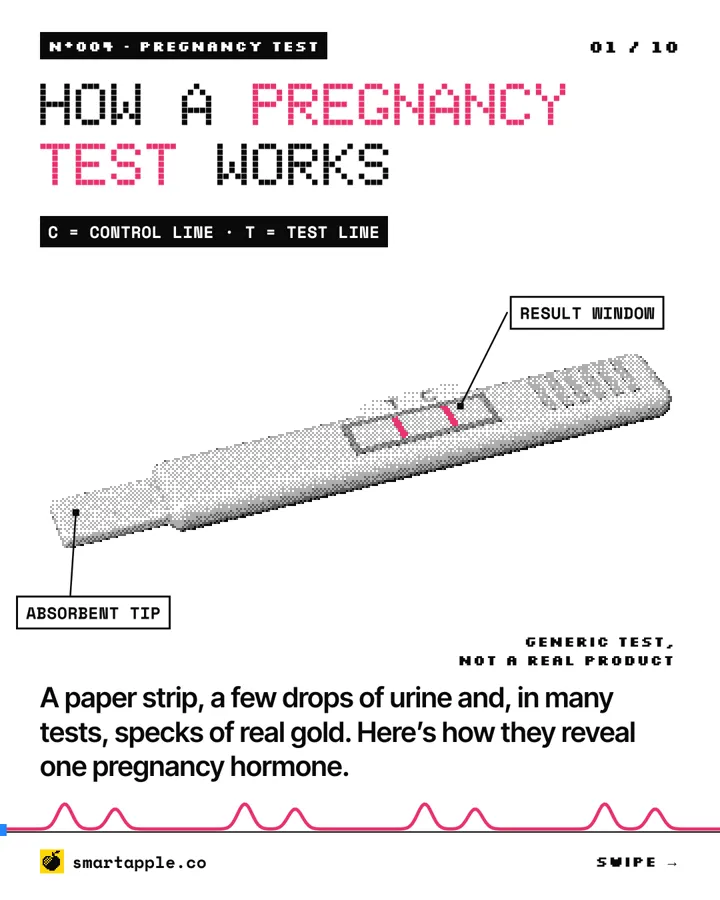
Una tira de papel, unas gotas de orina y, en muchas pruebas, partículas de oro de verdad. Te explicamos cómo revelan una hormona del embarazo.
La hormona que busca
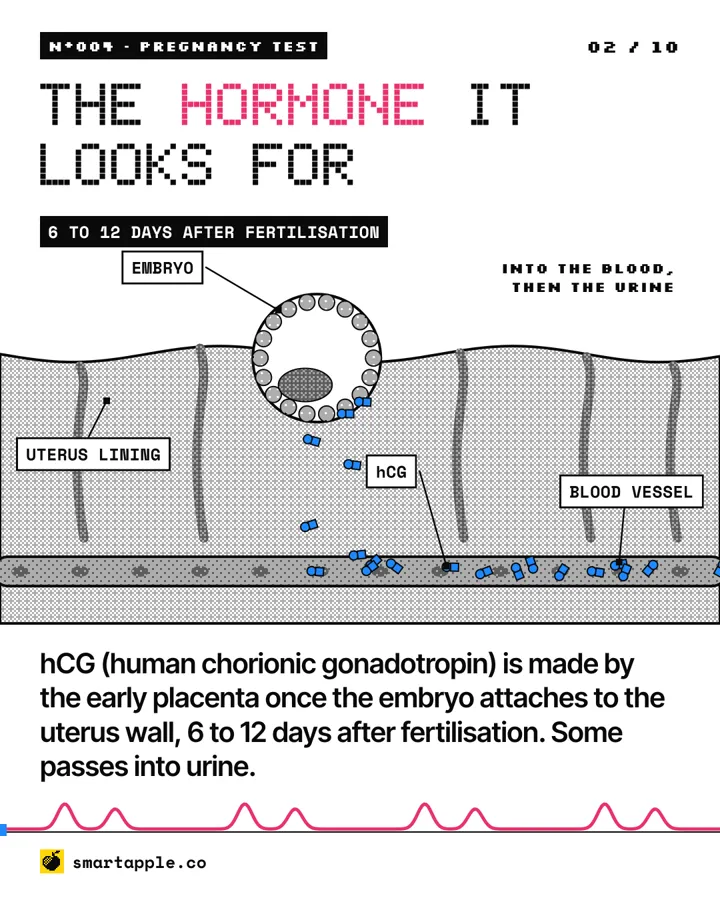
La hCG (gonadotropina coriónica humana) la produce la placenta en formación una vez que el embrión se implanta en la pared del útero, entre 6 y 12 días después de la fecundación. Una parte pasa a la orina.
Qué hay dentro de la prueba
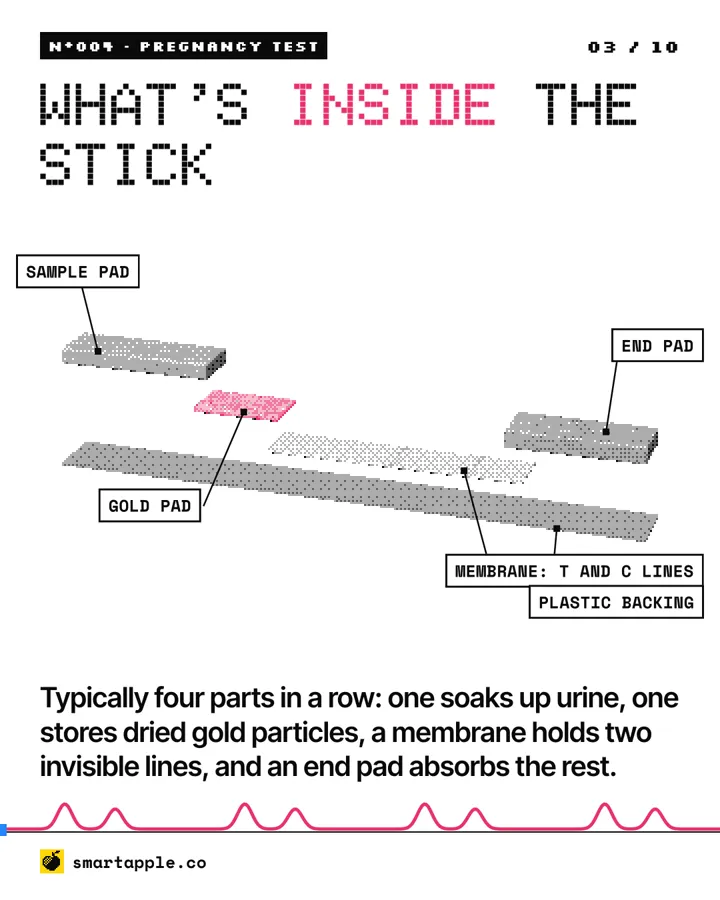
Normalmente, cuatro partes en fila: una se empapa de orina, otra guarda partículas de oro secas, una membrana lleva dos líneas invisibles y una almohadilla en el extremo absorbe el resto.
Cómo avanza la orina por sí sola
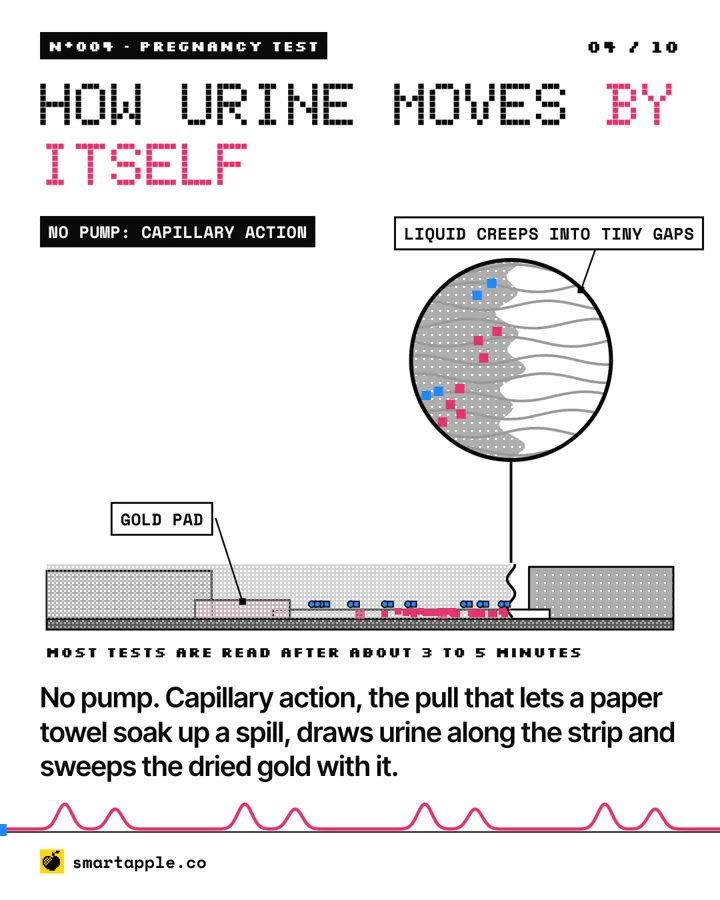
Sin bomba. La capilaridad, la fuerza que permite que el papel absorbente empape un líquido derramado, lleva la orina a lo largo de la tira y arrastra con ella el oro seco.
De dónde sale el rosa
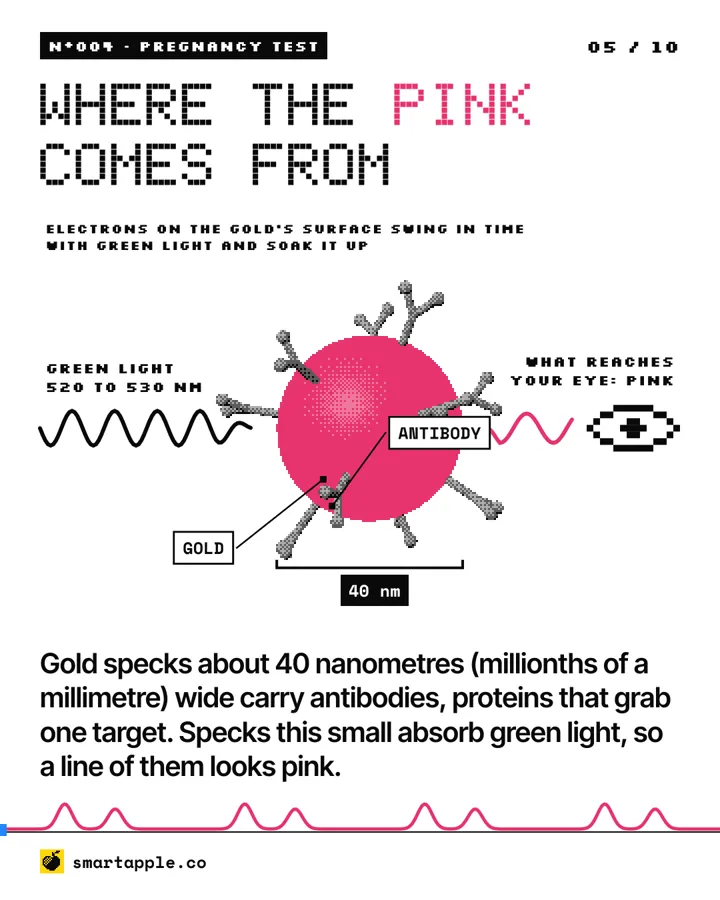
Las partículas de oro, de unos 40 nanómetros (millonésimas de milímetro) de ancho, llevan anticuerpos, proteínas que atrapan un único objetivo. Unas partículas tan pequeñas absorben la luz verde, así que una línea de ellas se ve rosa.
Cómo se forma la línea de prueba
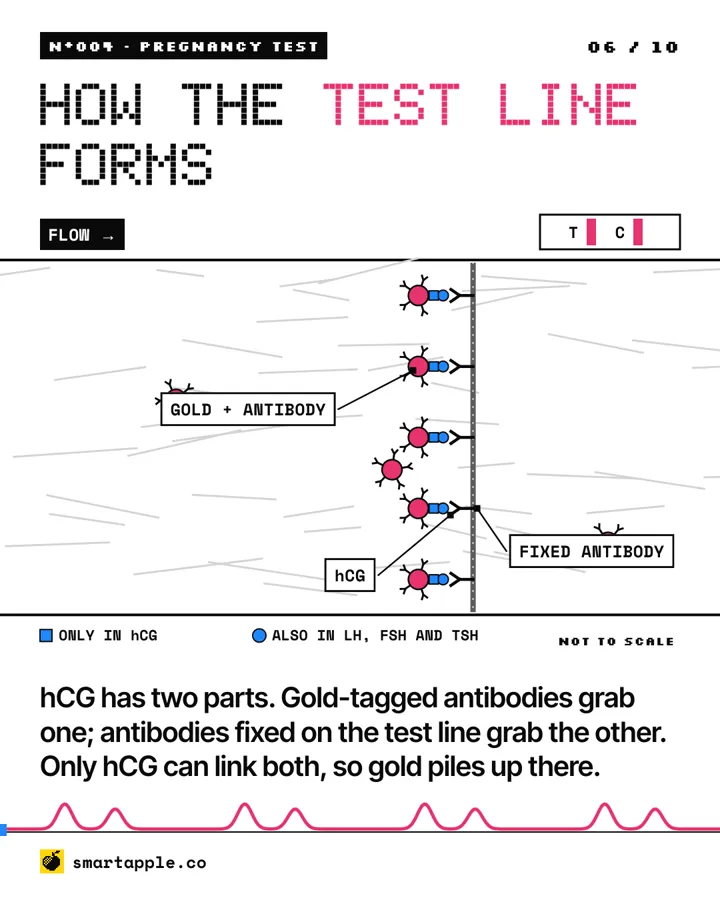
La hCG tiene dos partes. Los anticuerpos marcados con oro atrapan una; los anticuerpos fijados en la línea de prueba atrapan la otra. Solo la hCG puede unir ambos, así que el oro se acumula ahí.
Qué indica la línea de control
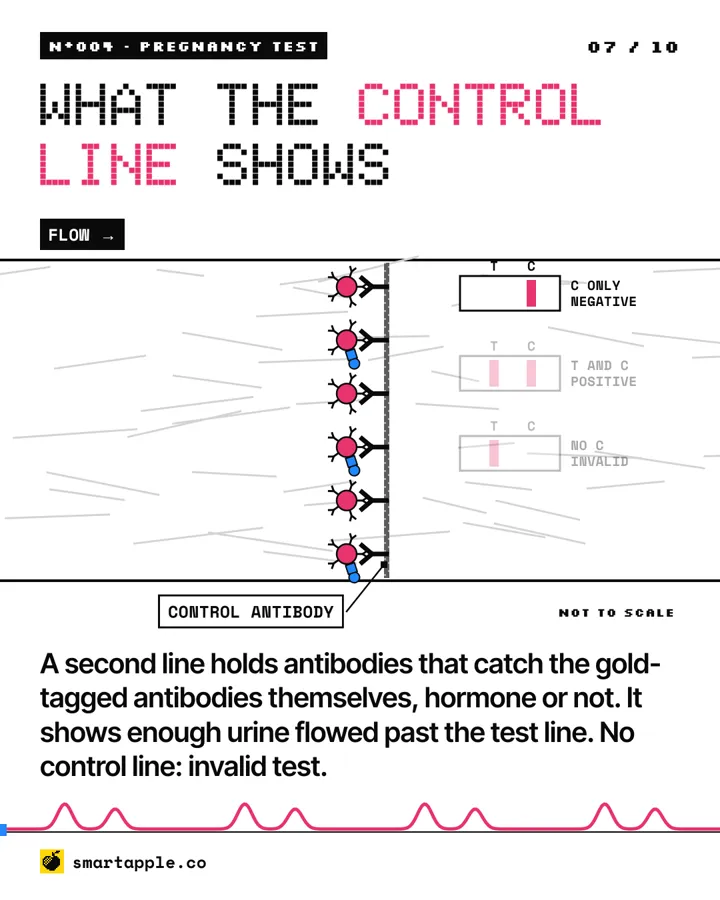
Una segunda línea tiene anticuerpos que atrapan a los propios anticuerpos marcados con oro, haya hormona o no. Indica que ha pasado suficiente orina por la línea de prueba. Sin línea de control: prueba no válida.
Por qué una prueba demasiado temprana puede fallar
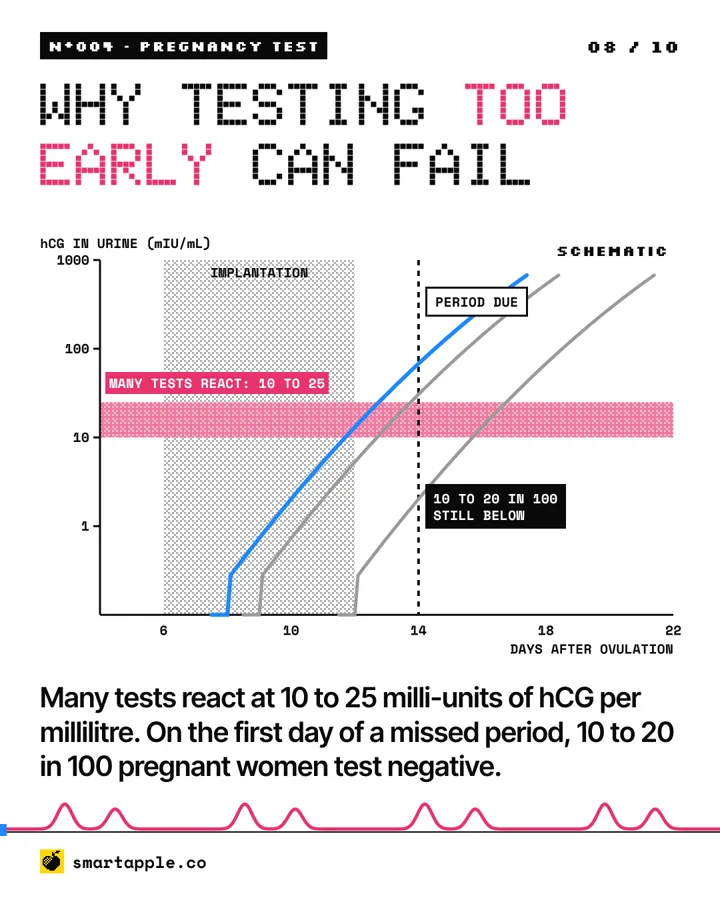
Muchas pruebas reaccionan con 10 a 25 miliunidades de hCG por mililitro. El primer día de retraso de la menstruación, entre 10 y 20 de cada 100 mujeres embarazadas dan negativo.
Antes de las tiras: ratones, conejos, ranas
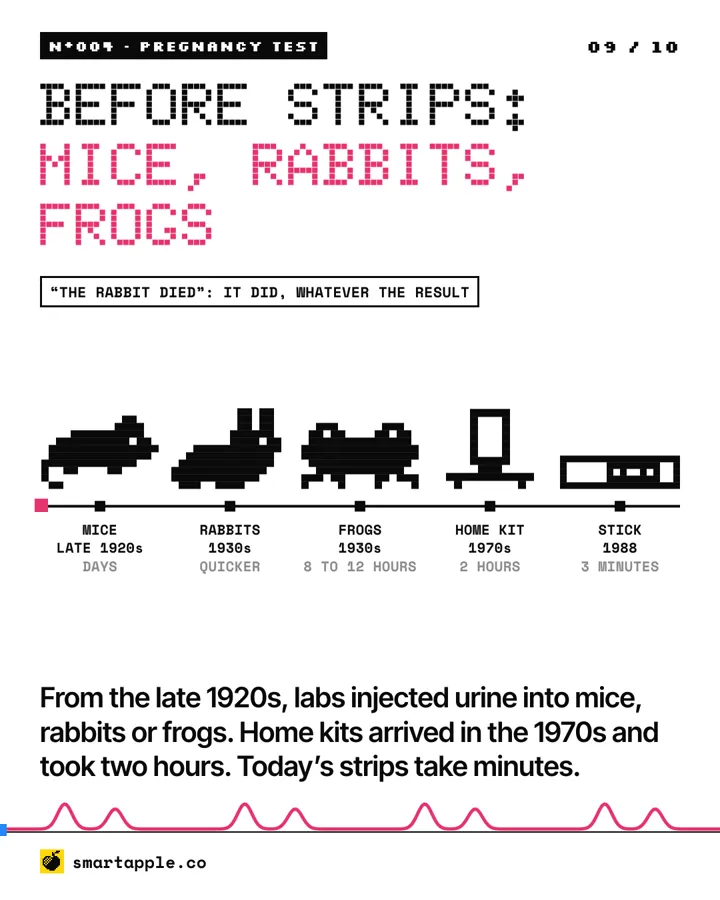
Desde finales de la década de 1920, los laboratorios inyectaban orina a ratones, conejos o ranas. Las pruebas caseras llegaron en la década de 1970 y tardaban dos horas. Las tiras actuales tardan minutos.
Así es como funciona.

Los temas de salud se explican solo con fines de información general. Esto no es un consejo médico: habla con un médico o un farmacéutico sobre tu caso.
No es un consejo médico. La prueba que se muestra es un diseño genérico.
Los dispositivos que se muestran son ilustraciones genéricas, no productos reales. Sin patrocinio.
Smart Apple es independiente y no tiene vínculos con Apple Inc. ni con ninguna empresa cuyos productos aparezcan en nuestras historias.
Hecho con ayuda de herramientas de IA y contrastado con fuentes primarias. Los videos llevan credenciales de contenido (Content Credentials, C2PA).
Fuentes
Diapositiva 1 de 10
- In many tests the pink line is made of gold particles ("colloidal gold conjugate", "form a pink line")accessdata.fda.gov
Diapositiva 2 de 10
- hCG (human chorionic gonadotropin) is made by the early placenta after the embryo attaches; it first appears 6 to 12 days after ovulation; some passes into urinepubmed.ncbi.nlm.nih.gov
- hCG (human chorionic gonadotropin) is made by the early placenta after the embryo attaches; it first appears 6 to 12 days after ovulation; some passes into urinesciencedaily.com
- hCG (human chorionic gonadotropin) is made by the early placenta after the embryo attaches; it first appears 6 to 12 days after ovulation; some passes into urinefda.gov
- The embryo attaches by the side that carries the inner cell massfrontiersin.org
Diapositiva 3 de 10
- A typical strip has four parts in a row: sample pad, conjugate (gold) pad, nitrocellulose membrane with the T and C lines, end (absorbent) pad, on a plastic backingmdpi.com
- A typical strip has four parts in a row: sample pad, conjugate (gold) pad, nitrocellulose membrane with the T and C lines, end (absorbent) pad, on a plastic backingcdn.shopify.com
Diapositiva 4 de 10
- No pump: capillary flow moves the sample and the dried gold; most tests are read after about 3 to 5 minutes (follow the leaflet)accessdata.fda.gov
- No pump: capillary flow moves the sample and the dried gold; most tests are read after about 3 to 5 minutes (follow the leaflet)fda.gov
Diapositiva 5 de 10
- Gold particles about 40 nm wide carry antibodies; at that size they absorb green light (peak about 520 to 530 nm), so a line of them looks pinksigmaaldrich.com
- Gold particles about 40 nm wide carry antibodies; at that size they absorb green light (peak about 520 to 530 nm), so a line of them looks pinkcdn.shopify.com
Diapositiva 6 de 10
- Gold-tagged antibody grabs the beta part of hCG; the antibody fixed on the test line grabs the alpha part; the alpha part is also in LH, FSH and TSHaccessdata.fda.gov
- Gold-tagged antibody grabs the beta part of hCG; the antibody fixed on the test line grabs the alpha part; the alpha part is also in LH, FSH and TSHncbi.nlm.nih.gov
Diapositiva 7 de 10
- The control line catches the gold-tagged antibodies themselves; it shows enough sample flowed past the test zone ("adequate sample volume and proper wicking"); no control line means an invalid testaccessdata.fda.gov
- The control line catches the gold-tagged antibodies themselves; it shows enough sample flowed past the test zone ("adequate sample volume and proper wicking"); no control line means an invalid testaccessdata.fda.gov
Diapositiva 8 de 10
- Many tests react at 10 to 25 mIU/mL; on the first day of a missed period, 10 to 20 in 100 pregnant women test negativeaccessdata.fda.gov
- Many tests react at 10 to 25 mIU/mL; on the first day of a missed period, 10 to 20 in 100 pregnant women test negativeaccessdata.fda.gov
- Many tests react at 10 to 25 mIU/mL; on the first day of a missed period, 10 to 20 in 100 pregnant women test negativefda.gov
- Many tests react at 10 to 25 mIU/mL; on the first day of a missed period, 10 to 20 in 100 pregnant women test negativescholars.duke.edu
- The hCG curves are schematic (implantation timing varies); the axis counts days after ovulationpubmed.ncbi.nlm.nih.gov
Diapositiva 9 de 10
- Mouse test from the late 1920s, then rabbits and frogs (frogs laid eggs 8 to 12 hours later); "the rabbit died" whatever the result; home kits in the 1970s took about two hours; the 1988 one-step stick took three minuteshistory.nih.gov
- Mouse test from the late 1920s, then rabbits and frogs (frogs laid eggs 8 to 12 hours later); "the rabbit died" whatever the result; home kits in the 1970s took about two hours; the 1988 one-step stick took three minutesijdb.ehu.eus
- Mouse test from the late 1920s, then rabbits and frogs (frogs laid eggs 8 to 12 hours later); "the rabbit died" whatever the result; home kits in the 1970s took about two hours; the 1988 one-step stick took three minutesogmagazine.org.au
- Mouse test from the late 1920s, then rabbits and frogs (frogs laid eggs 8 to 12 hours later); "the rabbit died" whatever the result; home kits in the 1970s took about two hours; the 1988 one-step stick took three minutessmithsonianmag.com
- Mouse test from the late 1920s, then rabbits and frogs (frogs laid eggs 8 to 12 hours later); "the rabbit died" whatever the result; home kits in the 1970s took about two hours; the 1988 one-step stick took three minutescollection.sciencemuseumgroup.org.uk