
Cómo un moldeador de aire riza el cabello
Sin pinza. Sin cilindro giratorio. Entonces, ¿cómo te riza el cabello un moldeador de aire?
·
Los moldeadores de aire no tienen pinza. Un chorro de aire rápido se adhiere al cilindro curvo (el efecto Coandă), arrastra el cabello a su alrededor y lo seca en esa posición. Al secarse el cabello con su nueva forma, unos enlaces débiles fijan el rizo, hasta que el aire húmedo los deshace.
Cómo un moldeador de aire riza el cabello
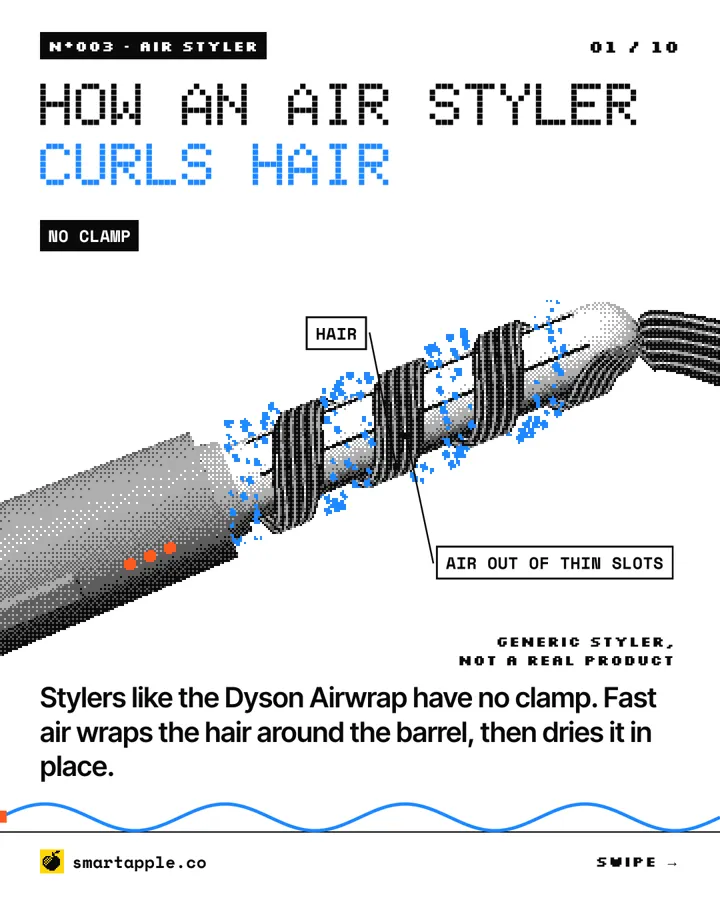
Los moldeadores como el Dyson Airwrap no tienen pinza. El aire rápido enrolla el cabello alrededor del cilindro y luego lo seca en esa posición.
Qué hay dentro del moldeador
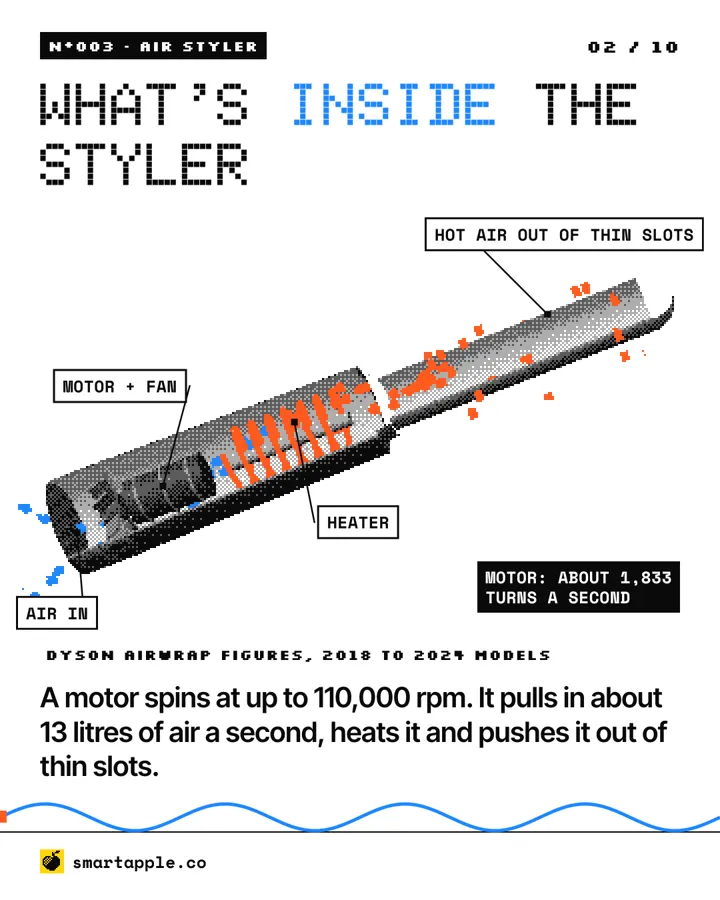
Un motor llega a girar a 110 000 rpm. Aspira unos 13 litros de aire por segundo, lo calienta y lo expulsa por unas ranuras finas.
El aire sigue las superficies curvas
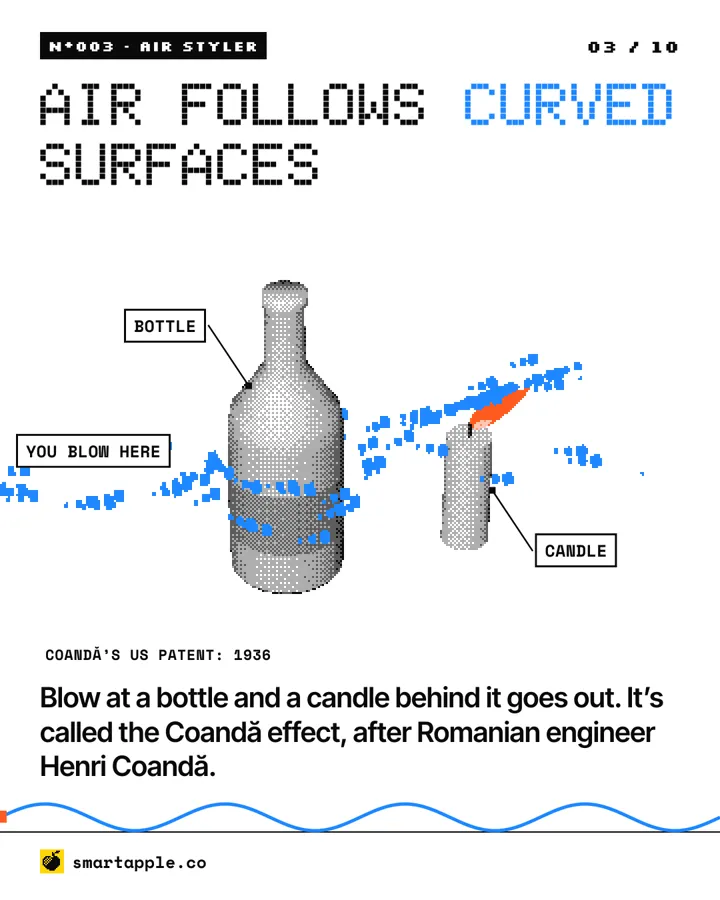
Si soplas contra una botella, una vela que haya detrás se apaga. Se llama efecto Coandă, por el ingeniero rumano Henri Coandă.
Por qué el aire sigue el cilindro
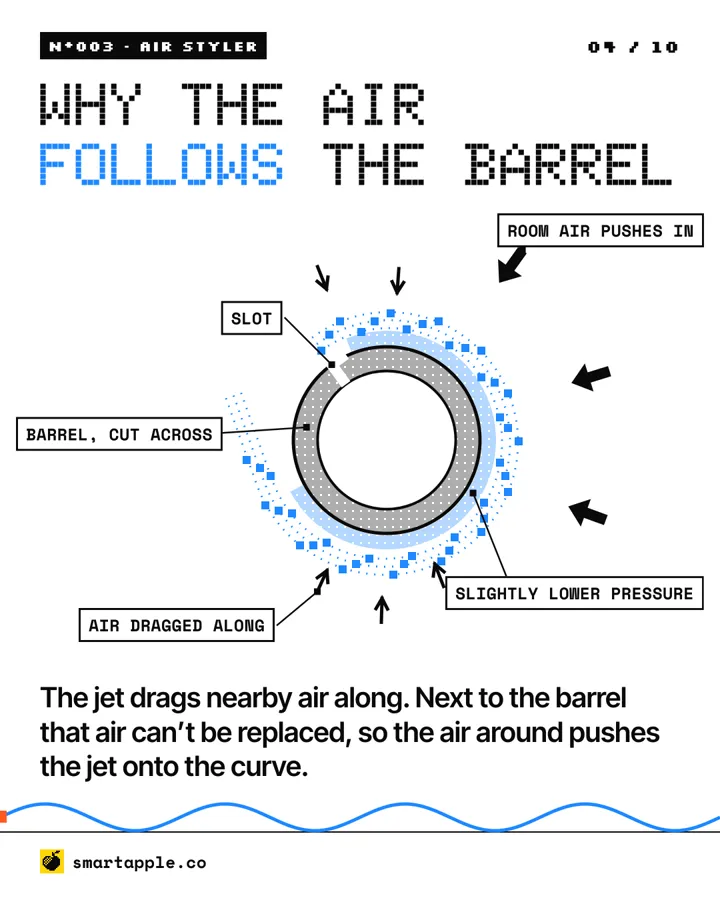
El chorro arrastra consigo el aire cercano. Junto al cilindro, ese aire no puede reponerse, así que el aire de alrededor empuja el chorro contra la curva.
El aire enrolla el cabello
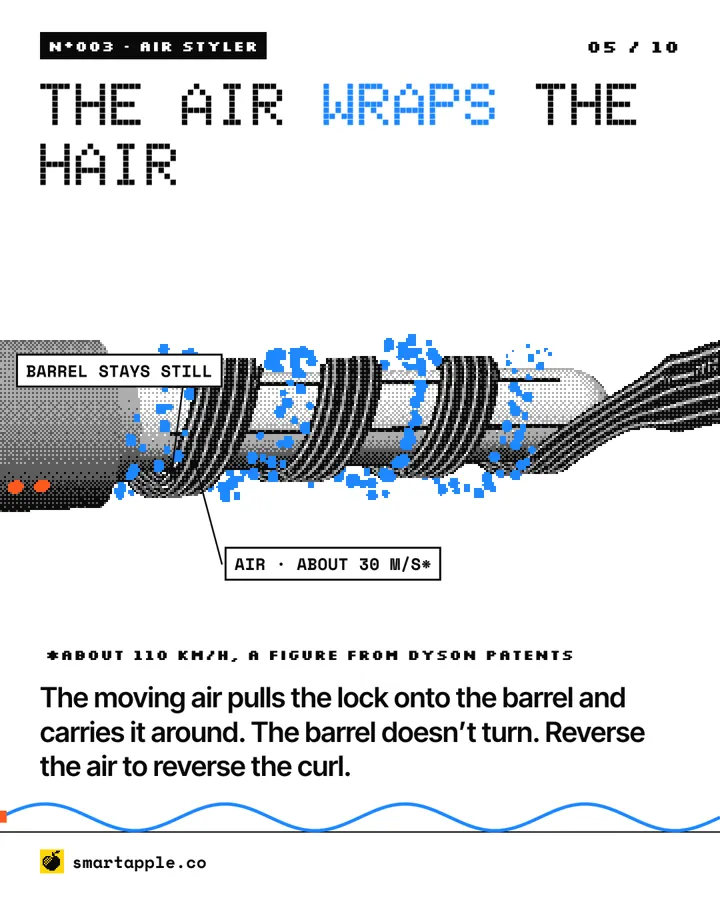
El aire en movimiento atrae el mechón hacia el cilindro y lo hace girar a su alrededor. El cilindro no gira. Si inviertes el aire, inviertes el rizo.
Cuánto se calienta el aire
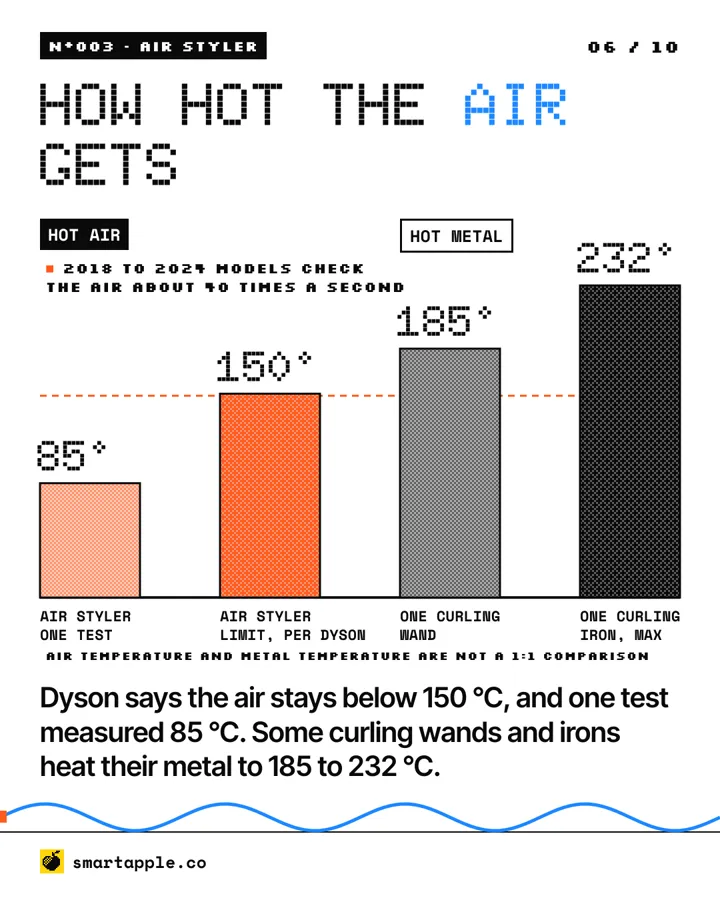
Según Dyson, el aire se mantiene por debajo de 150 °C, y en una prueba se midieron 85 °C. En algunos rizadores, con o sin pinza, el metal alcanza entre 185 y 232 °C.
El cabello mojado es fácil de moldear
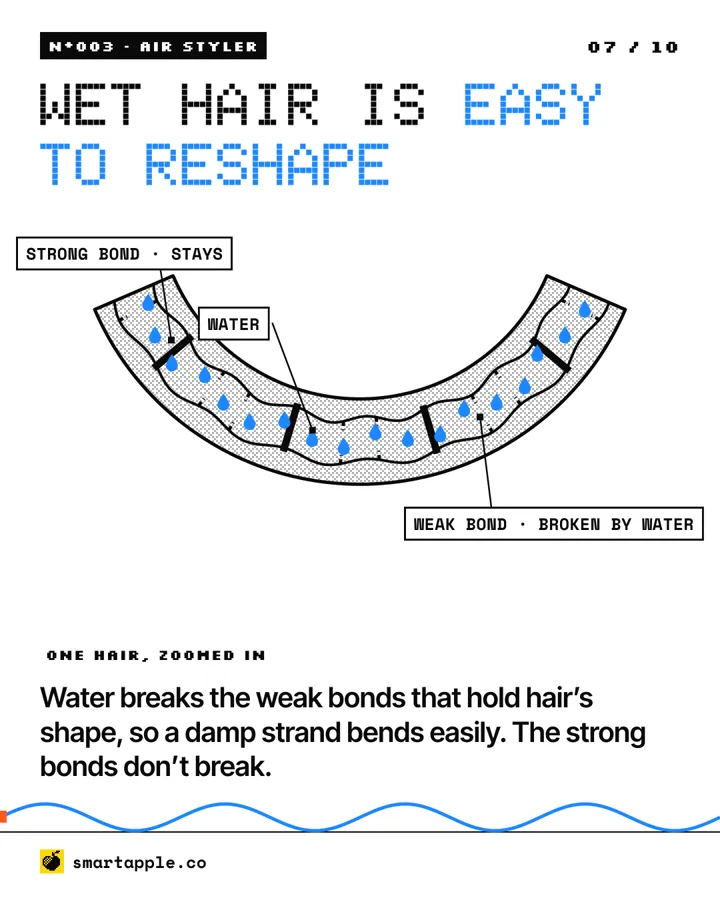
El agua rompe los enlaces débiles que mantienen la forma del cabello, así que un mechón húmedo se dobla con facilidad. Los enlaces fuertes no se rompen.
El rizo se fija al secarse
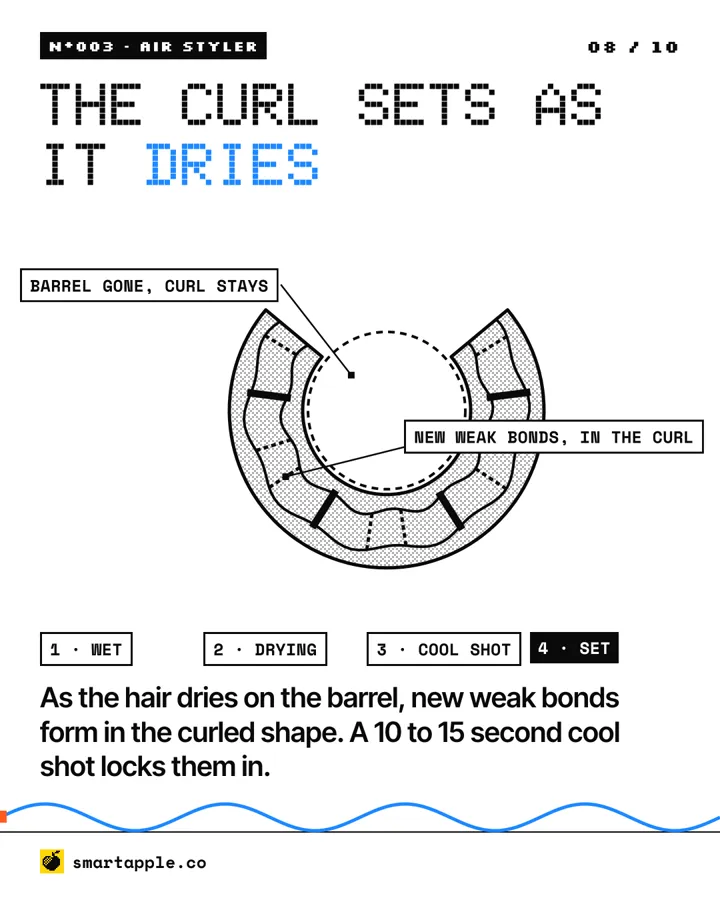
Al secarse el cabello en el cilindro, se forman nuevos enlaces débiles con la forma del rizo. Un golpe de aire frío de 10 a 15 segundos los fija.
Por qué la humedad deshace los rizos
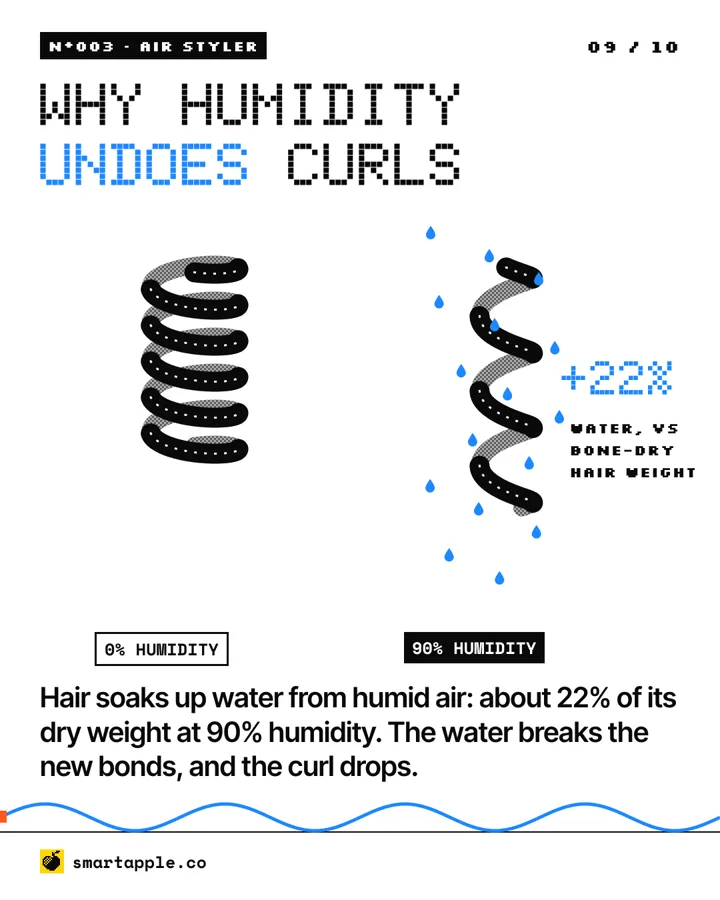
El cabello absorbe agua del aire húmedo: alrededor del 22 % de su peso en seco con un 90 % de humedad. El agua rompe los nuevos enlaces y el rizo se cae.
Así es como funciona.

El moldeador que se muestra es un diseño genérico. Sin patrocinio. Sin vínculos con Dyson.
Los dispositivos que se muestran son ilustraciones genéricas, no productos reales. Sin patrocinio.
Smart Apple es independiente y no tiene vínculos con Apple Inc. ni con ninguna empresa cuyos productos aparezcan en nuestras historias.
Hecho con ayuda de herramientas de IA y contrastado con fuentes primarias. Los videos llevan credenciales de contenido (Content Credentials, C2PA).
Fuentes
Diapositiva 1 de 10
- No clamp: air wraps the hair around the barrel automatically, clockwise or anticlockwisepatents.google.com
Diapositiva 2 de 10
- Motor (V9) up to 110,000 rpm, 13-blade impeller (Airwrap models 2018 to 2024)dyson.com
- Motor (V9) up to 110,000 rpm, 13-blade impeller (Airwrap models 2018 to 2024)lumafield.com
- About 13 litres of air per second (2018), heater, air out through thin slotstechradar.com
- About 13 litres of air per second (2018), heater, air out through thin slotst3.com
- 110,000 rpm = about 1,833 turns a secondCalculation from the cited figures
Diapositiva 3 de 10
- A fast jet next to a curved surface stays attached and follows it (Coandă effect); Henri Coandă, US patent 2,052,869, granted 1 Sep 1936en.wikipedia.org
- A fast jet next to a curved surface stays attached and follows it (Coandă effect); Henri Coandă, US patent 2,052,869, granted 1 Sep 1936patents.google.com
- Blowing at a bottle puts out a candle behind itthenakedscientists.com
Diapositiva 4 de 10
- The jet drags surrounding air along (entrainment); next to the surface that air can't be replaced, so the pressure there is slightly lower and the jet is pushed onto the curvepatents.google.com
- The jet drags surrounding air along (entrainment); next to the surface that air can't be replaced, so the pressure there is slightly lower and the jet is pushed onto the curveen.wikipedia.org
Diapositiva 5 de 10
- Air pulls the hair onto the barrel and carries it around; the barrel doesn't turn; reversing the airflow reverses the curlpatents.google.com
- Air pulls the hair onto the barrel and carries it around; the barrel doesn't turn; reversing the airflow reverses the curldyson.com
- Outlet air speed 30 to 35 m/s in Dyson patents (examples, not product specs)patents.google.com
- Outlet air speed 30 to 35 m/s in Dyson patents (examples, not product specs)patents.google.com
Diapositiva 6 de 10
- Air kept below 150 °C (a ceiling, not the hottest setting), temperature checked about 40 times a second in 2018 to 2024 models (Dyson claims; the 2025 Co-anda2x lists up to 150,000 rpm and faster checks)dyson.com.au
- Air kept below 150 °C (a ceiling, not the hottest setting), temperature checked about 40 times a second in 2018 to 2024 models (Dyson claims; the 2025 Co-anda2x lists up to 150,000 rpm and faster checks)dyson.in
- 85 °C measured on the hottest setting (one magazine test, method not stated)netzwelt.de
- One curling wand at 185 °C; one curling iron up to 450 °F (232 °C)ghdhair.com
- One curling wand at 185 °C; one curling iron up to 450 °F (232 °C)marlobeauty.com
Diapositiva 7 de 10
- Water breaks hair's hydrogen bonds; disulfide bonds stay; wet hair softens below 0 °Csmithsonianmag.com
- Water breaks hair's hydrogen bonds; disulfide bonds stay; wet hair softens below 0 °Cresearch.manchester.ac.uk
Diapositiva 8 de 10
- New hydrogen bonds form as the hair dries in shape; cooling below the softening point sets it; cool shot of 10 to 15 seconds (Dyson)library.scconline.org
- New hydrogen bonds form as the hair dries in shape; cooling below the softening point sets it; cool shot of 10 to 15 seconds (Dyson)dyson.in
Diapositiva 9 de 10
- Raising humidity from 0% to 90% increases hair weight by about 22% (water, relative to bone-dry hair); at everyday humidity hair already holds part of thatcosmeticsandtoiletries.com