
What an LED mask actually does
An LED mask sends red light about 2 mm into your skin. Here’s what it can and can’t do.
LED masks shine blue, red or near-infrared light onto the face. Red light reaches about 2 mm into the skin, where collagen is made, and in lab studies cells make more energy and collagen. Small trials found fewer inflamed acne spots and modest gains for fine lines. “FDA cleared” is not the same as “approved”.
What an LED mask actually does
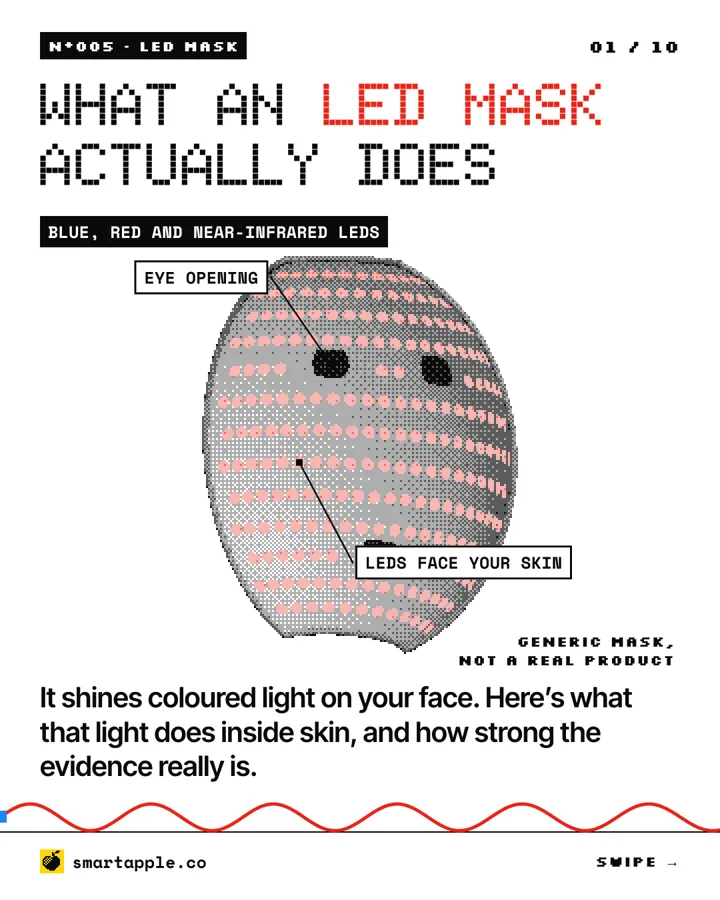
It shines coloured light on your face. Here’s what that light does inside skin, and how strong the evidence really is.
What light the mask shines
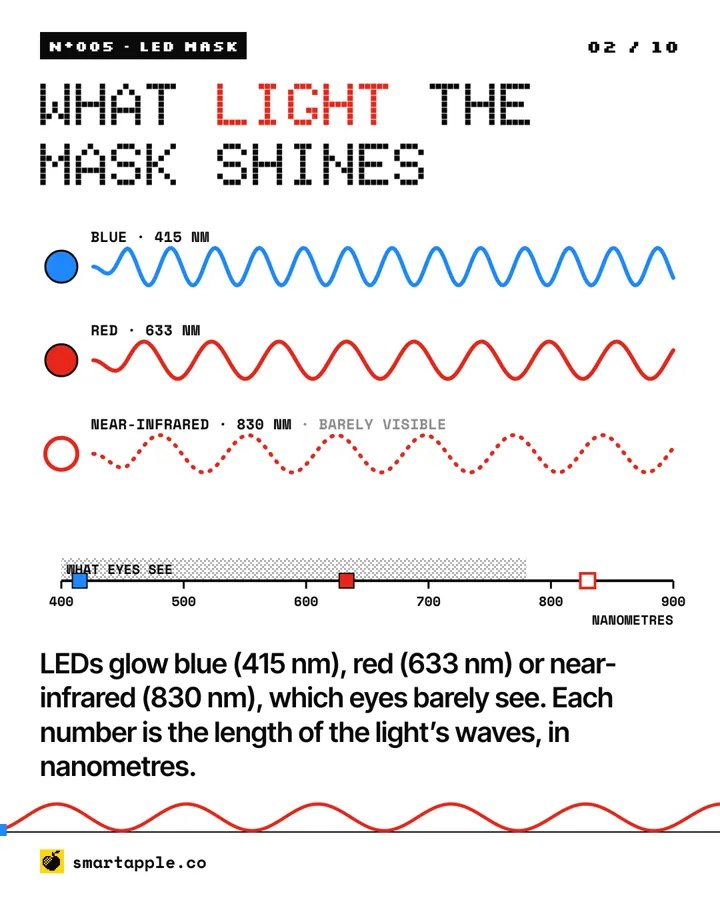
LEDs glow blue (415 nm), red (633 nm) or near-infrared (830 nm), which eyes barely see. Each number is the length of the light’s waves, in nanometres.
How deep each light goes
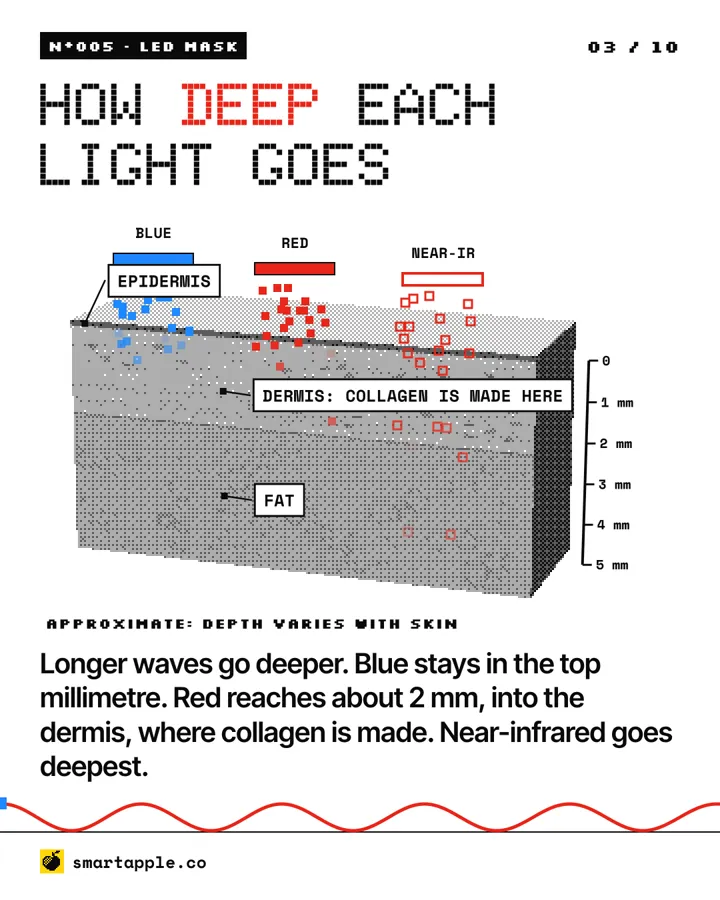
Longer waves go deeper. Blue stays in the top millimetre. Red reaches about 2 mm, into the dermis, where collagen is made. Near-infrared goes deepest.
What red light does in cells
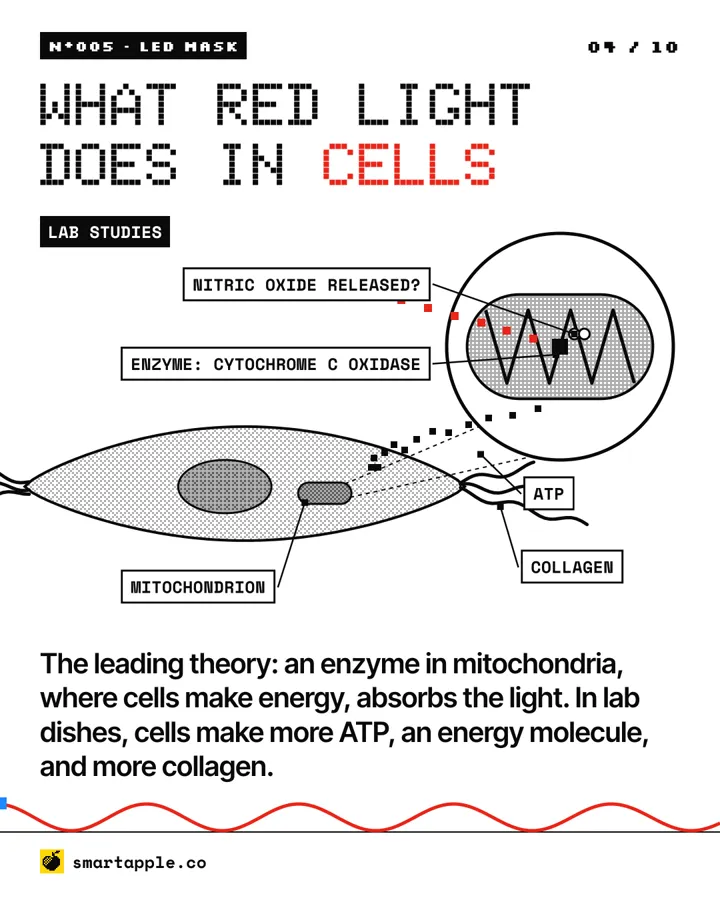
The leading theory: an enzyme in mitochondria, where cells make energy, absorbs the light. In lab dishes, cells make more ATP, an energy molecule, and more collagen.
What blue light does to acne
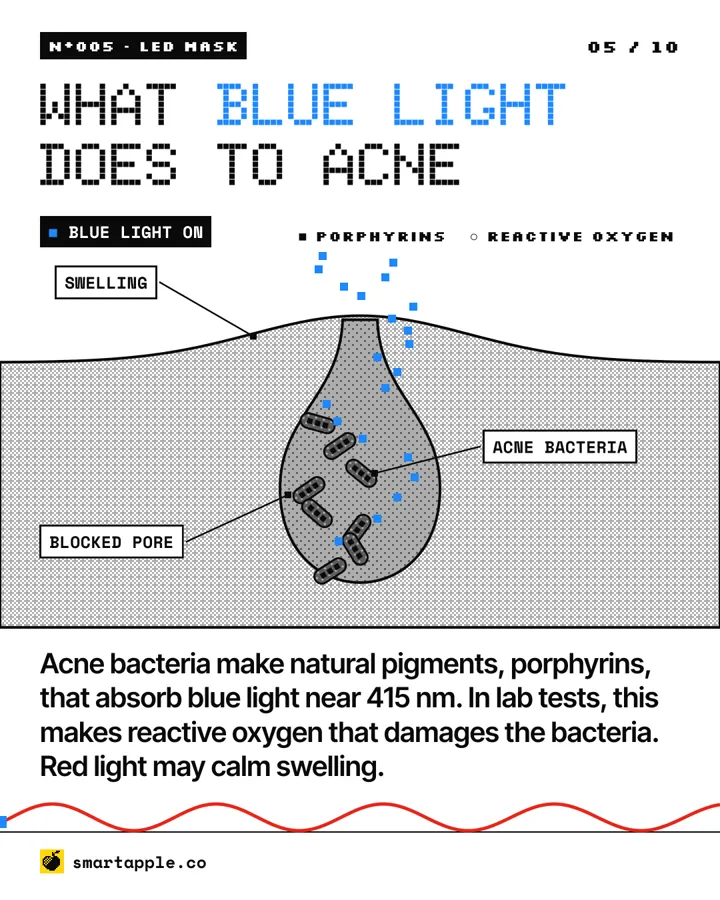
Acne bacteria make natural pigments, porphyrins, that absorb blue light near 415 nm. In lab tests, this makes reactive oxygen that damages the bacteria. Red light may calm swelling.
What the trials actually found
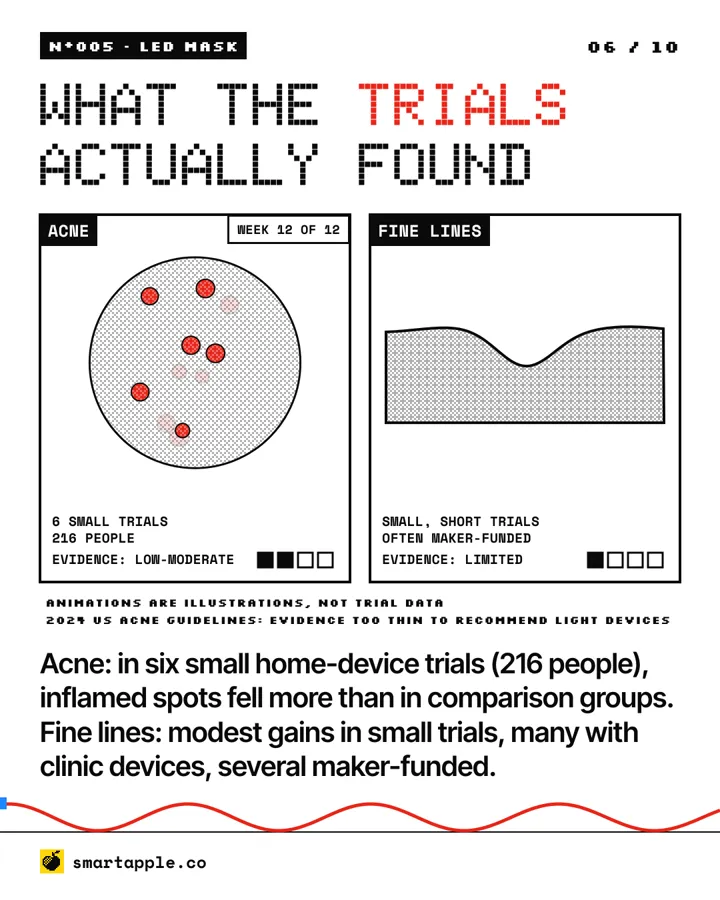
Acne: in six small home-device trials (216 people), inflamed spots fell more than in comparison groups. Fine lines: modest gains in small trials, many with clinic devices, several maker-funded.
How much light a mask gives
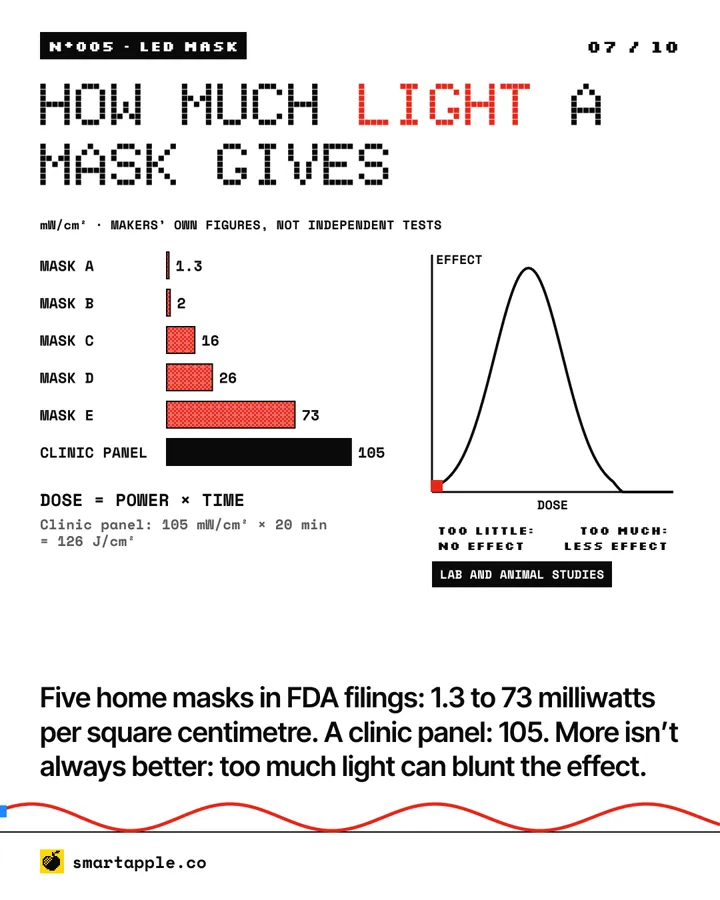
Five home masks in FDA filings: 1.3 to 73 milliwatts per square centimetre. A clinic panel: 105. More isn’t always better: too much light can blunt the effect.
Why your eyes need protecting
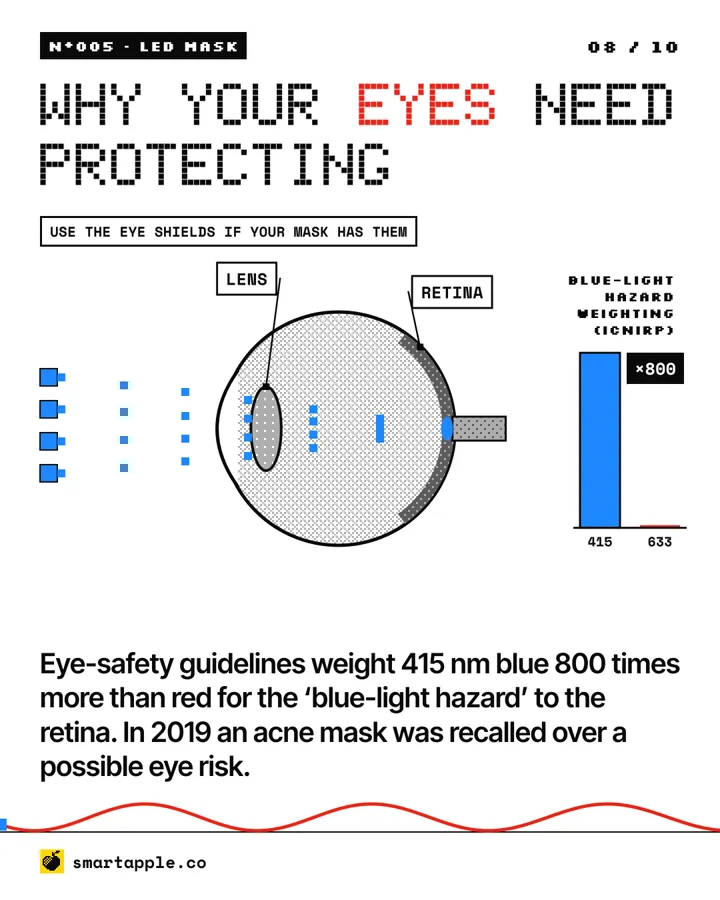
Eye-safety guidelines weight 415 nm blue 800 times more than red for the ‘blue-light hazard’ to the retina. In 2019 an acne mask was recalled over a possible eye risk.
What a mask can’t do
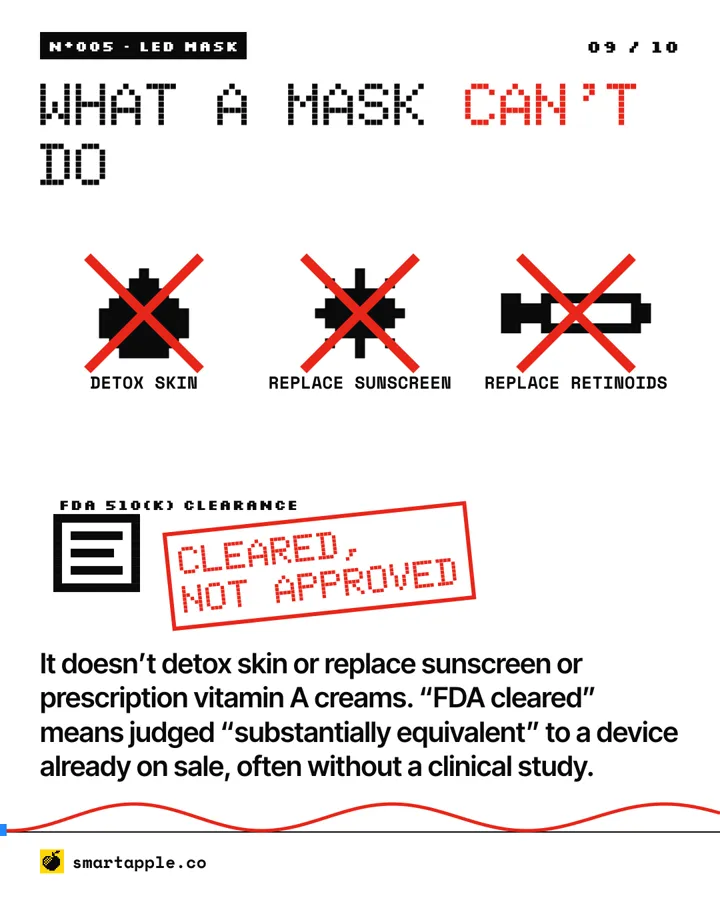
It doesn’t detox skin or replace sunscreen or prescription vitamin A creams. “FDA cleared” means judged “substantially equivalent” to a device already on sale, often without a clinical study.
So that’s how.
Health topics are explained for general information only. This is not medical advice: talk to a doctor or pharmacist about your own situation.
Not medical advice. The mask shown is a generic design. Not sponsored.
Devices shown are generic illustrations, not real products. Not sponsored.
Smart Apple is independent and not affiliated with Apple Inc. or with any company whose products appear in our stories.
Made with the help of AI tools and checked against primary sources. The videos carry Content Credentials (C2PA).
Sources
Slide 1 of 10
- Home masks shine blue, red and near-infrared LEDs onto the faceaccessdata.fda.gov
- Home masks shine blue, red and near-infrared LEDs onto the faceaccessdata.fda.gov
Slide 2 of 10
- Typical wavelengths: blue 415 nm, red 633 nm, near-infrared 830 nmaccessdata.fda.gov
- Typical wavelengths: blue 415 nm, red 633 nm, near-infrared 830 nmaccessdata.fda.gov
Slide 3 of 10
- Longer wavelengths go deeper: blue stays in the top millimetre, red reaches about 2 mm into the dermis, near-infrared goes deepest; depth varies with skinscmsjournal.com
- Longer wavelengths go deeper: blue stays in the top millimetre, red reaches about 2 mm into the dermis, near-infrared goes deepest; depth varies with skinomlc.org
Slide 4 of 10
- Leading theory: cytochrome c oxidase in mitochondria absorbs red and near-infrared light; in lab studies cells make more ATP and collagen; nitric oxide release is a proposed stepaimspress.com
- Leading theory: cytochrome c oxidase in mitochondria absorbs red and near-infrared light; in lab studies cells make more ATP and collagen; nitric oxide release is a proposed steppubs.rsc.org
Slide 5 of 10
- Acne bacteria make porphyrins that absorb blue light near 415 nm; in lab tests this makes reactive oxygen that damages the bacteria; red light may calm inflammationcris.biu.ac.il
- Acne bacteria make porphyrins that absorb blue light near 415 nm; in lab tests this makes reactive oxygen that damages the bacteria; red light may calm inflammationlink.springer.com
Slide 6 of 10
- Acne: six small home-device trials, 216 people, inflamed spots fell more than in comparison groupsjamanetwork.com
- Acne: six small home-device trials, 216 people, inflamed spots fell more than in comparison groupsnews.massgeneralbrigham.org
- Fine lines: modest gains in small trials, many with clinic devices, several funded by makersjcadonline.com
- Fine lines: modest gains in small trials, many with clinic devices, several funded by makersjournals.sagepub.com
- 2024 US acne guidelines: evidence insufficient to recommend light-based devices; Cochrane: high-quality evidence lackingdermatologytimes.com
- 2024 US acne guidelines: evidence insufficient to recommend light-based devices; Cochrane: high-quality evidence lackingaad.org
- 2024 US acne guidelines: evidence insufficient to recommend light-based devices; Cochrane: high-quality evidence lackingcochrane.org
Slide 7 of 10
- Five home masks in FDA filings: 1.3 to 73 mW/cm² (makers' own figures); a clinic panel: 105 mW/cm² (distributor brochure); 105 mW/cm² for 20 min = 126 J/cm²accessdata.fda.gov
- Five home masks in FDA filings: 1.3 to 73 mW/cm² (makers' own figures); a clinic panel: 105 mW/cm² (distributor brochure); 105 mW/cm² for 20 min = 126 J/cm²accessdata.fda.gov
- Five home masks in FDA filings: 1.3 to 73 mW/cm² (makers' own figures); a clinic panel: 105 mW/cm² (distributor brochure); 105 mW/cm² for 20 min = 126 J/cm²accessdata.fda.gov
- Five home masks in FDA filings: 1.3 to 73 mW/cm² (makers' own figures); a clinic panel: 105 mW/cm² (distributor brochure); 105 mW/cm² for 20 min = 126 J/cm²accessdata.fda.gov
- Five home masks in FDA filings: 1.3 to 73 mW/cm² (makers' own figures); a clinic panel: 105 mW/cm² (distributor brochure); 105 mW/cm² for 20 min = 126 J/cm²jmec.co.jp
- Biphasic dose response (too little does nothing, too much does less), seen in lab and animal studiesjournals.sagepub.com
Slide 8 of 10
- ICNIRP's blue-light hazard weighting: 0.8 at 415 nm against 0.001 for red (about 800 times)icnirp.org
- 2019 recall of an acne light mask over a theoretical risk of eye injury; a case report of blue LED retinopathy after mask use; keep the eyes coveredrecalls-rappels.canada.ca
- 2019 recall of an acne light mask over a theoretical risk of eye injury; a case report of blue LED retinopathy after mask use; keep the eyes coveredaop.org.uk
- 2019 recall of an acne light mask over a theoretical risk of eye injury; a case report of blue LED retinopathy after mask use; keep the eyes coveredpure.skku.edu
Slide 9 of 10
- No evidence it detoxes skin; it blocks no UV, so it can't replace sunscreen; no trial shows it replaces prescription retinoidsnccih.nih.gov
- No evidence it detoxes skin; it blocks no UV, so it can't replace sunscreen; no trial shows it replaces prescription retinoidsaad.org
- No evidence it detoxes skin; it blocks no UV, so it can't replace sunscreen; no trial shows it replaces prescription retinoidsaccessdata.fda.gov
- "FDA cleared" (510(k)) means judged substantially equivalent to a device already on the market, often with no clinical study; cleared is not approvedfda.gov
- "FDA cleared" (510(k)) means judged substantially equivalent to a device already on the market, often with no clinical study; cleared is not approvedfda.gov
- "FDA cleared" (510(k)) means judged substantially equivalent to a device already on the market, often with no clinical study; cleared is not approvedaccessdata.fda.gov