
How a microwave heats food
No flame. No hot coil. So how does a microwave heat your food?
A tube called a magnetron fills the metal box with waves whose pull swings back and forth 2.45 billion times a second. Water molecules in the food twist with it and turn that motion into heat, most of it in the first 2 cm. The middle warms as heat spreads inwards, so stirring and standing time matter.
How a microwave heats food
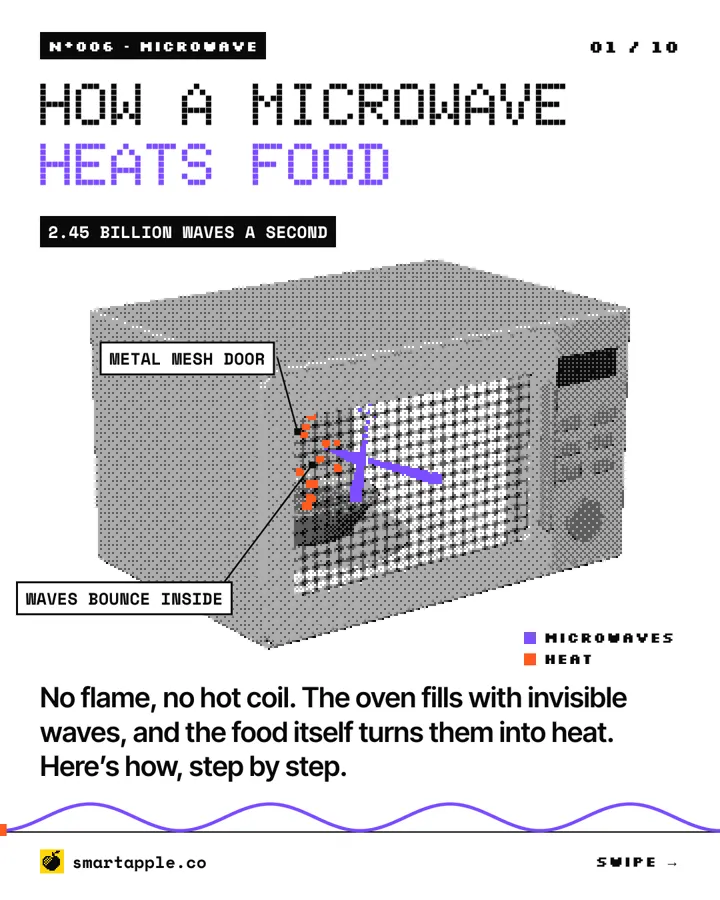
No flame, no hot coil. The oven fills with invisible waves, and the food itself turns them into heat. Here’s how, step by step.
What makes the microwaves
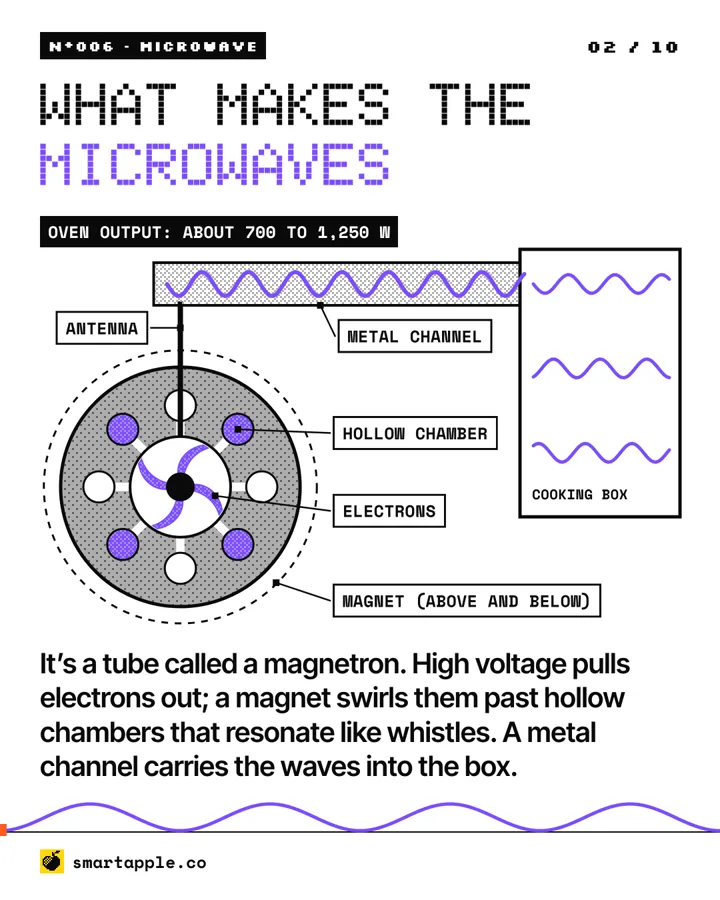
It’s a tube called a magnetron. High voltage pulls electrons out; a magnet swirls them past hollow chambers that resonate like whistles. A metal channel carries the waves into the box.
How water turns waves into heat
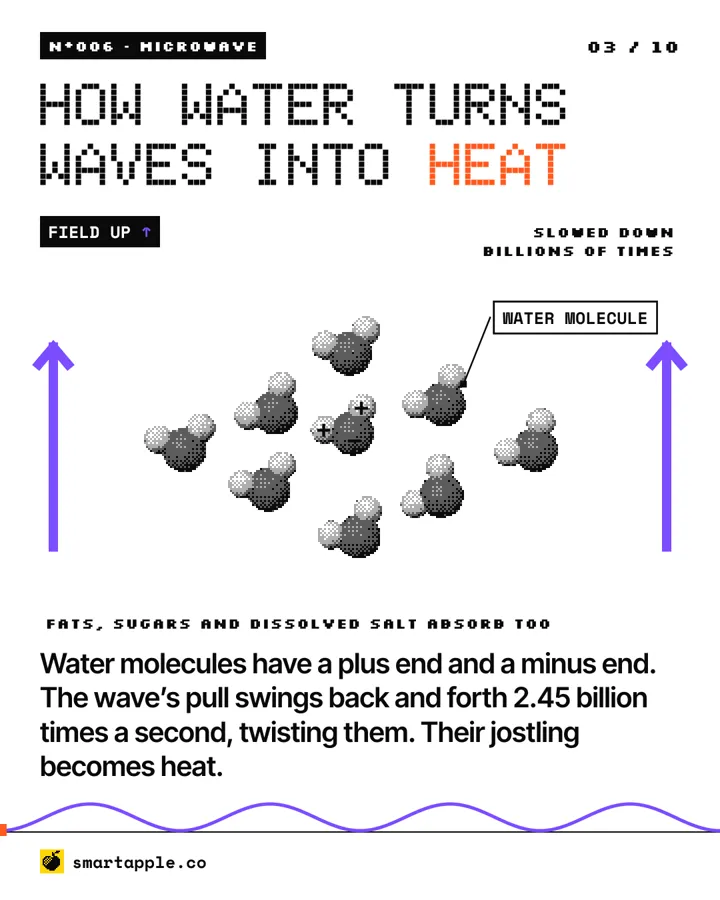
Water molecules have a plus end and a minus end. The wave’s pull swings back and forth 2.45 billion times a second, twisting them. Their jostling becomes heat.
Why ovens use 2.45 GHz
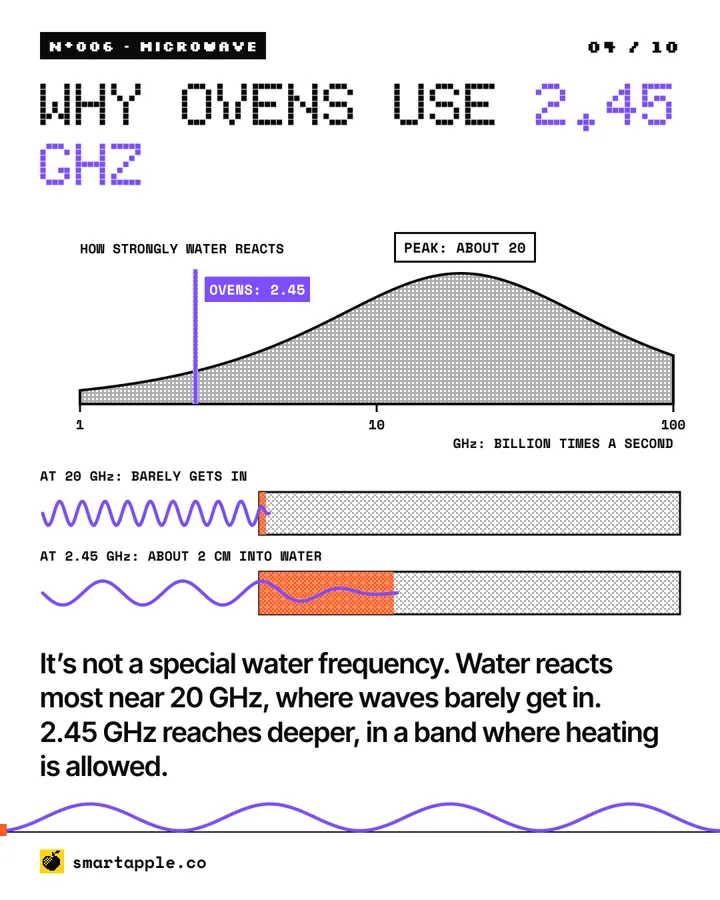
It’s not a special water frequency. Water reacts most near 20 GHz, where waves barely get in. 2.45 GHz reaches deeper, in a band where heating is allowed.
How deep the waves go
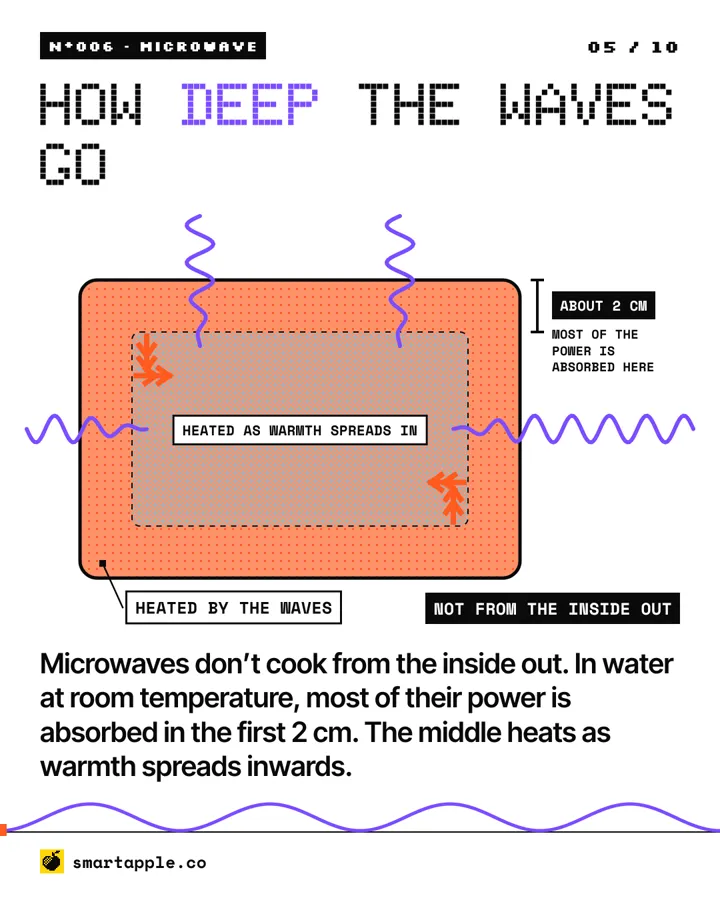
Microwaves don’t cook from the inside out. In water at room temperature, most of their power is absorbed in the first 2 cm. The middle heats as warmth spreads inwards.
Why food has cold spots
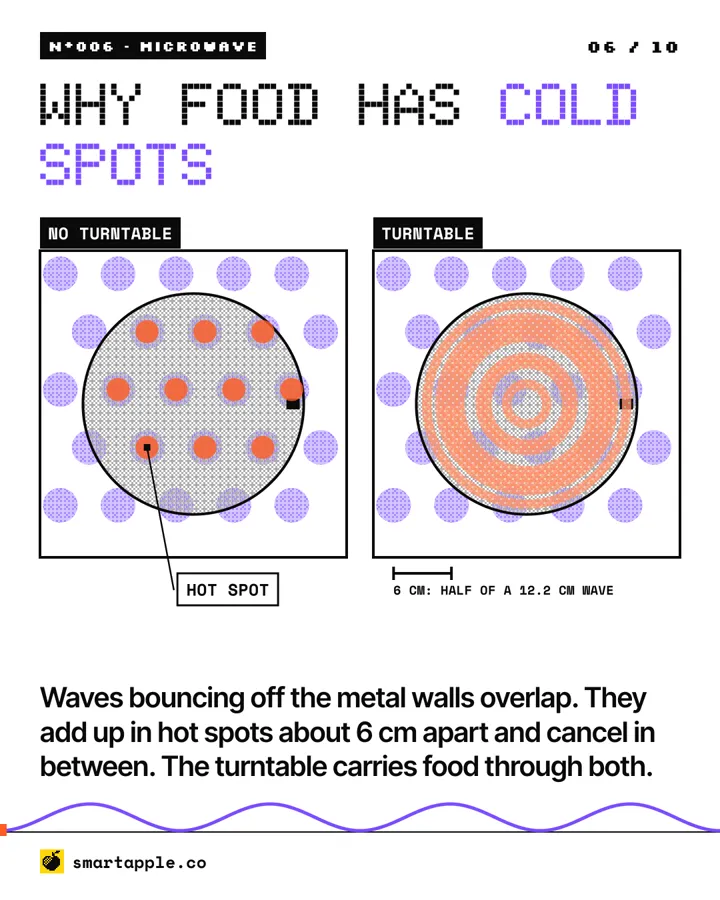
Waves bouncing off the metal walls overlap. They add up in hot spots about 6 cm apart and cancel in between. The turntable carries food through both.
Why frozen food heats unevenly
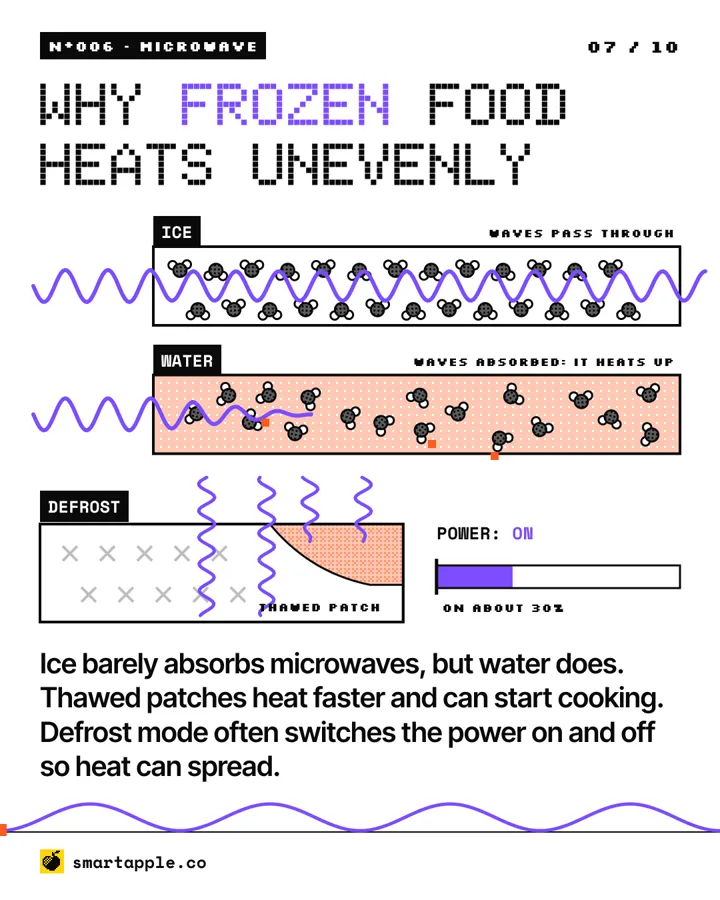
Ice barely absorbs microwaves, but water does. Thawed patches heat faster and can start cooking. Defrost mode often switches the power on and off so heat can spread.
Why some metal sparks
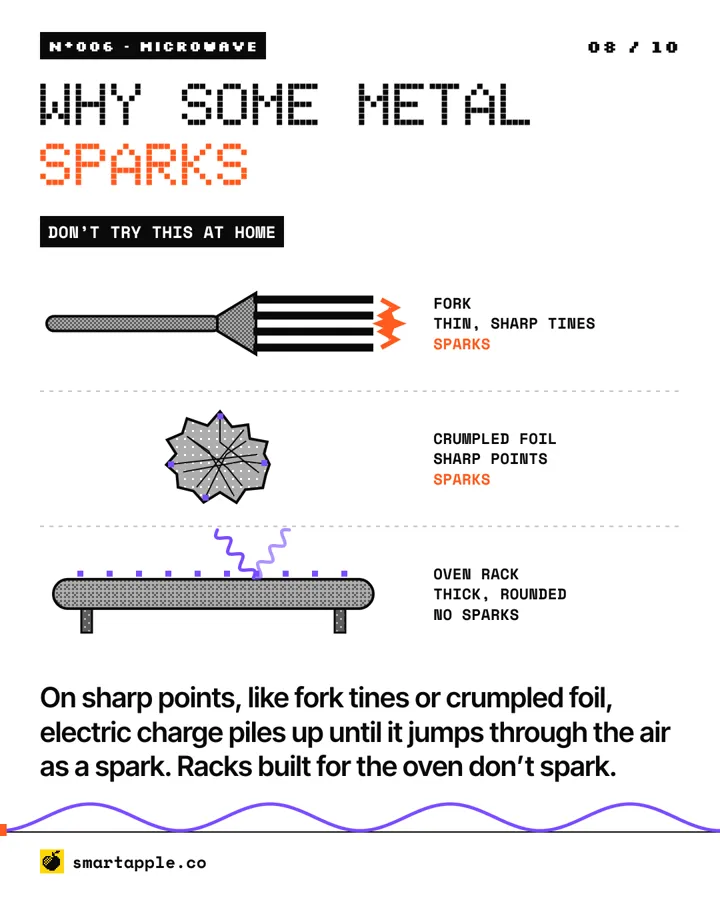
On sharp points, like fork tines or crumpled foil, electric charge piles up until it jumps through the air as a spark. Racks built for the oven don’t spark.
Why the waves stay inside
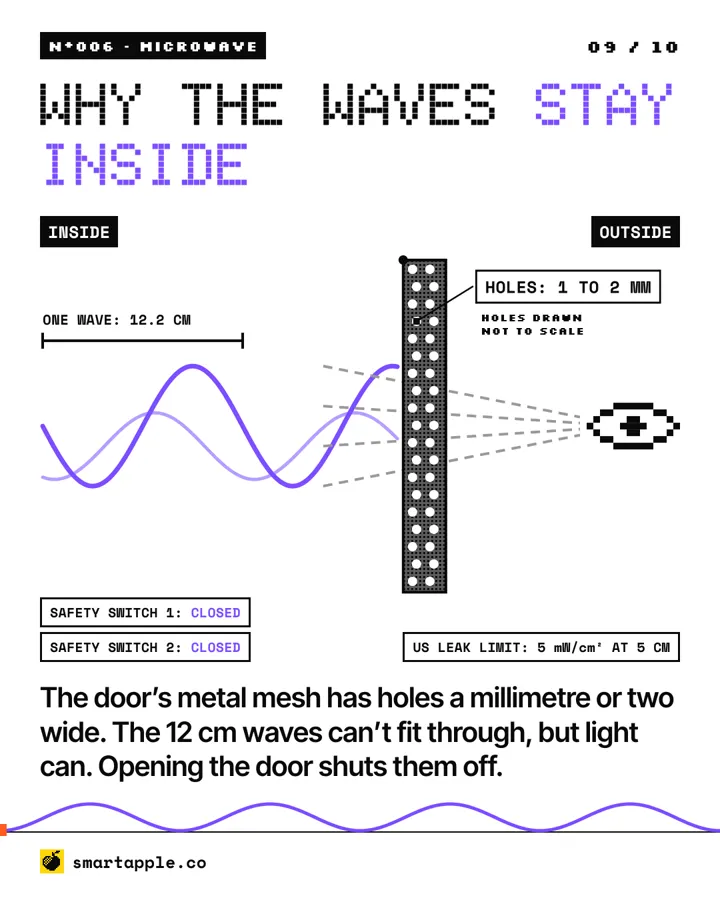
The door’s metal mesh has holes a millimetre or two wide. The 12 cm waves can’t fit through, but light can. Opening the door shuts them off.
So that’s how.
The oven shown is a generic design. Not sponsored. Stir halfway, let food stand, and follow your oven’s manual on metal.
Devices shown are generic illustrations, not real products. Not sponsored.
Smart Apple is independent and not affiliated with Apple Inc. or with any company whose products appear in our stories.
Made with the help of AI tools and checked against primary sources. The videos carry Content Credentials (C2PA).
Sources
Slide 1 of 10
- Ovens run at 2.45 GHz (2,450 MHz); the waves bounce off the metal walls; the food absorbs thembritannica.com
- Ovens run at 2.45 GHz (2,450 MHz); the waves bounce off the metal walls; the food absorbs themfda.gov
- Ovens run at 2.45 GHz (2,450 MHz); the waves bounce off the metal walls; the food absorbs themitu.int
Slide 2 of 10
- A magnetron makes the waves: high voltage drives electrons from the centre outwards, a magnet swirls them past resonant cavities, an antenna and a metal channel (waveguide) carry the waves to the cavityhyperphysics.gsu.edu
- A magnetron makes the waves: high voltage drives electrons from the centre outwards, a magnet swirls them past resonant cavities, an antenna and a metal channel (waveguide) carry the waves to the cavitybritannica.com
- A magnetron makes the waves: high voltage drives electrons from the centre outwards, a magnet swirls them past resonant cavities, an antenna and a metal channel (waveguide) carry the waves to the cavityrpaulsingh.com
- Home ovens put out about 700 to 1,250 W (rated cooking power)consumerreports.org
Slide 3 of 10
- Water molecules are polar; the oscillating field twists them and they lag behind; their collisions turn this into heat; fats, sugars and dissolved salts absorb toowater.lsbu.ac.uk
- Water molecules are polar; the oscillating field twists them and they lag behind; their collisions turn this into heat; fats, sugars and dissolved salts absorb toowtamu.edu
- Water molecules are polar; the oscillating field twists them and they lag behind; their collisions turn this into heat; fats, sugars and dissolved salts absorb toobritannica.com
- Water molecules are polar; the oscillating field twists them and they lag behind; their collisions turn this into heat; fats, sugars and dissolved salts absorb toocfs.gov.hk
- The animation shows 4 field cycles in 6.4 s against 2.45 billion a second: slowed down billions of timesCalculation from the cited figures
Slide 4 of 10
- Not a special water frequency: water's dielectric loss peaks near 20 GHz (a broad relaxation), where waves are absorbed in the first layer; 2.45 GHz sits in the 2,400 to 2,500 MHz ISM bandarxiv.org
- Not a special water frequency: water's dielectric loss peaks near 20 GHz (a broad relaxation), where waves are absorbed in the first layer; 2.45 GHz sits in the 2,400 to 2,500 MHz ISM bandwater.lsbu.ac.uk
- Not a special water frequency: water's dielectric loss peaks near 20 GHz (a broad relaxation), where waves are absorbed in the first layer; 2.45 GHz sits in the 2,400 to 2,500 MHz ISM banditu.int
- Not a special water frequency: water's dielectric loss peaks near 20 GHz (a broad relaxation), where waves are absorbed in the first layer; 2.45 GHz sits in the 2,400 to 2,500 MHz ISM bandecfr.gov
Slide 5 of 10
- Not from the inside out: outer layers are heated by the microwaves, the inside mainly by conductionfda.gov
Slide 6 of 10
- Reflected waves form hot spots about half a wavelength (about 6 cm) apart; the wavelength is about 12.2 cm; the turntable moves food through them; cold spots remain, so stir and let food standphysics.umd.edu
- Reflected waves form hot spots about half a wavelength (about 6 cm) apart; the wavelength is about 12.2 cm; the turntable moves food through them; cold spots remain, so stir and let food standitu.int
- Reflected waves form hot spots about half a wavelength (about 6 cm) apart; the wavelength is about 12.2 cm; the turntable moves food through them; cold spots remain, so stir and let food standconsumerreports.org
- Reflected waves form hot spots about half a wavelength (about 6 cm) apart; the wavelength is about 12.2 cm; the turntable moves food through them; cold spots remain, so stir and let food standgovinfo.gov
Slide 7 of 10
- Ice is almost transparent to microwaves; thawed parts heat faster ("runaway heating") and can start cooking; defrost settings often cycle full power on and off (about 30%) so heat can spreadwater.lsbu.ac.uk
- Ice is almost transparent to microwaves; thawed parts heat faster ("runaway heating") and can start cooking; defrost settings often cycle full power on and off (about 30%) so heat can spreadintechopen.com
- Ice is almost transparent to microwaves; thawed parts heat faster ("runaway heating") and can start cooking; defrost settings often cycle full power on and off (about 30%) so heat can spreadpatents.google.com
- Ice is almost transparent to microwaves; thawed parts heat faster ("runaway heating") and can start cooking; defrost settings often cycle full power on and off (about 30%) so heat can spreadpatents.google.com
- Ice is almost transparent to microwaves; thawed parts heat faster ("runaway heating") and can start cooking; defrost settings often cycle full power on and off (about 30%) so heat can spreadfood.unl.edu
Slide 8 of 10
- On thin, sharp metal (fork tines, crumpled foil) charge piles up and the air breaks down into a spark; thick, blunt racks built for the oven reflect the waves safelyscienceupdate.com
- On thin, sharp metal (fork tines, crumpled foil) charge piles up and the air breaks down into a spark; thick, blunt racks built for the oven reflect the waves safelylivescience.com
Slide 9 of 10
- The door mesh has holes of about 1 mm (some screens use about 1.6 mm); the waves are about 120 times bigger, light passes; ovens must have two interlocks that stop the waves when the door openshyperphysics.gsu.edu
- The door mesh has holes of about 1 mm (some screens use about 1.6 mm); the waves are about 120 times bigger, light passes; ovens must have two interlocks that stop the waves when the door openspatents.google.com
- The door mesh has holes of about 1 mm (some screens use about 1.6 mm); the waves are about 120 times bigger, light passes; ovens must have two interlocks that stop the waves when the door opensvan.physics.illinois.edu
- The door mesh has holes of about 1 mm (some screens use about 1.6 mm); the waves are about 120 times bigger, light passes; ovens must have two interlocks that stop the waves when the door opensecfr.gov
- US leakage limit: 5 mW/cm² at 5 cm over the oven's lifetime (1 mW/cm² before sale)ecfr.gov
- US leakage limit: 5 mW/cm² at 5 cm over the oven's lifetime (1 mW/cm² before sale)fda.gov
- In water at room temperature, most of the power is absorbed in the first 2 cm (penetration depth about 1.4 cm with Chaplin's values, about 1.7 to 1.9 cm with current loss data; either way more than half is absorbed by 2 cm)water.lsbu.ac.uk
- In water at room temperature, most of the power is absorbed in the first 2 cm (penetration depth about 1.4 cm with Chaplin's values, about 1.7 to 1.9 cm with current loss data; either way more than half is absorbed by 2 cm)chimia.ch
- In water at room temperature, most of the power is absorbed in the first 2 cm (penetration depth about 1.4 cm with Chaplin's values, about 1.7 to 1.9 cm with current loss data; either way more than half is absorbed by 2 cm)hyperphysics.gsu.edu