
How a pregnancy test works
The pink line on many pregnancy tests is made of gold particles. Here’s how it works.
A home pregnancy test looks for hCG, a hormone made once an embryo attaches to the uterus wall. Urine moves along a paper strip by capillary action, carrying antibodies tagged with gold specks about 40 nanometres wide. Where hCG links them to the test line, the gold piles up into a pink line.
How a pregnancy test works
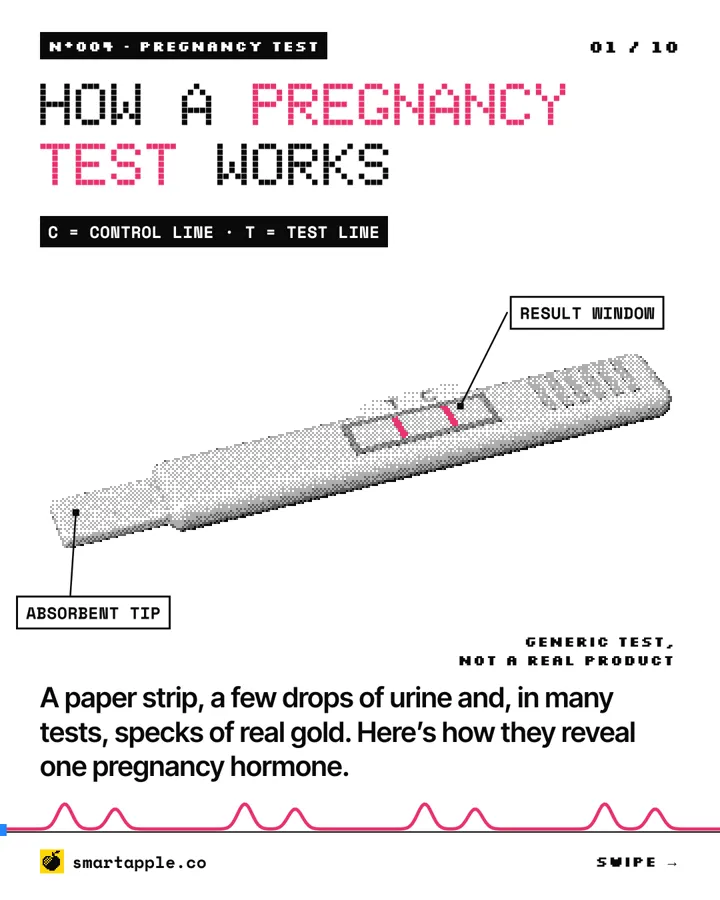
A paper strip, a few drops of urine and, in many tests, specks of real gold. Here’s how they reveal one pregnancy hormone.
The hormone it looks for
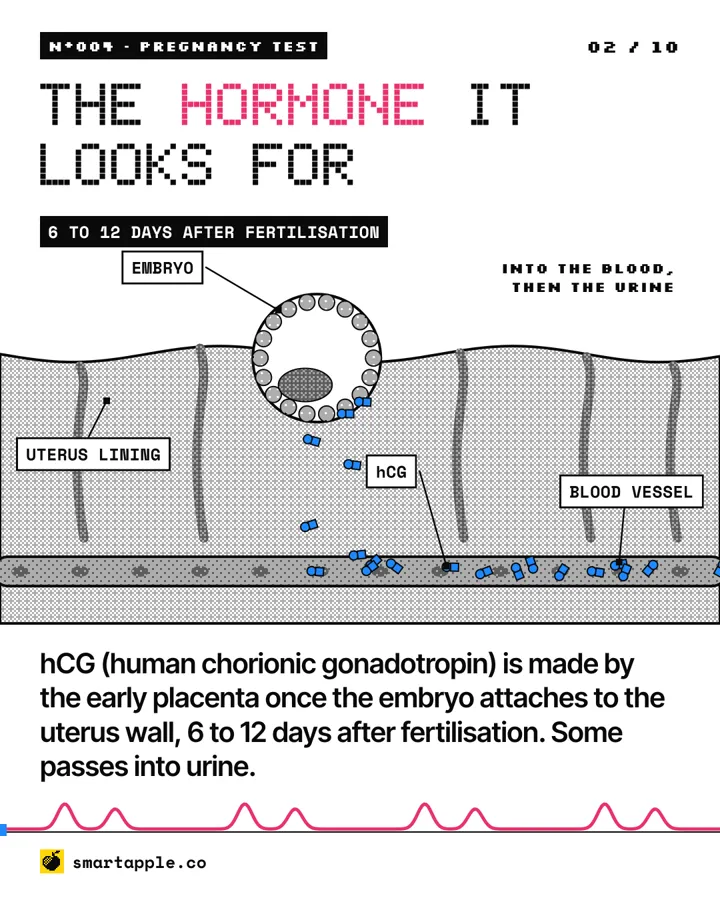
hCG (human chorionic gonadotropin) is made by the early placenta once the embryo attaches to the uterus wall, 6 to 12 days after fertilisation. Some passes into urine.
What’s inside the stick
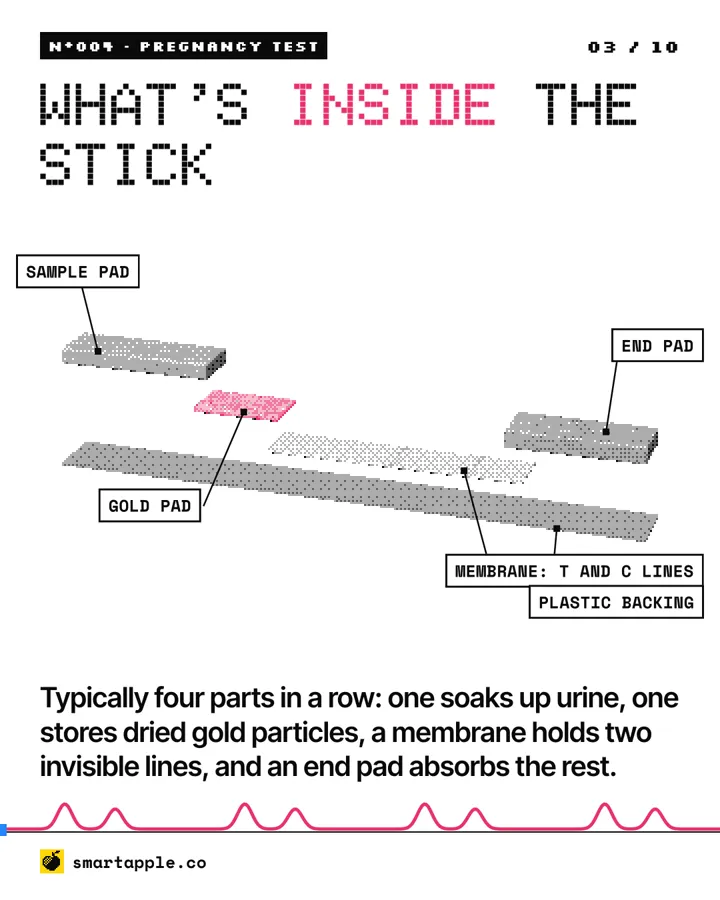
Typically four parts in a row: one soaks up urine, one stores dried gold particles, a membrane holds two invisible lines, and an end pad absorbs the rest.
How urine moves by itself
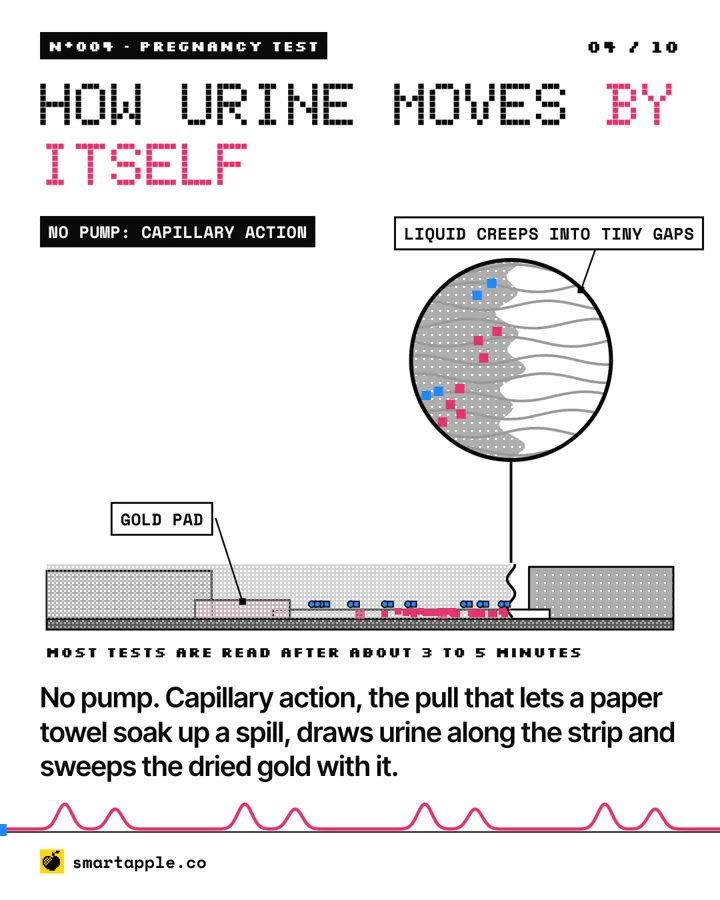
No pump. Capillary action, the pull that lets a paper towel soak up a spill, draws urine along the strip and sweeps the dried gold with it.
Where the pink comes from
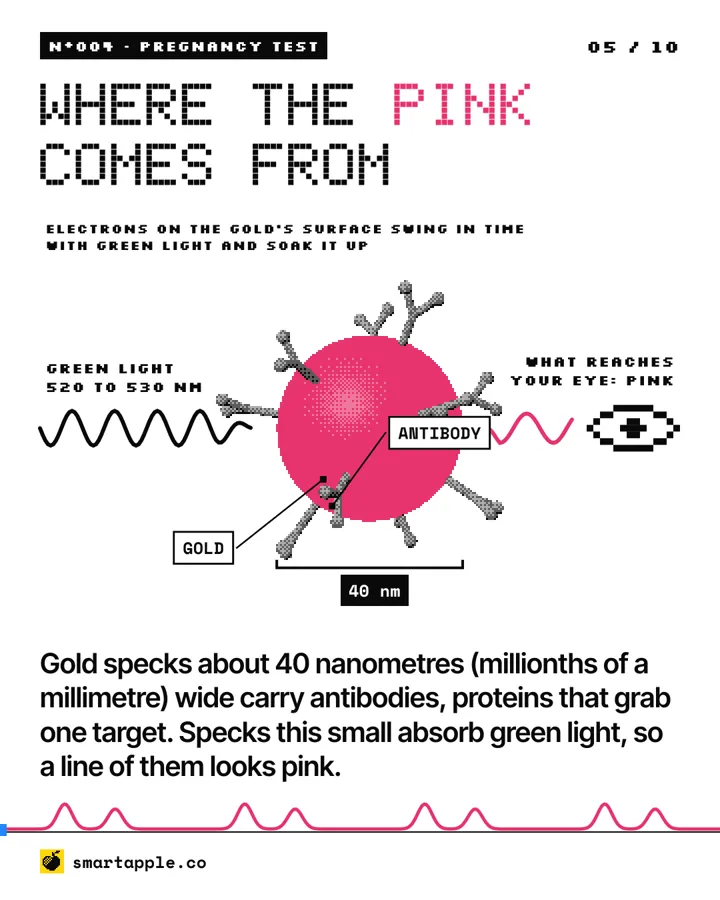
Gold specks about 40 nanometres (millionths of a millimetre) wide carry antibodies, proteins that grab one target. Specks this small absorb green light, so a line of them looks pink.
How the test line forms
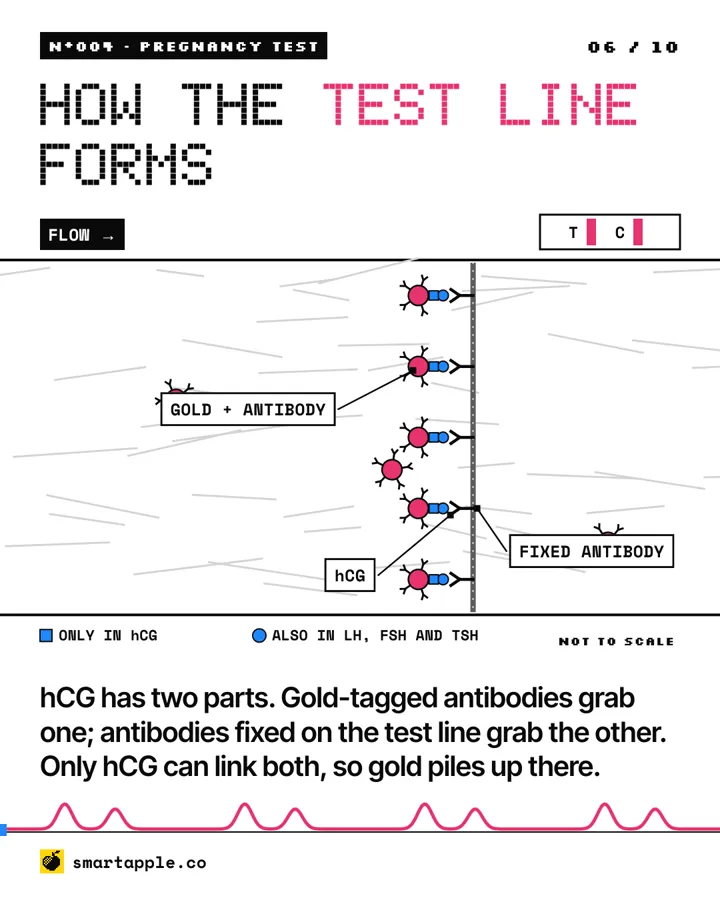
hCG has two parts. Gold-tagged antibodies grab one; antibodies fixed on the test line grab the other. Only hCG can link both, so gold piles up there.
What the control line shows
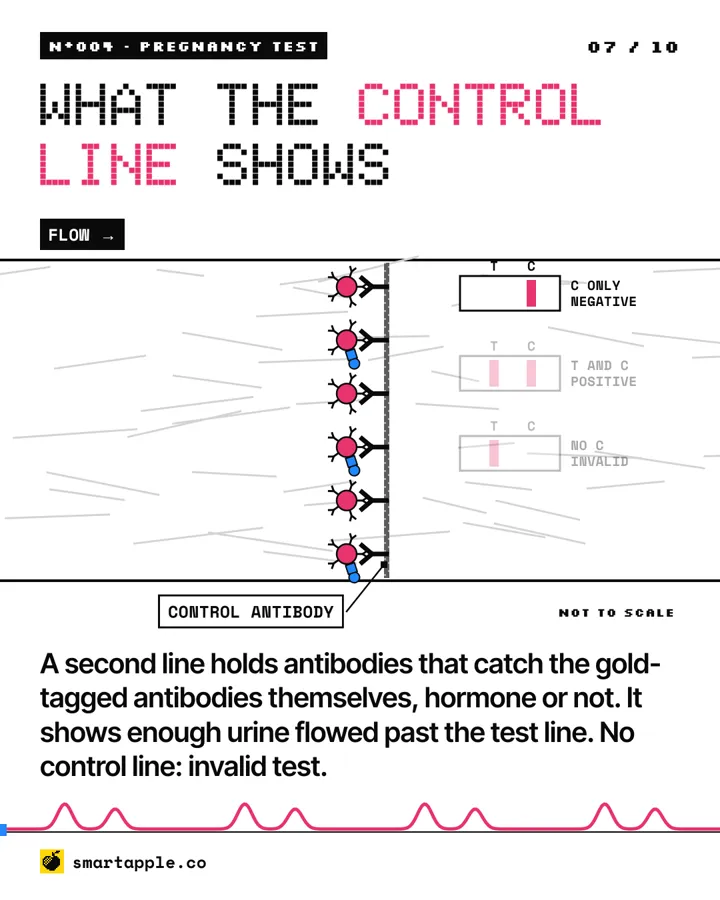
A second line holds antibodies that catch the gold-tagged antibodies themselves, hormone or not. It shows enough urine flowed past the test line. No control line: invalid test.
Why testing too early can fail
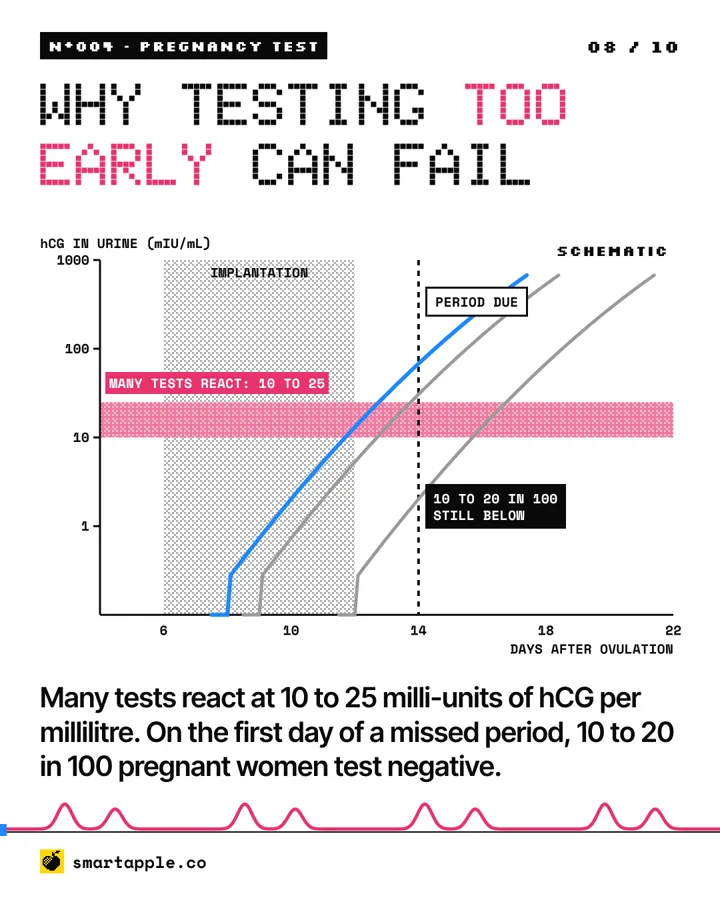
Many tests react at 10 to 25 milli-units of hCG per millilitre. On the first day of a missed period, 10 to 20 in 100 pregnant women test negative.
Before strips: mice, rabbits, frogs
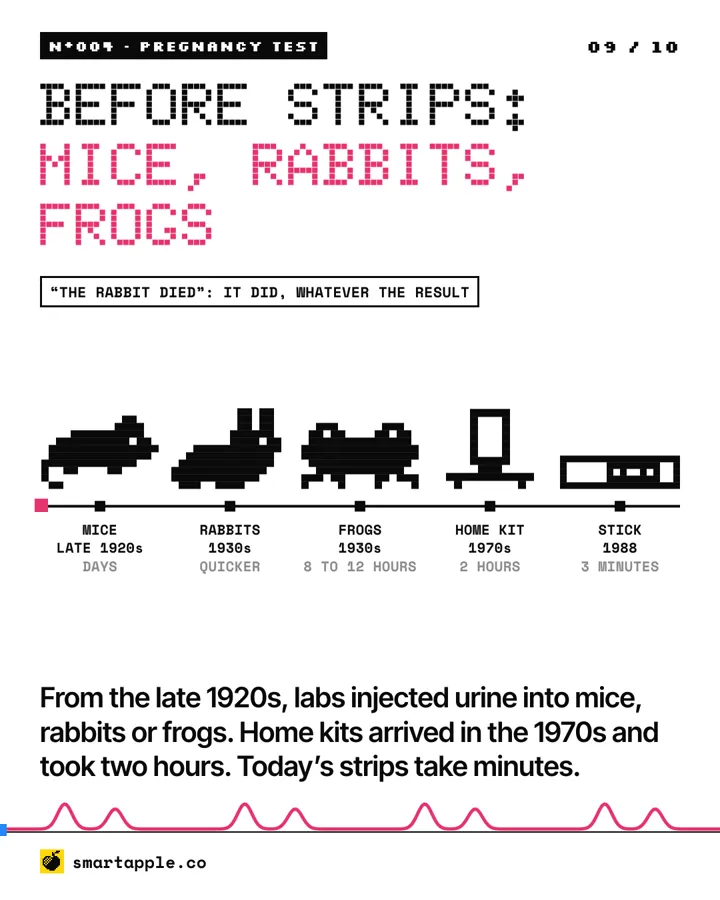
From the late 1920s, labs injected urine into mice, rabbits or frogs. Home kits arrived in the 1970s and took two hours. Today’s strips take minutes.
So that’s how.

Health topics are explained for general information only. This is not medical advice: talk to a doctor or pharmacist about your own situation.
Not medical advice. The test shown is a generic design.
Devices shown are generic illustrations, not real products. Not sponsored.
Smart Apple is independent and not affiliated with Apple Inc. or with any company whose products appear in our stories.
Made with the help of AI tools and checked against primary sources. The videos carry Content Credentials (C2PA).
Sources
Slide 1 of 10
- In many tests the pink line is made of gold particles ("colloidal gold conjugate", "form a pink line")accessdata.fda.gov
Slide 2 of 10
- hCG (human chorionic gonadotropin) is made by the early placenta after the embryo attaches; it first appears 6 to 12 days after ovulation; some passes into urinepubmed.ncbi.nlm.nih.gov
- hCG (human chorionic gonadotropin) is made by the early placenta after the embryo attaches; it first appears 6 to 12 days after ovulation; some passes into urinesciencedaily.com
- hCG (human chorionic gonadotropin) is made by the early placenta after the embryo attaches; it first appears 6 to 12 days after ovulation; some passes into urinefda.gov
- The embryo attaches by the side that carries the inner cell massfrontiersin.org
Slide 3 of 10
- A typical strip has four parts in a row: sample pad, conjugate (gold) pad, nitrocellulose membrane with the T and C lines, end (absorbent) pad, on a plastic backingmdpi.com
- A typical strip has four parts in a row: sample pad, conjugate (gold) pad, nitrocellulose membrane with the T and C lines, end (absorbent) pad, on a plastic backingcdn.shopify.com
Slide 4 of 10
- No pump: capillary flow moves the sample and the dried gold; most tests are read after about 3 to 5 minutes (follow the leaflet)accessdata.fda.gov
- No pump: capillary flow moves the sample and the dried gold; most tests are read after about 3 to 5 minutes (follow the leaflet)fda.gov
Slide 5 of 10
- Gold particles about 40 nm wide carry antibodies; at that size they absorb green light (peak about 520 to 530 nm), so a line of them looks pinksigmaaldrich.com
- Gold particles about 40 nm wide carry antibodies; at that size they absorb green light (peak about 520 to 530 nm), so a line of them looks pinkcdn.shopify.com
Slide 6 of 10
- Gold-tagged antibody grabs the beta part of hCG; the antibody fixed on the test line grabs the alpha part; the alpha part is also in LH, FSH and TSHaccessdata.fda.gov
- Gold-tagged antibody grabs the beta part of hCG; the antibody fixed on the test line grabs the alpha part; the alpha part is also in LH, FSH and TSHncbi.nlm.nih.gov
Slide 7 of 10
- The control line catches the gold-tagged antibodies themselves; it shows enough sample flowed past the test zone ("adequate sample volume and proper wicking"); no control line means an invalid testaccessdata.fda.gov
- The control line catches the gold-tagged antibodies themselves; it shows enough sample flowed past the test zone ("adequate sample volume and proper wicking"); no control line means an invalid testaccessdata.fda.gov
Slide 8 of 10
- Many tests react at 10 to 25 mIU/mL; on the first day of a missed period, 10 to 20 in 100 pregnant women test negativeaccessdata.fda.gov
- Many tests react at 10 to 25 mIU/mL; on the first day of a missed period, 10 to 20 in 100 pregnant women test negativeaccessdata.fda.gov
- Many tests react at 10 to 25 mIU/mL; on the first day of a missed period, 10 to 20 in 100 pregnant women test negativefda.gov
- Many tests react at 10 to 25 mIU/mL; on the first day of a missed period, 10 to 20 in 100 pregnant women test negativescholars.duke.edu
- The hCG curves are schematic (implantation timing varies); the axis counts days after ovulationpubmed.ncbi.nlm.nih.gov
Slide 9 of 10
- Mouse test from the late 1920s, then rabbits and frogs (frogs laid eggs 8 to 12 hours later); "the rabbit died" whatever the result; home kits in the 1970s took about two hours; the 1988 one-step stick took three minuteshistory.nih.gov
- Mouse test from the late 1920s, then rabbits and frogs (frogs laid eggs 8 to 12 hours later); "the rabbit died" whatever the result; home kits in the 1970s took about two hours; the 1988 one-step stick took three minutesijdb.ehu.eus
- Mouse test from the late 1920s, then rabbits and frogs (frogs laid eggs 8 to 12 hours later); "the rabbit died" whatever the result; home kits in the 1970s took about two hours; the 1988 one-step stick took three minutesogmagazine.org.au
- Mouse test from the late 1920s, then rabbits and frogs (frogs laid eggs 8 to 12 hours later); "the rabbit died" whatever the result; home kits in the 1970s took about two hours; the 1988 one-step stick took three minutessmithsonianmag.com
- Mouse test from the late 1920s, then rabbits and frogs (frogs laid eggs 8 to 12 hours later); "the rabbit died" whatever the result; home kits in the 1970s took about two hours; the 1988 one-step stick took three minutescollection.sciencemuseumgroup.org.uk