
How an air styler curls hair
No clamp. No spinning barrel. So how does an air styler curl your hair?
·
Air stylers have no clamp. A fast jet of air clings to the curved barrel (the Coandă effect), pulls the hair around it and dries it in place. As the hair dries in its new shape, weak bonds lock in the curl, until humid air undoes them.
How an air styler curls hair
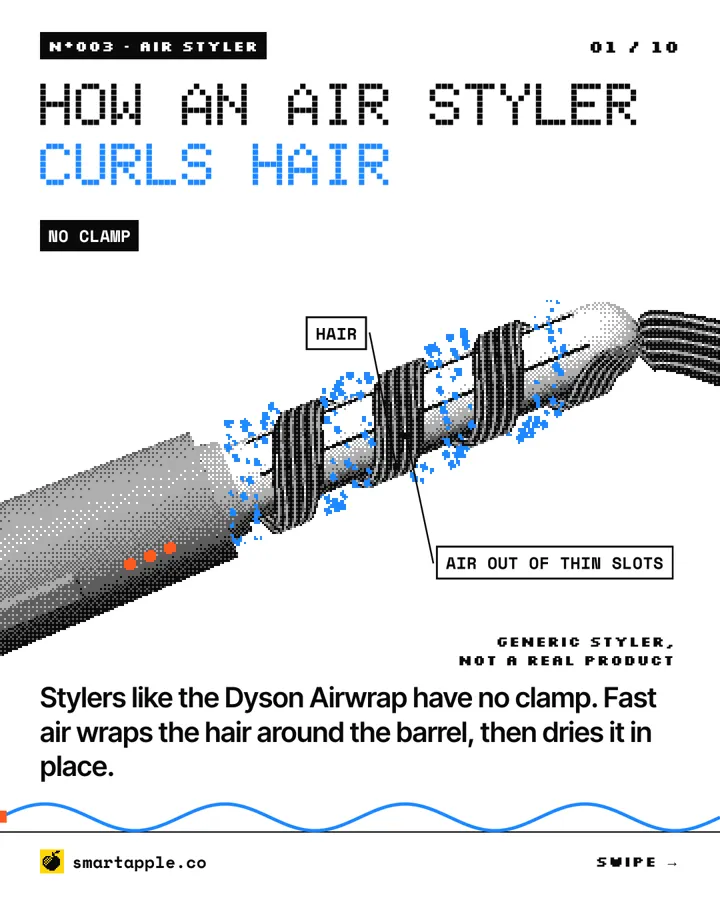
Stylers like the Dyson Airwrap have no clamp. Fast air wraps the hair around the barrel, then dries it in place.
What’s inside the styler
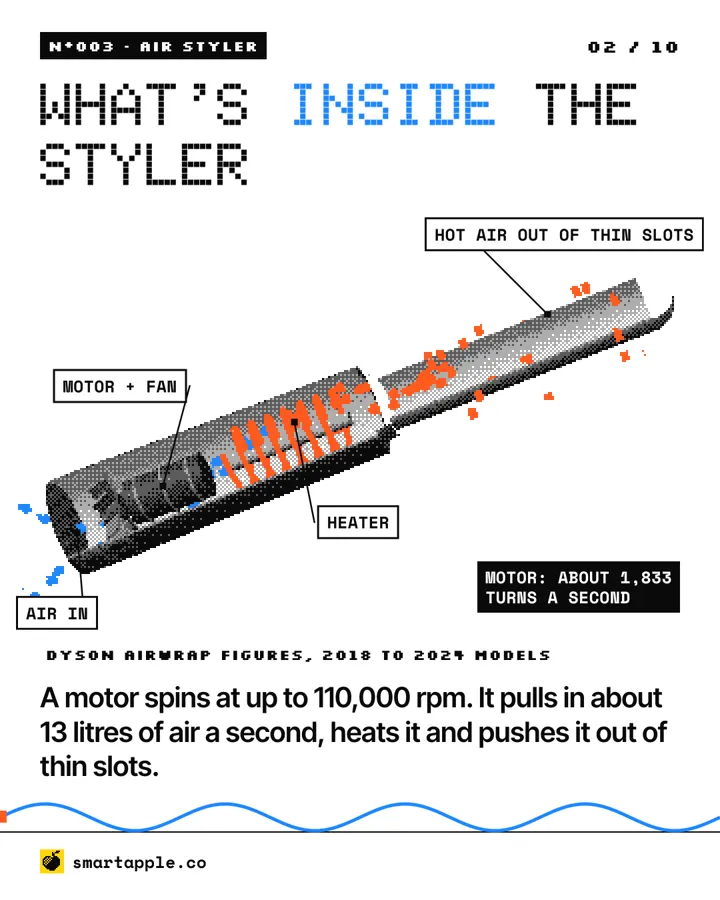
A motor spins at up to 110,000 rpm. It pulls in about 13 litres of air a second, heats it and pushes it out of thin slots.
Air follows curved surfaces
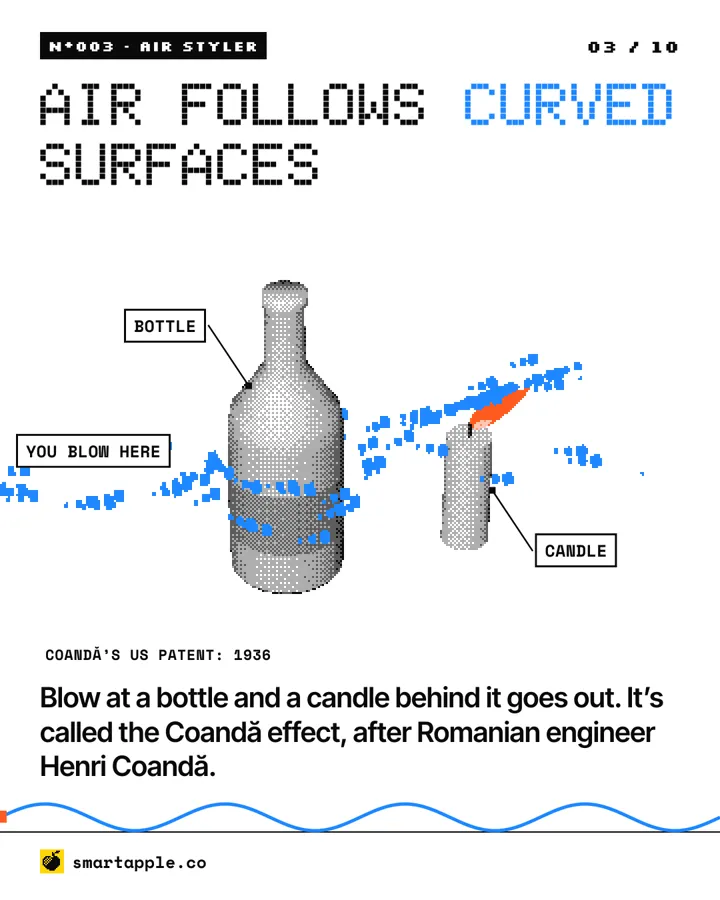
Blow at a bottle and a candle behind it goes out. It’s called the Coandă effect, after Romanian engineer Henri Coandă.
Why the air follows the barrel
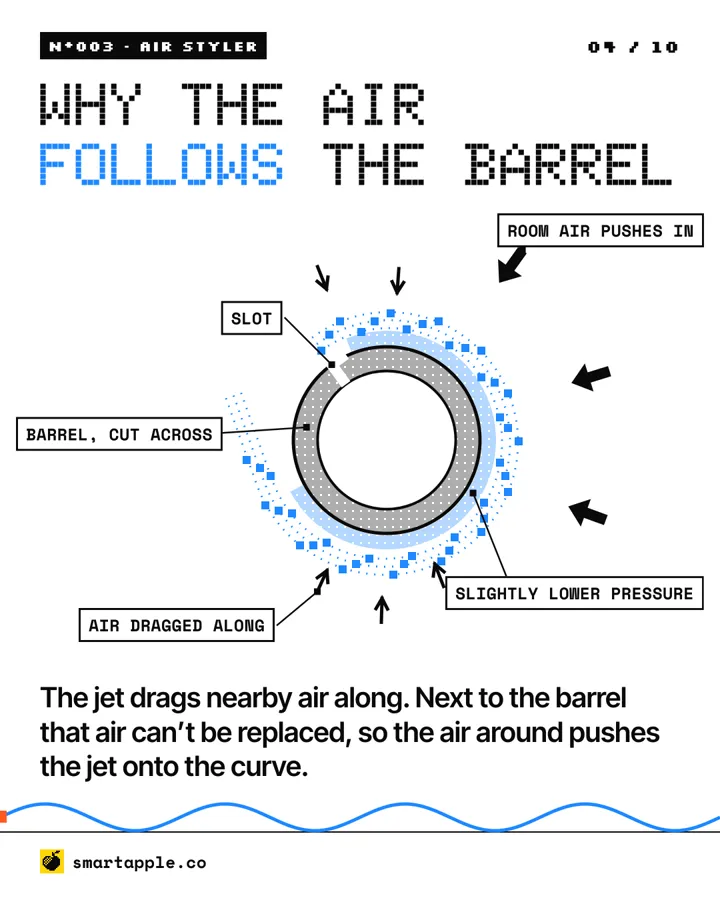
The jet drags nearby air along. Next to the barrel that air can’t be replaced, so the air around pushes the jet onto the curve.
The air wraps the hair
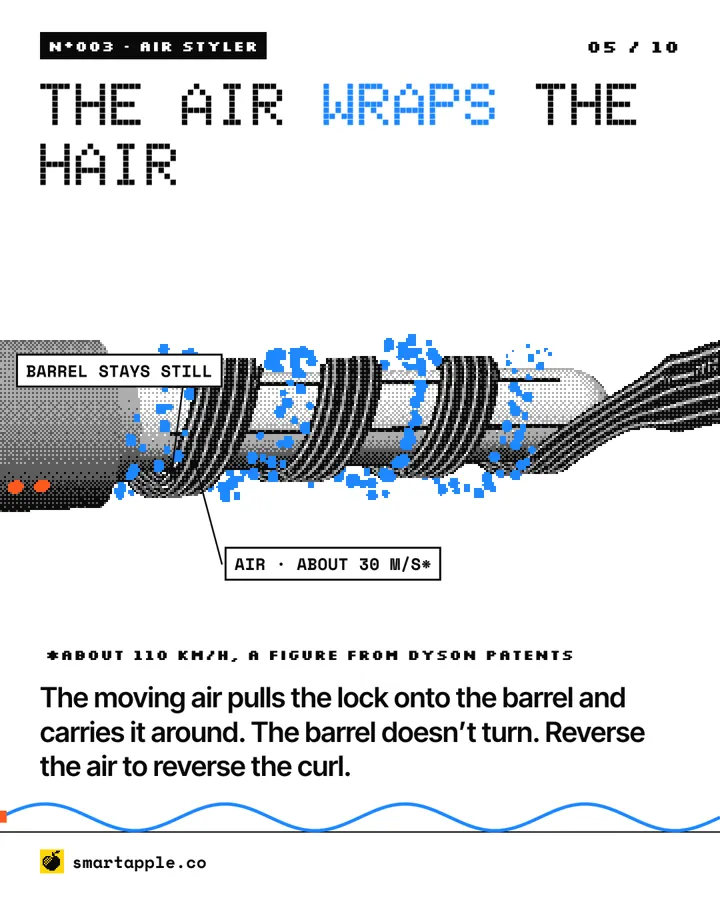
The moving air pulls the lock onto the barrel and carries it around. The barrel doesn’t turn. Reverse the air to reverse the curl.
How hot the air gets
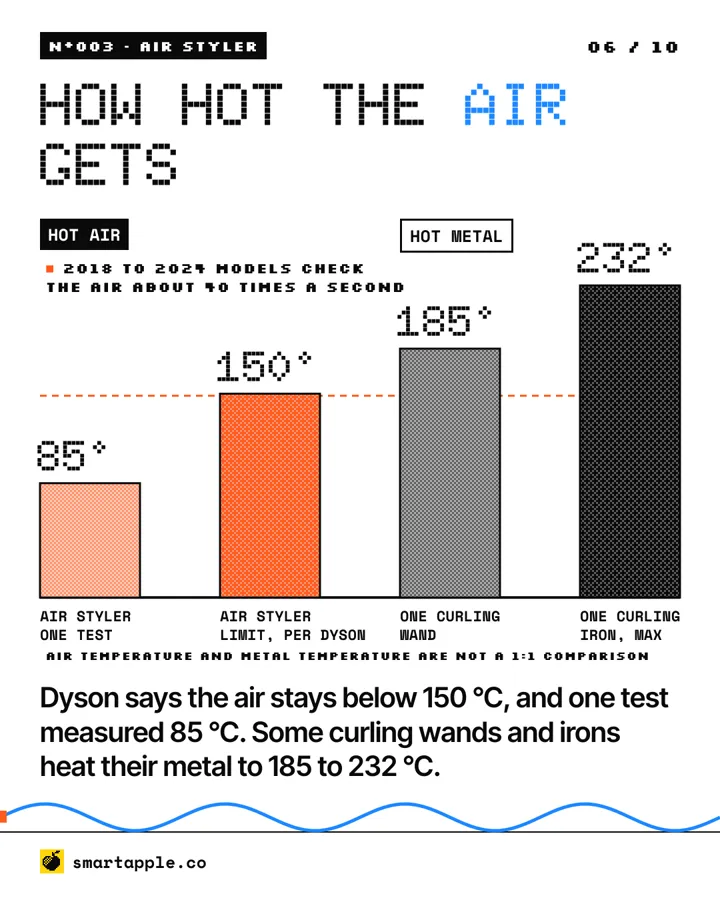
Dyson says the air stays below 150 °C, and one test measured 85 °C. Some curling wands and irons heat their metal to 185 to 232 °C.
Wet hair is easy to reshape
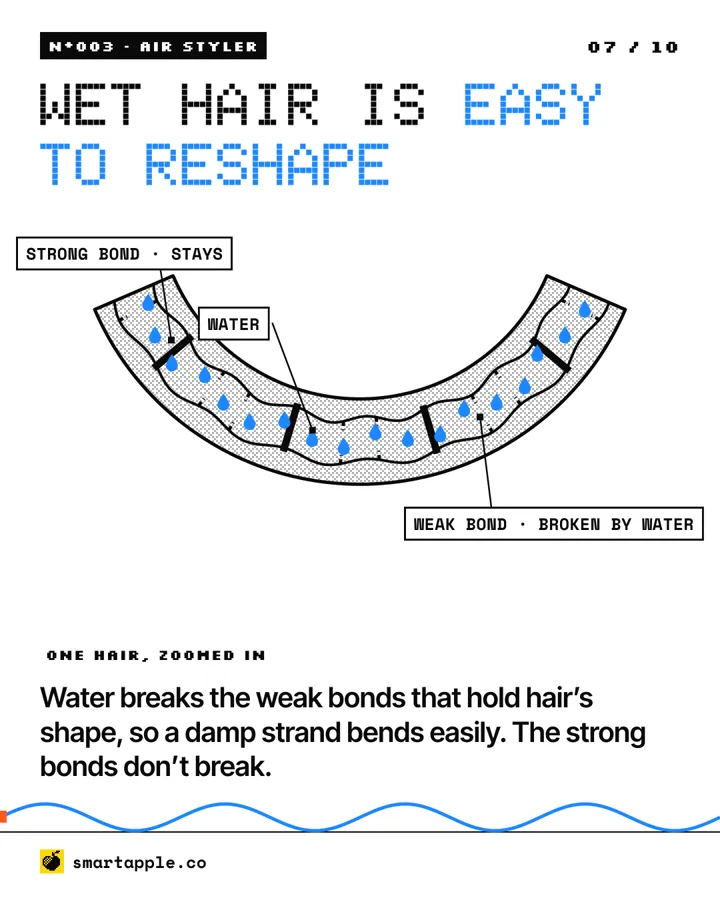
Water breaks the weak bonds that hold hair’s shape, so a damp strand bends easily. The strong bonds don’t break.
The curl sets as it dries
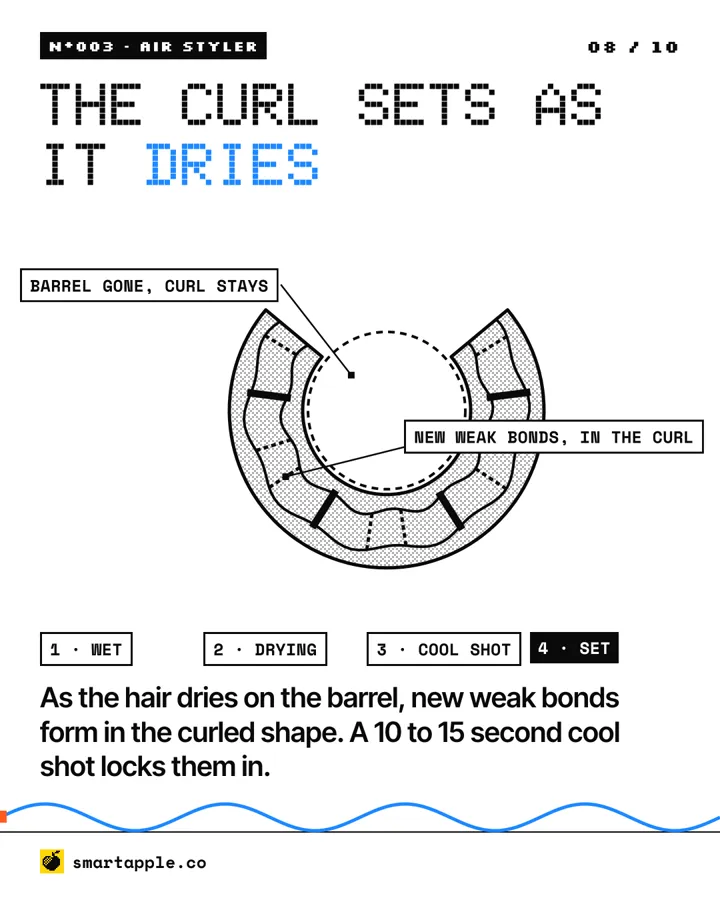
As the hair dries on the barrel, new weak bonds form in the curled shape. A 10 to 15 second cool shot locks them in.
Why humidity undoes curls
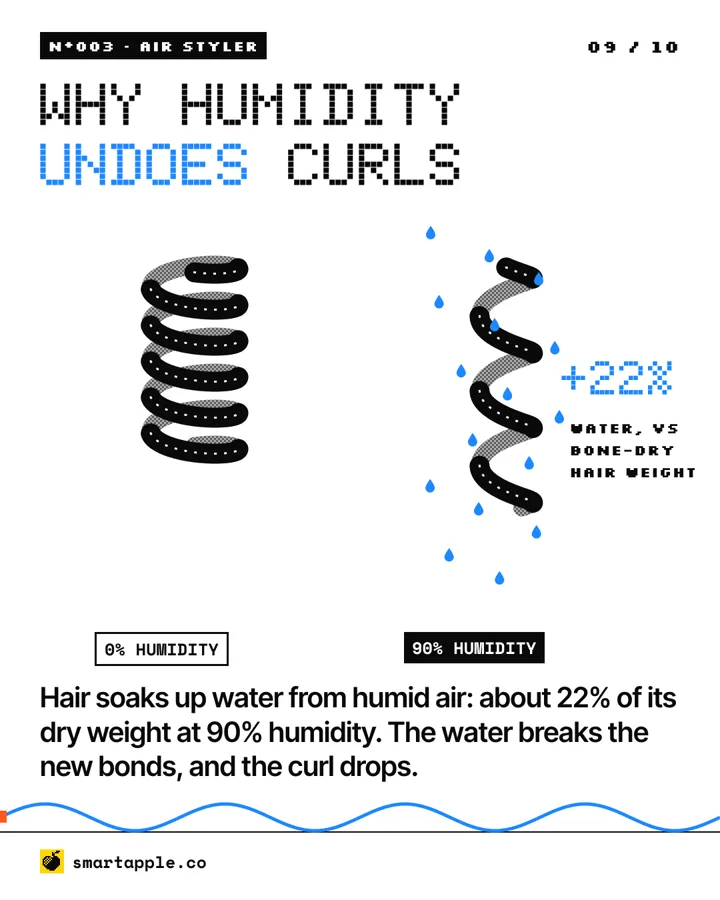
Hair soaks up water from humid air: about 22% of its dry weight at 90% humidity. The water breaks the new bonds, and the curl drops.
So that’s how.

The styler shown is a generic design. Not sponsored. Not affiliated with Dyson.
Devices shown are generic illustrations, not real products. Not sponsored.
Smart Apple is independent and not affiliated with Apple Inc. or with any company whose products appear in our stories.
Made with the help of AI tools and checked against primary sources. The videos carry Content Credentials (C2PA).
Sources
Slide 1 of 10
- No clamp: air wraps the hair around the barrel automatically, clockwise or anticlockwisepatents.google.com
Slide 2 of 10
- Motor (V9) up to 110,000 rpm, 13-blade impeller (Airwrap models 2018 to 2024)dyson.com
- Motor (V9) up to 110,000 rpm, 13-blade impeller (Airwrap models 2018 to 2024)lumafield.com
- About 13 litres of air per second (2018), heater, air out through thin slotstechradar.com
- About 13 litres of air per second (2018), heater, air out through thin slotst3.com
- 110,000 rpm = about 1,833 turns a secondCalculation from the cited figures
Slide 3 of 10
- A fast jet next to a curved surface stays attached and follows it (Coandă effect); Henri Coandă, US patent 2,052,869, granted 1 Sep 1936en.wikipedia.org
- A fast jet next to a curved surface stays attached and follows it (Coandă effect); Henri Coandă, US patent 2,052,869, granted 1 Sep 1936patents.google.com
- Blowing at a bottle puts out a candle behind itthenakedscientists.com
Slide 4 of 10
- The jet drags surrounding air along (entrainment); next to the surface that air can't be replaced, so the pressure there is slightly lower and the jet is pushed onto the curvepatents.google.com
- The jet drags surrounding air along (entrainment); next to the surface that air can't be replaced, so the pressure there is slightly lower and the jet is pushed onto the curveen.wikipedia.org
Slide 5 of 10
- Air pulls the hair onto the barrel and carries it around; the barrel doesn't turn; reversing the airflow reverses the curlpatents.google.com
- Air pulls the hair onto the barrel and carries it around; the barrel doesn't turn; reversing the airflow reverses the curldyson.com
- Outlet air speed 30 to 35 m/s in Dyson patents (examples, not product specs)patents.google.com
- Outlet air speed 30 to 35 m/s in Dyson patents (examples, not product specs)patents.google.com
Slide 6 of 10
- Air kept below 150 °C (a ceiling, not the hottest setting), temperature checked about 40 times a second in 2018 to 2024 models (Dyson claims; the 2025 Co-anda2x lists up to 150,000 rpm and faster checks)dyson.com.au
- Air kept below 150 °C (a ceiling, not the hottest setting), temperature checked about 40 times a second in 2018 to 2024 models (Dyson claims; the 2025 Co-anda2x lists up to 150,000 rpm and faster checks)dyson.in
- 85 °C measured on the hottest setting (one magazine test, method not stated)netzwelt.de
- One curling wand at 185 °C; one curling iron up to 450 °F (232 °C)ghdhair.com
- One curling wand at 185 °C; one curling iron up to 450 °F (232 °C)marlobeauty.com
Slide 7 of 10
- Water breaks hair's hydrogen bonds; disulfide bonds stay; wet hair softens below 0 °Csmithsonianmag.com
- Water breaks hair's hydrogen bonds; disulfide bonds stay; wet hair softens below 0 °Cresearch.manchester.ac.uk
Slide 8 of 10
- New hydrogen bonds form as the hair dries in shape; cooling below the softening point sets it; cool shot of 10 to 15 seconds (Dyson)library.scconline.org
- New hydrogen bonds form as the hair dries in shape; cooling below the softening point sets it; cool shot of 10 to 15 seconds (Dyson)dyson.in
Slide 9 of 10
- Raising humidity from 0% to 90% increases hair weight by about 22% (water, relative to bone-dry hair); at everyday humidity hair already holds part of thatcosmeticsandtoiletries.com