
Como um modelador a ar faz cachos
Sem pinça. Sem cilindro giratório. Então como um modelador a ar faz cachos no seu cabelo?
·
Modeladores a ar não têm pinça. Um jato de ar rápido fica colado ao cilindro curvo (o efeito Coandă), puxa o cabelo em volta dele e o seca nessa posição. Conforme o cabelo seca no novo formato, ligações fracas fixam o cacho, até que o ar úmido as desfaça.
Como um modelador a ar faz cachos
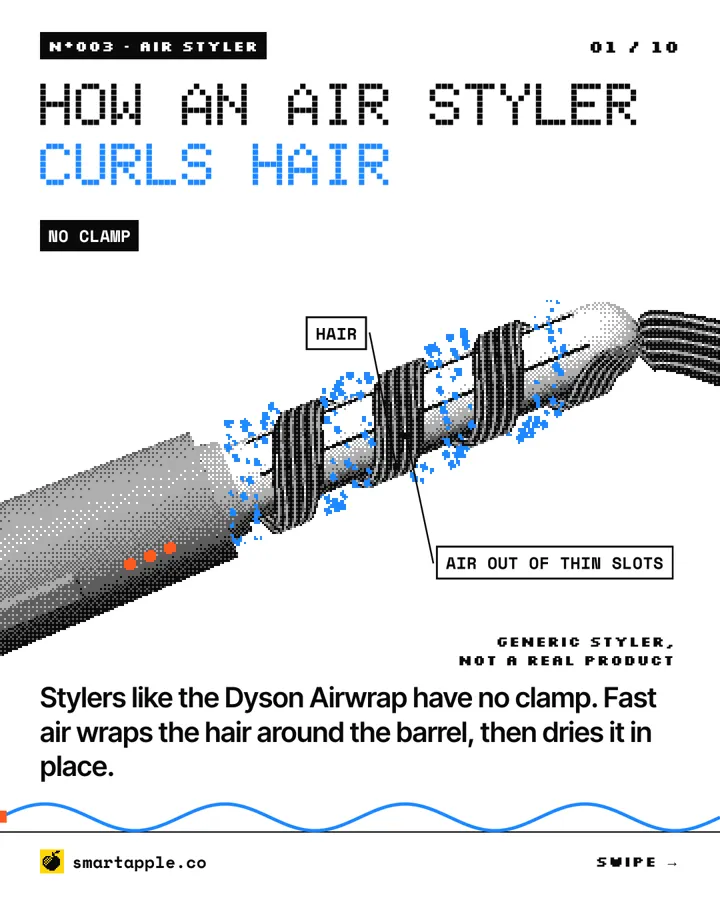
Modeladores como o Dyson Airwrap não têm pinça. O ar em alta velocidade enrola o cabelo no cilindro e depois o seca nessa posição.
O que tem dentro do modelador
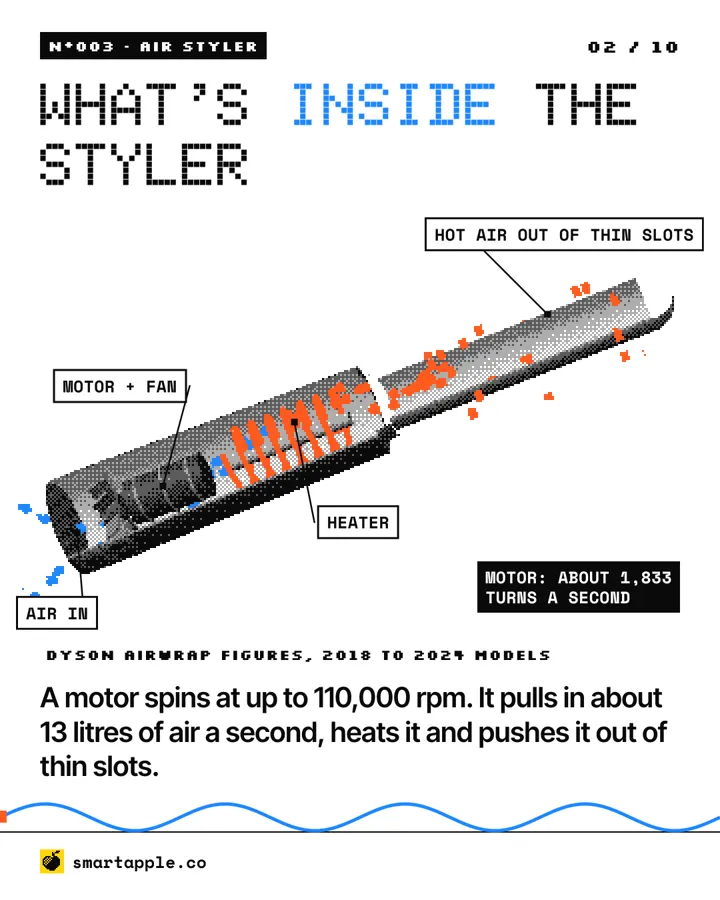
Um motor gira a até 110.000 rpm. Ele puxa cerca de 13 litros de ar por segundo, aquece esse ar e o empurra para fora por fendas estreitas.
O ar segue superfícies curvas
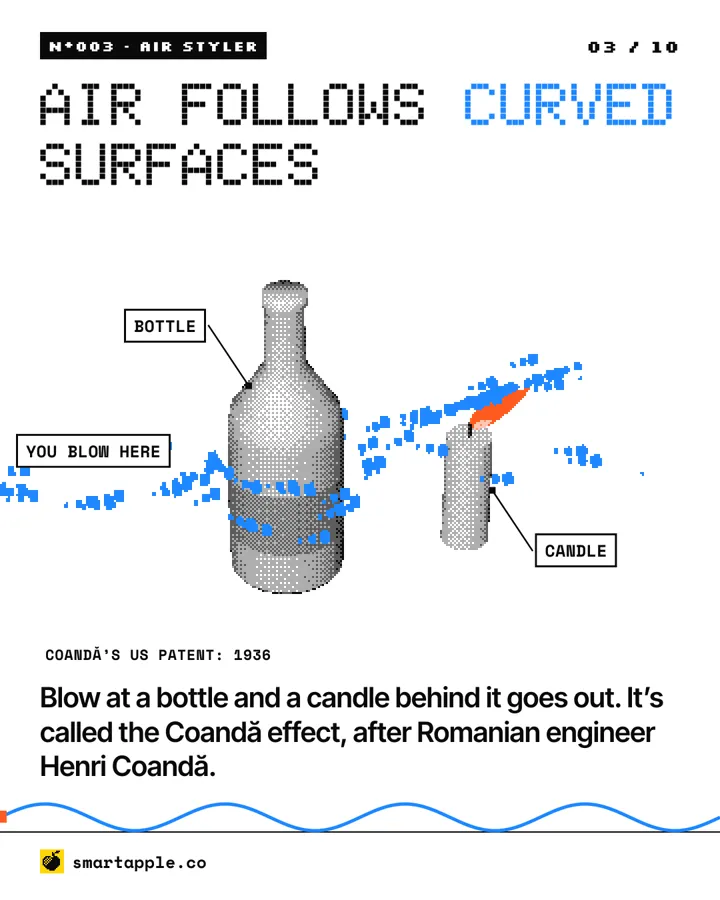
Sopre contra uma garrafa e uma vela atrás dela se apaga. É o chamado efeito Coandă, em homenagem ao engenheiro romeno Henri Coandă.
Por que o ar segue o cilindro
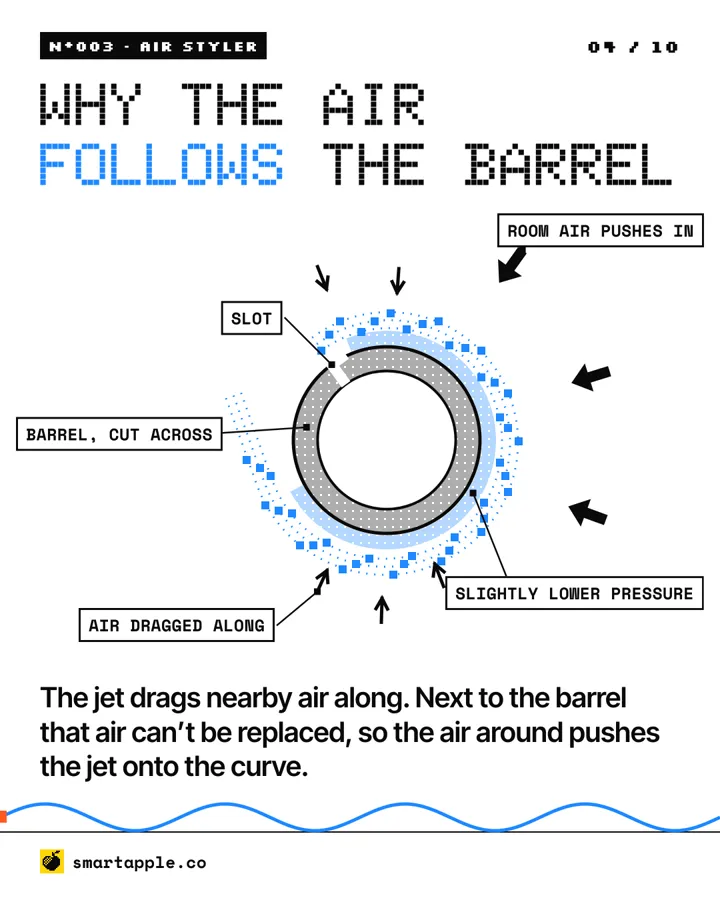
O jato arrasta consigo o ar próximo. Junto ao cilindro, esse ar não pode ser reposto, então o ar ao redor empurra o jato contra a curva.
O ar enrola o cabelo
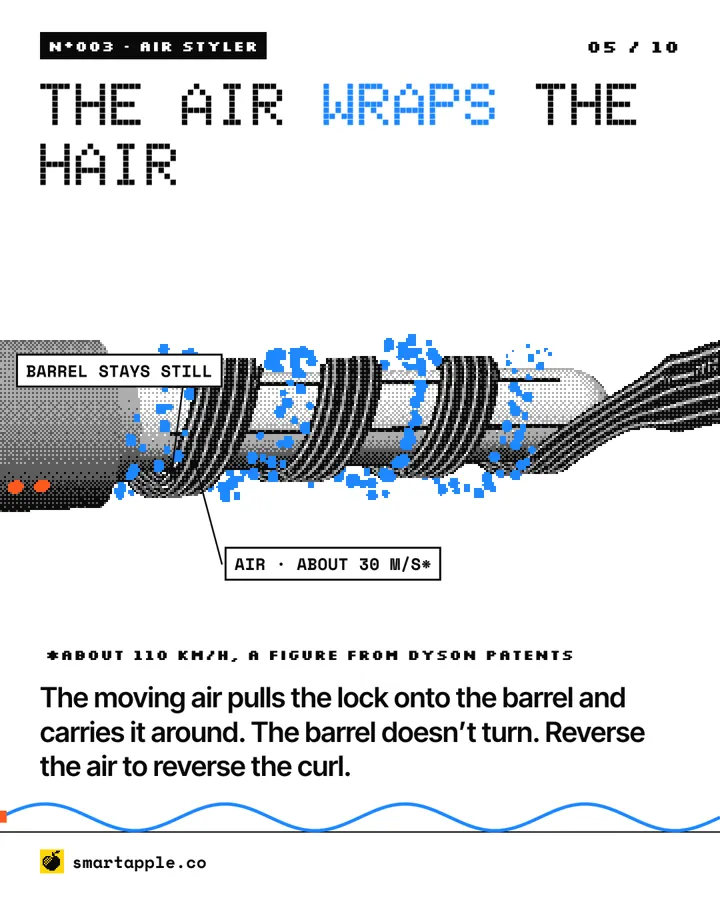
O ar em movimento puxa a mecha para o cilindro e a leva ao redor dele. O cilindro não gira. Inverta o sentido do ar para inverter o cacho.
Quanto o ar esquenta
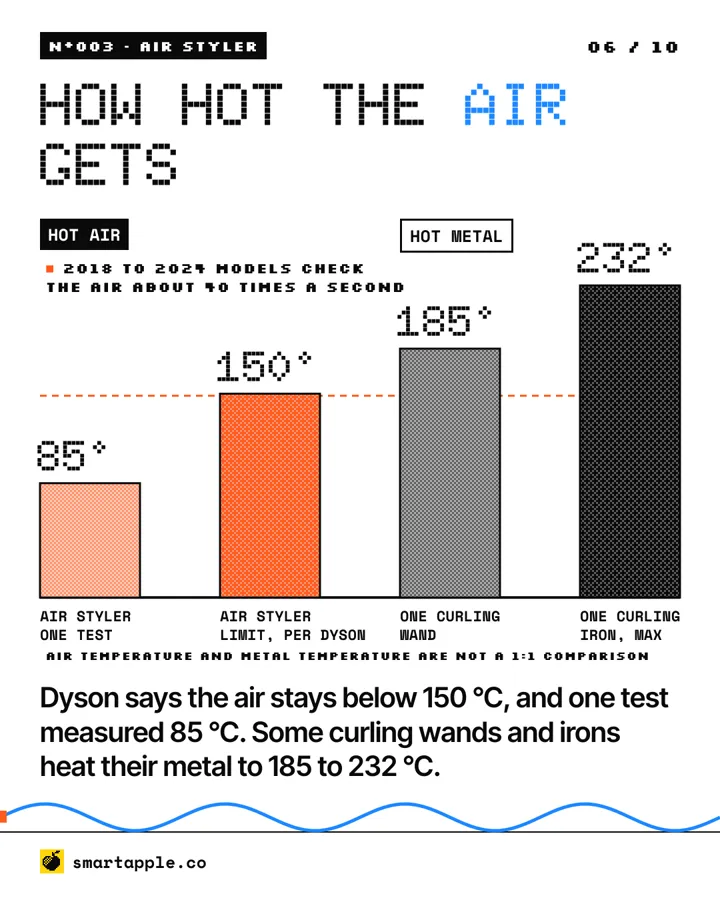
A Dyson diz que o ar fica abaixo de 150 °C, e um teste mediu 85 °C. Alguns modeladores de cachos, com ou sem pinça, aquecem o metal a temperaturas de 185 a 232 °C.
Cabelo molhado é fácil de modelar
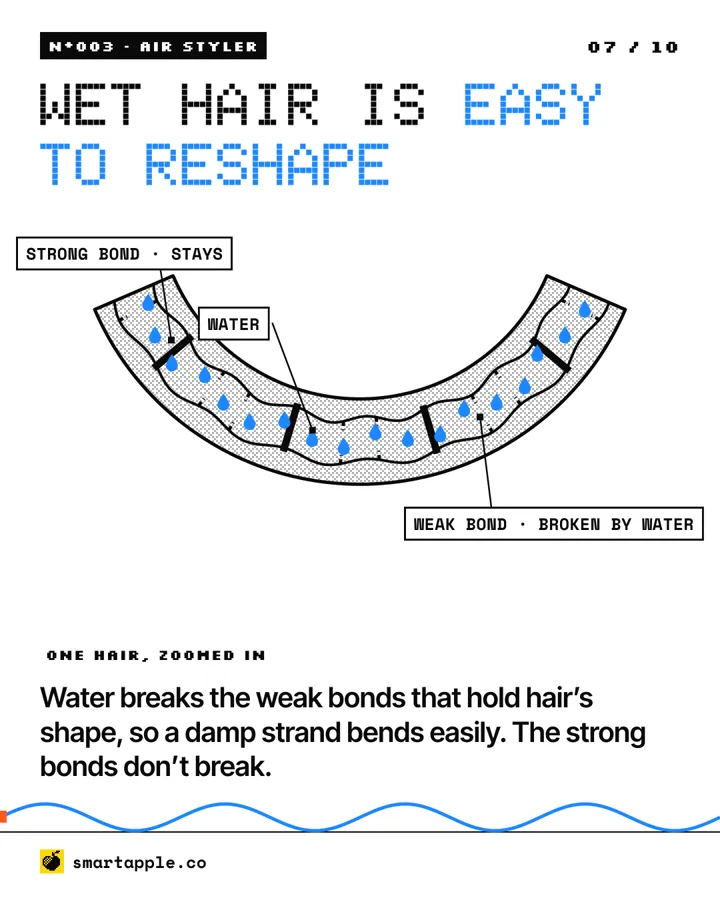
A água quebra as ligações fracas que mantêm o formato do cabelo, então um fio úmido se dobra com facilidade. As ligações fortes não se quebram.
O cacho se fixa ao secar
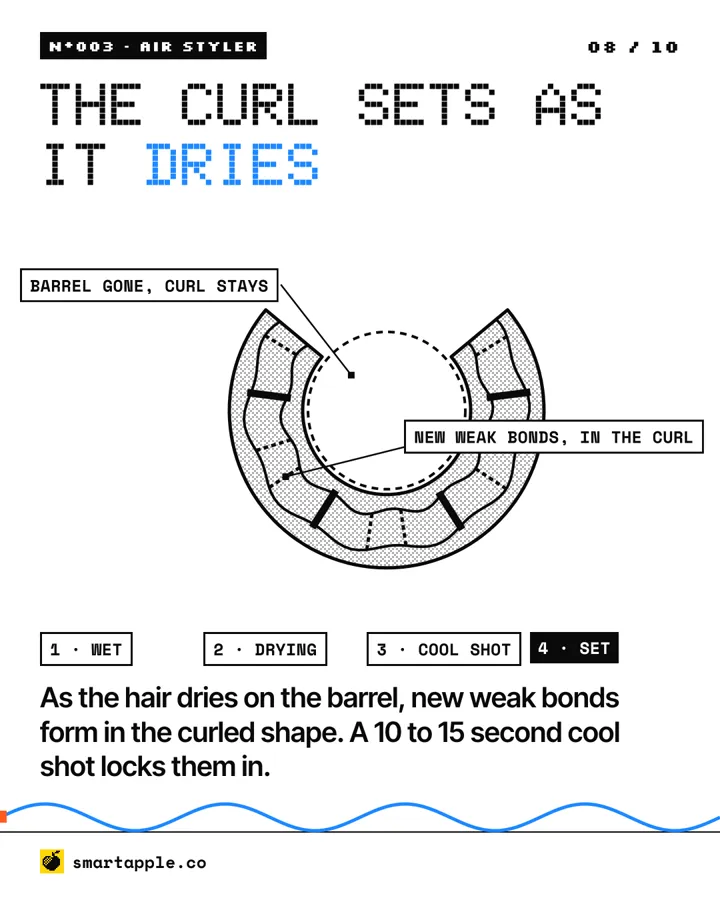
Enquanto o cabelo seca no cilindro, novas ligações fracas se formam no formato do cacho. Um jato de ar frio de 10 a 15 segundos as fixa.
Por que a umidade desfaz os cachos
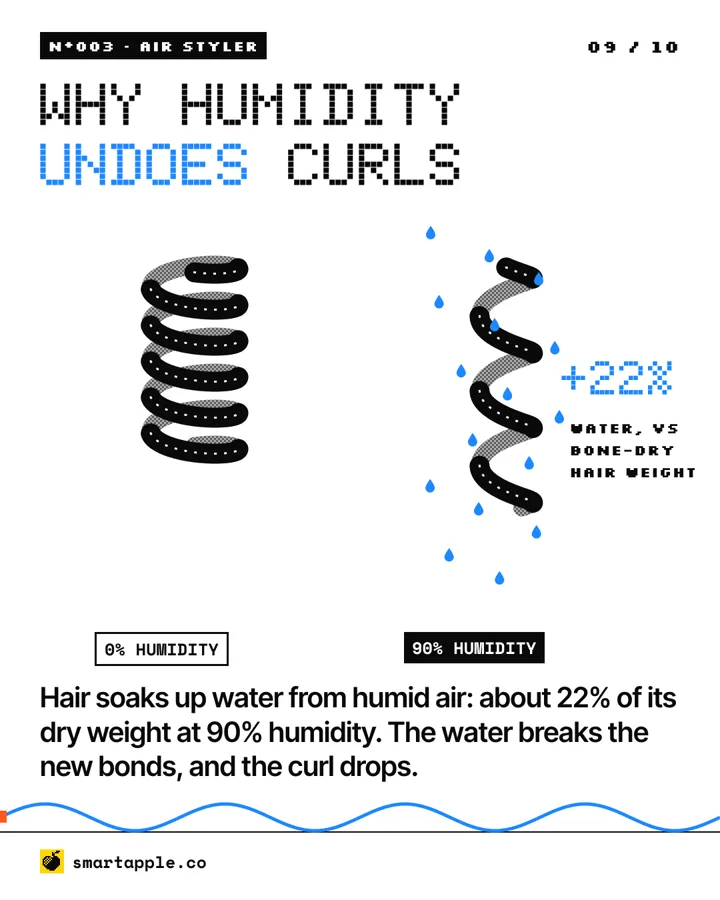
O cabelo absorve água do ar úmido: cerca de 22% do seu peso seco com 90% de umidade. A água quebra as novas ligações, e o cacho cai.
É assim que funciona.

O modelador mostrado tem design genérico. Sem patrocínio. Sem vínculo com a Dyson.
Os aparelhos mostrados são ilustrações genéricas, não produtos reais. Sem patrocínio.
O Smart Apple é independente e não tem vínculo com a Apple Inc. nem com nenhuma empresa cujos produtos aparecem nas nossas histórias.
Feito com a ajuda de ferramentas de IA e conferido com fontes primárias. Os vídeos trazem Content Credentials (C2PA).
Fontes
Slide 1 de 10
- No clamp: air wraps the hair around the barrel automatically, clockwise or anticlockwisepatents.google.com
Slide 2 de 10
- Motor (V9) up to 110,000 rpm, 13-blade impeller (Airwrap models 2018 to 2024)dyson.com
- Motor (V9) up to 110,000 rpm, 13-blade impeller (Airwrap models 2018 to 2024)lumafield.com
- About 13 litres of air per second (2018), heater, air out through thin slotstechradar.com
- About 13 litres of air per second (2018), heater, air out through thin slotst3.com
- 110,000 rpm = about 1,833 turns a secondCalculation from the cited figures
Slide 3 de 10
- A fast jet next to a curved surface stays attached and follows it (Coandă effect); Henri Coandă, US patent 2,052,869, granted 1 Sep 1936en.wikipedia.org
- A fast jet next to a curved surface stays attached and follows it (Coandă effect); Henri Coandă, US patent 2,052,869, granted 1 Sep 1936patents.google.com
- Blowing at a bottle puts out a candle behind itthenakedscientists.com
Slide 4 de 10
- The jet drags surrounding air along (entrainment); next to the surface that air can't be replaced, so the pressure there is slightly lower and the jet is pushed onto the curvepatents.google.com
- The jet drags surrounding air along (entrainment); next to the surface that air can't be replaced, so the pressure there is slightly lower and the jet is pushed onto the curveen.wikipedia.org
Slide 5 de 10
- Air pulls the hair onto the barrel and carries it around; the barrel doesn't turn; reversing the airflow reverses the curlpatents.google.com
- Air pulls the hair onto the barrel and carries it around; the barrel doesn't turn; reversing the airflow reverses the curldyson.com
- Outlet air speed 30 to 35 m/s in Dyson patents (examples, not product specs)patents.google.com
- Outlet air speed 30 to 35 m/s in Dyson patents (examples, not product specs)patents.google.com
Slide 6 de 10
- Air kept below 150 °C (a ceiling, not the hottest setting), temperature checked about 40 times a second in 2018 to 2024 models (Dyson claims; the 2025 Co-anda2x lists up to 150,000 rpm and faster checks)dyson.com.au
- Air kept below 150 °C (a ceiling, not the hottest setting), temperature checked about 40 times a second in 2018 to 2024 models (Dyson claims; the 2025 Co-anda2x lists up to 150,000 rpm and faster checks)dyson.in
- 85 °C measured on the hottest setting (one magazine test, method not stated)netzwelt.de
- One curling wand at 185 °C; one curling iron up to 450 °F (232 °C)ghdhair.com
- One curling wand at 185 °C; one curling iron up to 450 °F (232 °C)marlobeauty.com
Slide 7 de 10
- Water breaks hair's hydrogen bonds; disulfide bonds stay; wet hair softens below 0 °Csmithsonianmag.com
- Water breaks hair's hydrogen bonds; disulfide bonds stay; wet hair softens below 0 °Cresearch.manchester.ac.uk
Slide 8 de 10
- New hydrogen bonds form as the hair dries in shape; cooling below the softening point sets it; cool shot of 10 to 15 seconds (Dyson)library.scconline.org
- New hydrogen bonds form as the hair dries in shape; cooling below the softening point sets it; cool shot of 10 to 15 seconds (Dyson)dyson.in
Slide 9 de 10
- Raising humidity from 0% to 90% increases hair weight by about 22% (water, relative to bone-dry hair); at everyday humidity hair already holds part of thatcosmeticsandtoiletries.com