
Como funciona um teste de gravidez
A linha rosa de muitos testes de gravidez é feita de partículas de ouro. Veja como funciona.
Um teste de gravidez de farmácia procura o hCG, um hormônio produzido quando um embrião se fixa na parede do útero. A urina avança por uma tira de papel por capilaridade, levando anticorpos marcados com partículas de ouro de cerca de 40 nanômetros de diâmetro. Onde o hCG os prende à linha de teste, o ouro se acumula e forma uma linha rosa.
Como funciona um teste de gravidez
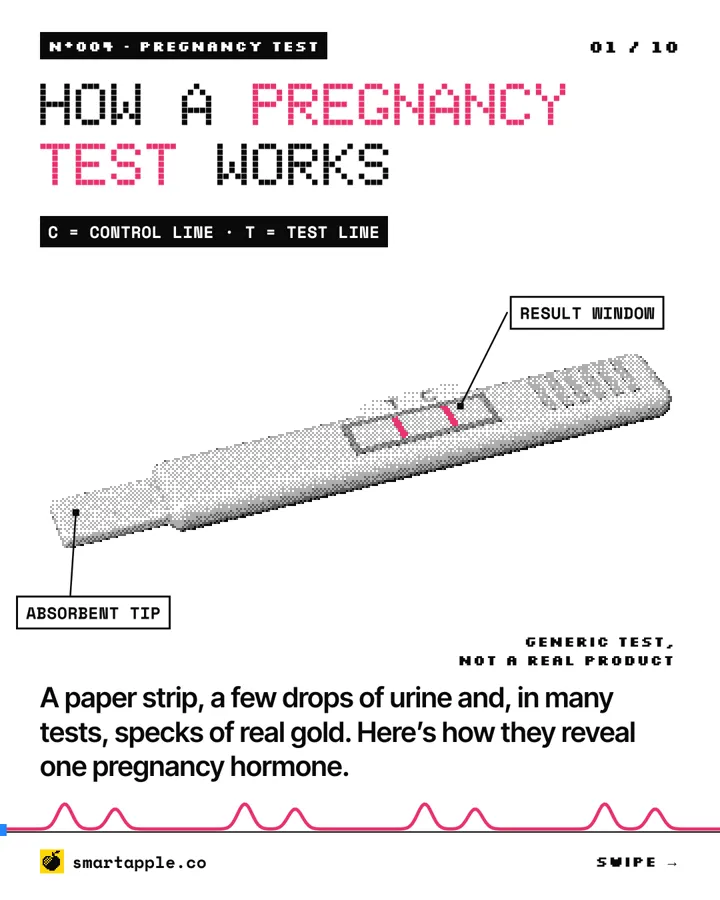
Uma tira de papel, algumas gotas de urina e, em muitos testes, partículas de ouro de verdade. Veja como elas revelam um hormônio da gravidez.
O hormônio que ele procura
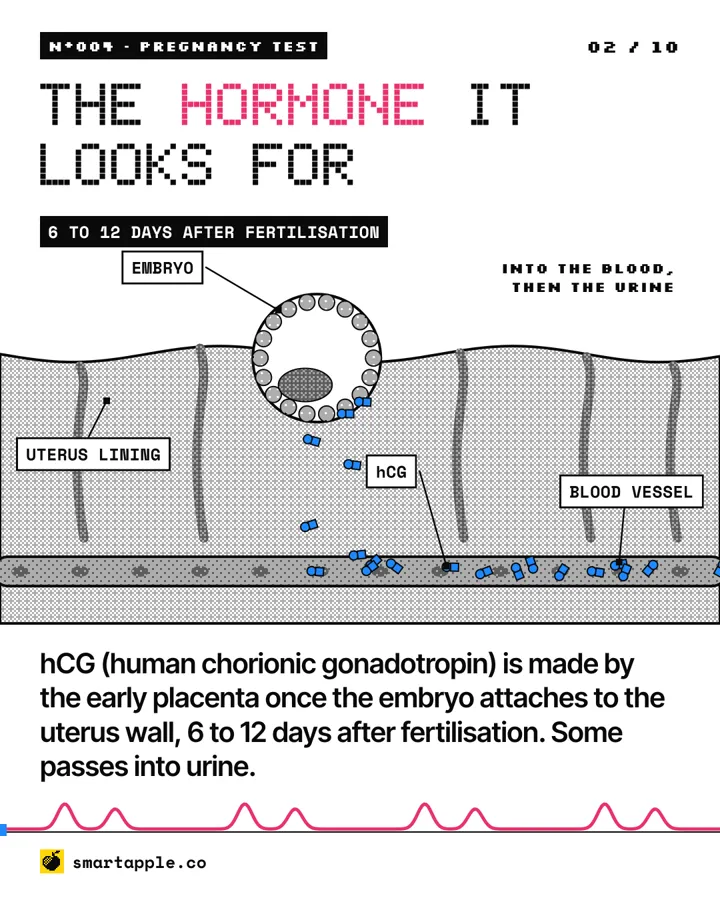
O hCG (gonadotrofina coriônica humana) é produzido pela placenta em formação quando o embrião se fixa na parede do útero, 6 a 12 dias após a fecundação. Uma parte passa para a urina.
O que tem dentro do teste
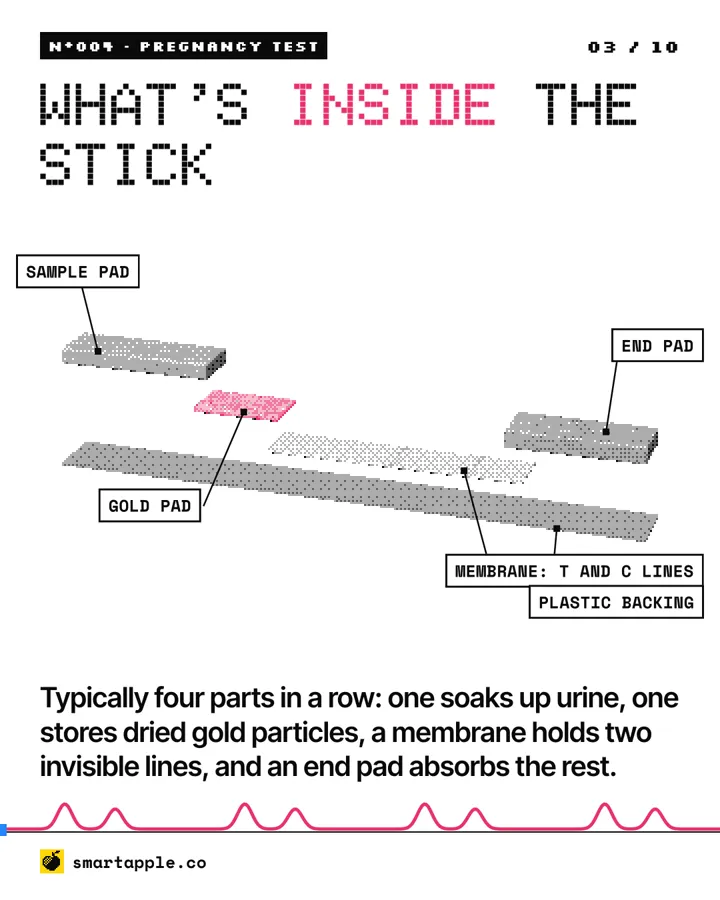
Em geral, quatro partes em sequência: uma absorve a urina, outra guarda partículas de ouro secas, uma membrana tem duas linhas invisíveis e uma almofada na ponta absorve o resto.
Como a urina se move sozinha
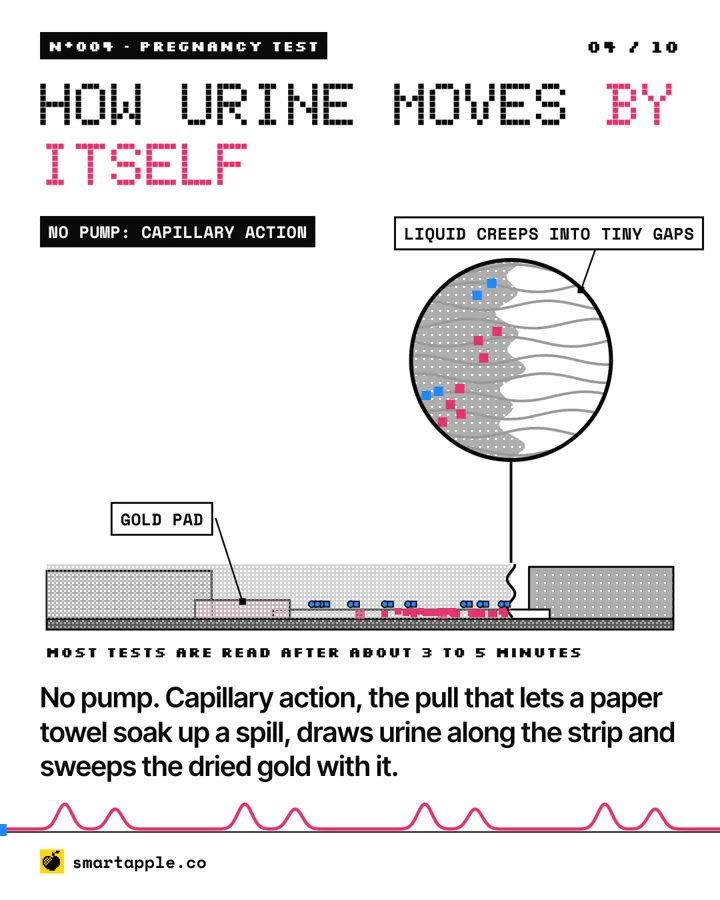
Sem bomba. A capilaridade, a força que faz o papel-toalha absorver um líquido derramado, puxa a urina ao longo da tira e arrasta junto o ouro seco.
De onde vem o rosa
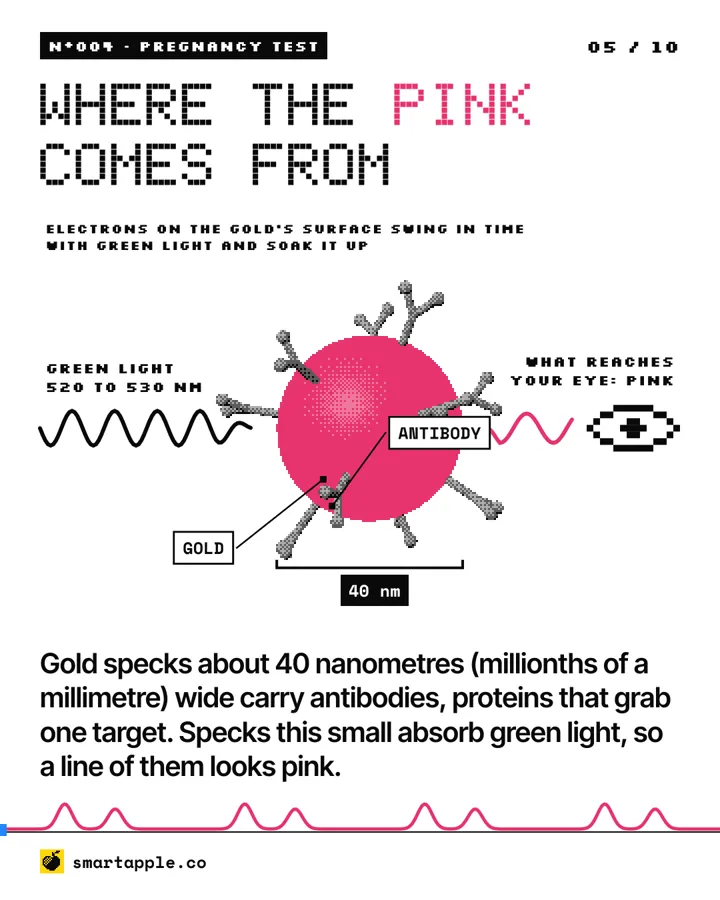
Partículas de ouro de cerca de 40 nanômetros (milionésimos de milímetro) de diâmetro carregam anticorpos, proteínas que agarram um único alvo. Partículas tão pequenas absorvem luz verde, então uma linha delas parece rosa.
Como a linha de teste se forma
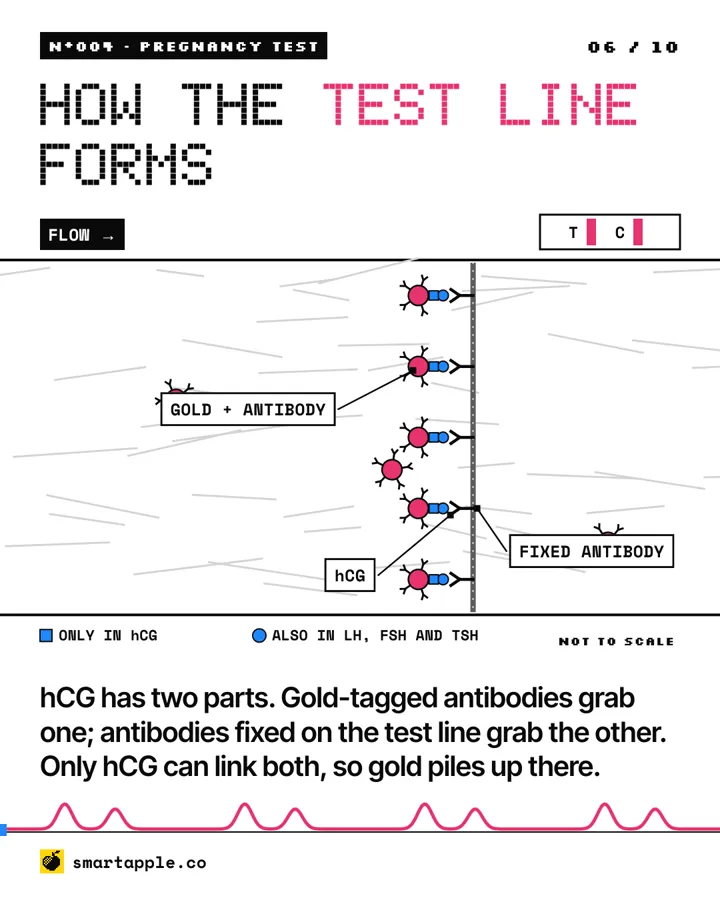
O hCG tem duas partes. Anticorpos marcados com ouro agarram uma; anticorpos fixos na linha de teste agarram a outra. Só o hCG consegue ligar os dois, então o ouro se acumula ali.
O que a linha de controle mostra
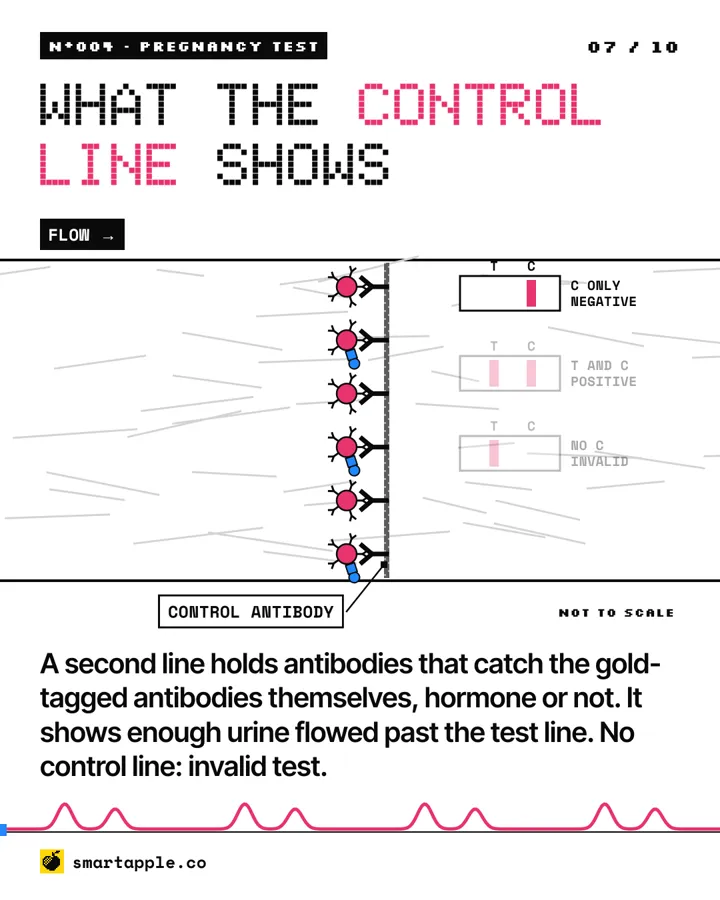
Uma segunda linha tem anticorpos que capturam os próprios anticorpos marcados com ouro, com ou sem hormônio. Ela mostra que passou urina suficiente pela linha de teste. Sem linha de controle: teste inválido.
Por que testar cedo demais pode falhar
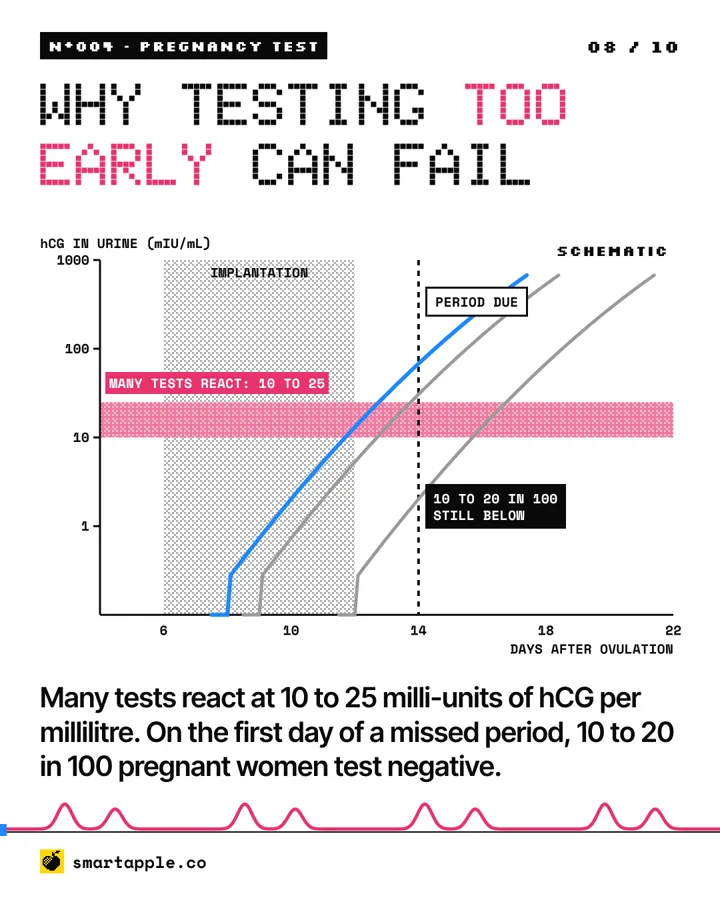
Muitos testes reagem com 10 a 25 miliunidades de hCG por mililitro. No primeiro dia de atraso da menstruação, 10 a 20 em cada 100 grávidas têm resultado negativo.
Antes das tiras: camundongos, coelhos, rãs
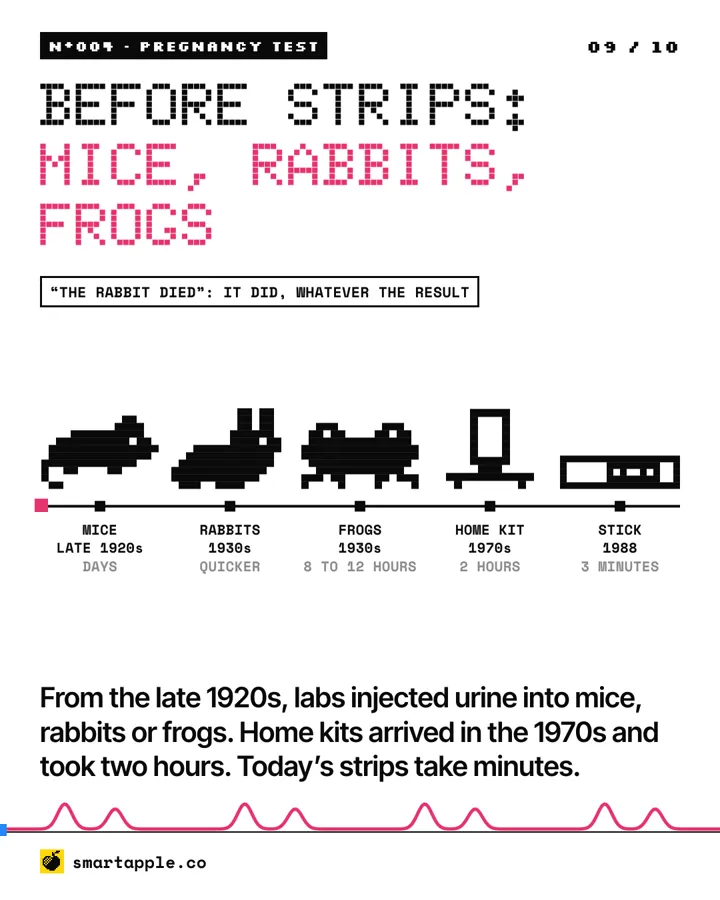
A partir do fim dos anos 1920, laboratórios injetavam urina em camundongos, coelhos ou rãs. Os kits para fazer em casa chegaram nos anos 1970 e levavam duas horas. As tiras de hoje levam minutos.
É assim que funciona.

Os temas de saúde são explicados apenas para informação geral. Isto não é orientação médica: converse com um médico ou farmacêutico sobre o seu caso.
Não é orientação médica. O teste mostrado tem design genérico.
Os aparelhos mostrados são ilustrações genéricas, não produtos reais. Sem patrocínio.
O Smart Apple é independente e não tem vínculo com a Apple Inc. nem com nenhuma empresa cujos produtos aparecem nas nossas histórias.
Feito com a ajuda de ferramentas de IA e conferido com fontes primárias. Os vídeos trazem Content Credentials (C2PA).
Fontes
Slide 1 de 10
- In many tests the pink line is made of gold particles ("colloidal gold conjugate", "form a pink line")accessdata.fda.gov
Slide 2 de 10
- hCG (human chorionic gonadotropin) is made by the early placenta after the embryo attaches; it first appears 6 to 12 days after ovulation; some passes into urinepubmed.ncbi.nlm.nih.gov
- hCG (human chorionic gonadotropin) is made by the early placenta after the embryo attaches; it first appears 6 to 12 days after ovulation; some passes into urinesciencedaily.com
- hCG (human chorionic gonadotropin) is made by the early placenta after the embryo attaches; it first appears 6 to 12 days after ovulation; some passes into urinefda.gov
- The embryo attaches by the side that carries the inner cell massfrontiersin.org
Slide 3 de 10
- A typical strip has four parts in a row: sample pad, conjugate (gold) pad, nitrocellulose membrane with the T and C lines, end (absorbent) pad, on a plastic backingmdpi.com
- A typical strip has four parts in a row: sample pad, conjugate (gold) pad, nitrocellulose membrane with the T and C lines, end (absorbent) pad, on a plastic backingcdn.shopify.com
Slide 4 de 10
- No pump: capillary flow moves the sample and the dried gold; most tests are read after about 3 to 5 minutes (follow the leaflet)accessdata.fda.gov
- No pump: capillary flow moves the sample and the dried gold; most tests are read after about 3 to 5 minutes (follow the leaflet)fda.gov
Slide 5 de 10
- Gold particles about 40 nm wide carry antibodies; at that size they absorb green light (peak about 520 to 530 nm), so a line of them looks pinksigmaaldrich.com
- Gold particles about 40 nm wide carry antibodies; at that size they absorb green light (peak about 520 to 530 nm), so a line of them looks pinkcdn.shopify.com
Slide 6 de 10
- Gold-tagged antibody grabs the beta part of hCG; the antibody fixed on the test line grabs the alpha part; the alpha part is also in LH, FSH and TSHaccessdata.fda.gov
- Gold-tagged antibody grabs the beta part of hCG; the antibody fixed on the test line grabs the alpha part; the alpha part is also in LH, FSH and TSHncbi.nlm.nih.gov
Slide 7 de 10
- The control line catches the gold-tagged antibodies themselves; it shows enough sample flowed past the test zone ("adequate sample volume and proper wicking"); no control line means an invalid testaccessdata.fda.gov
- The control line catches the gold-tagged antibodies themselves; it shows enough sample flowed past the test zone ("adequate sample volume and proper wicking"); no control line means an invalid testaccessdata.fda.gov
Slide 8 de 10
- Many tests react at 10 to 25 mIU/mL; on the first day of a missed period, 10 to 20 in 100 pregnant women test negativeaccessdata.fda.gov
- Many tests react at 10 to 25 mIU/mL; on the first day of a missed period, 10 to 20 in 100 pregnant women test negativeaccessdata.fda.gov
- Many tests react at 10 to 25 mIU/mL; on the first day of a missed period, 10 to 20 in 100 pregnant women test negativefda.gov
- Many tests react at 10 to 25 mIU/mL; on the first day of a missed period, 10 to 20 in 100 pregnant women test negativescholars.duke.edu
- The hCG curves are schematic (implantation timing varies); the axis counts days after ovulationpubmed.ncbi.nlm.nih.gov
Slide 9 de 10
- Mouse test from the late 1920s, then rabbits and frogs (frogs laid eggs 8 to 12 hours later); "the rabbit died" whatever the result; home kits in the 1970s took about two hours; the 1988 one-step stick took three minuteshistory.nih.gov
- Mouse test from the late 1920s, then rabbits and frogs (frogs laid eggs 8 to 12 hours later); "the rabbit died" whatever the result; home kits in the 1970s took about two hours; the 1988 one-step stick took three minutesijdb.ehu.eus
- Mouse test from the late 1920s, then rabbits and frogs (frogs laid eggs 8 to 12 hours later); "the rabbit died" whatever the result; home kits in the 1970s took about two hours; the 1988 one-step stick took three minutesogmagazine.org.au
- Mouse test from the late 1920s, then rabbits and frogs (frogs laid eggs 8 to 12 hours later); "the rabbit died" whatever the result; home kits in the 1970s took about two hours; the 1988 one-step stick took three minutessmithsonianmag.com
- Mouse test from the late 1920s, then rabbits and frogs (frogs laid eggs 8 to 12 hours later); "the rabbit died" whatever the result; home kits in the 1970s took about two hours; the 1988 one-step stick took three minutescollection.sciencemuseumgroup.org.uk