
電子レンジが食べ物を温める仕組み
炎はありません。熱くなるコイルもありません。では、電子レンジはどうやって食べ物を温めるのでしょうか?
マグネトロンと呼ばれる真空管が、金属の箱の中を波で満たします。この波の引っ張る力は、1秒間に24億5000万回往復します。食べ物の中の水分子はそれに合わせてねじれ、その動きを熱に変えます。熱の大部分は表面から2 cmまでで生じます。中心部は熱が内側へ広がることで温まるため、かき混ぜることと、加熱後に置いておく時間が大切です。
電子レンジが食べ物を温める仕組み
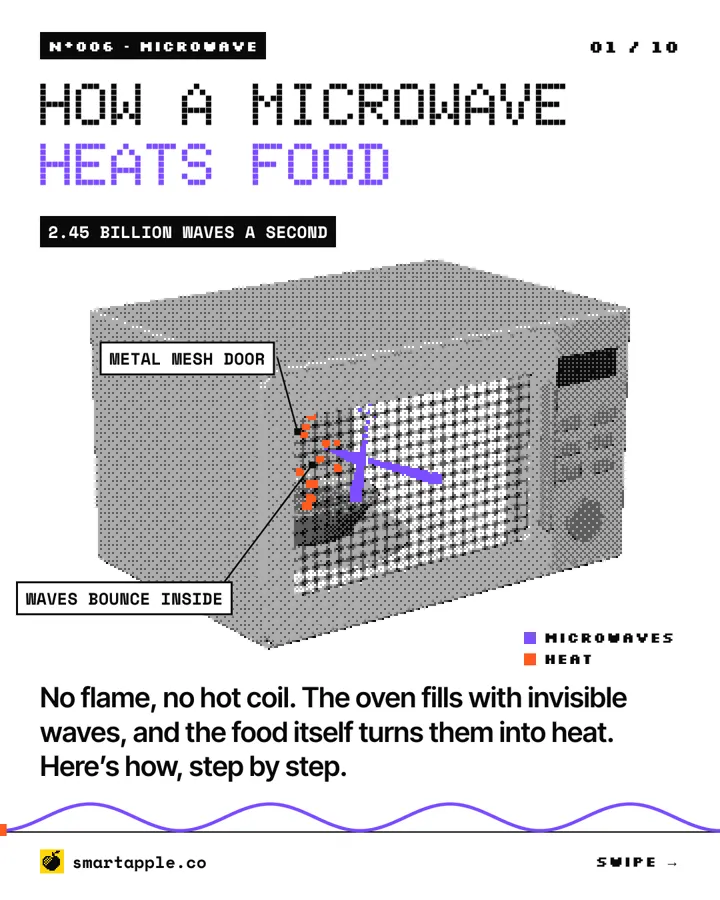
炎も熱いコイルもありません。庫内は目に見えない波で満たされ、食べ物自身がそれを熱に変えます。その仕組みを、順を追って見ていきましょう。
マイクロ波の発生源
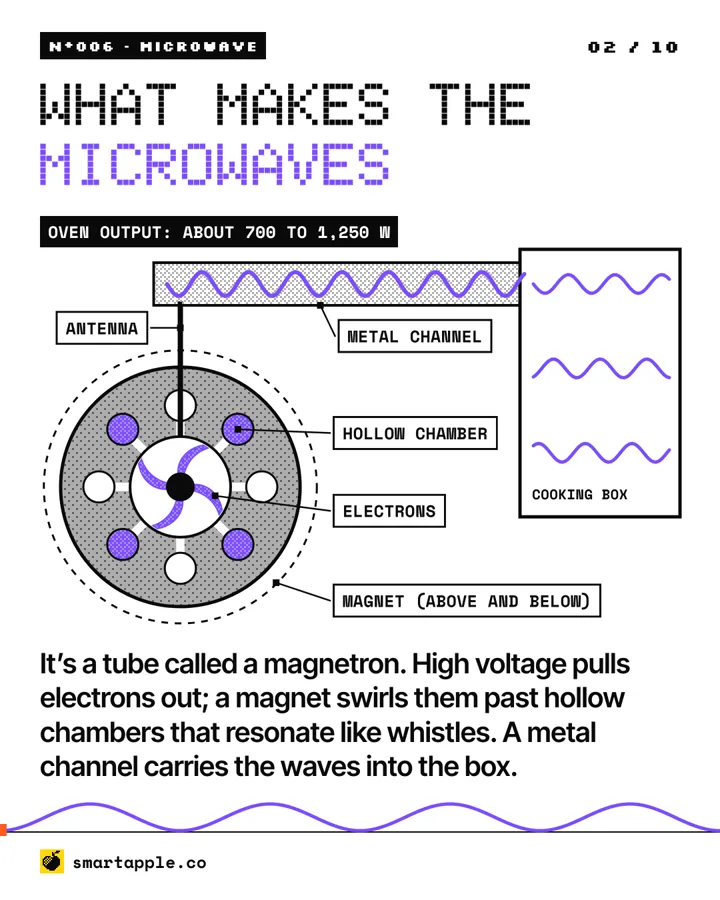
マグネトロンという真空管です。高電圧で電子を引き出し、磁石の力でその電子を渦のように回しながら、笛のように共鳴する空洞のそばを通過させます。金属の通路が、その波を庫内へ運びます。
水が波を熱に変える仕組み
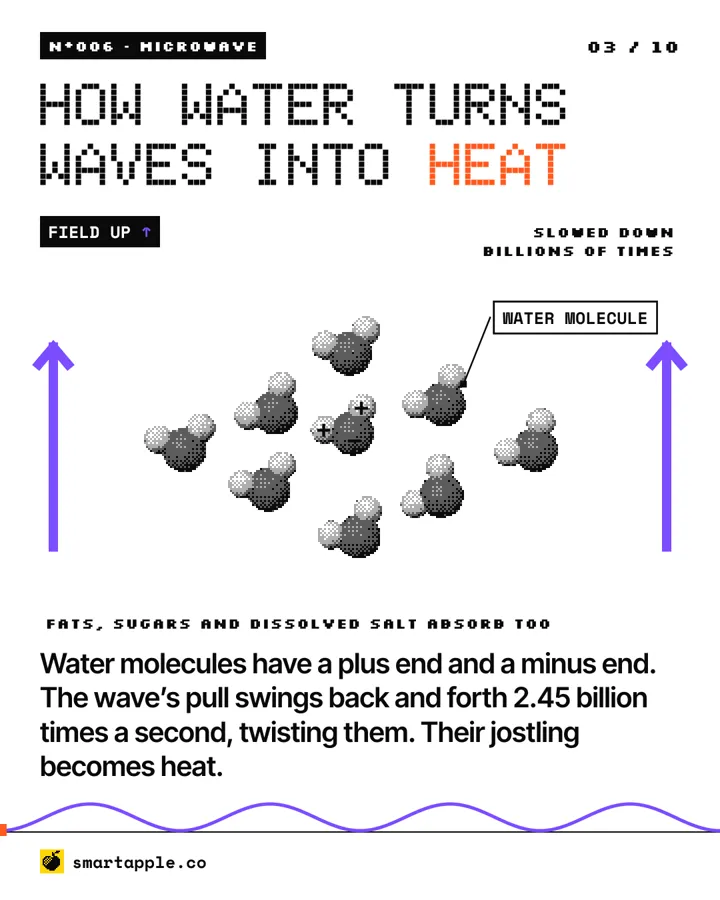
水分子には、プラスの端とマイナスの端があります。波の引っ張る力が1秒間に24億5000万回往復し、水分子をねじります。水分子どうしのもみ合いが、熱になります。
電子レンジが2.45 GHzを使う理由
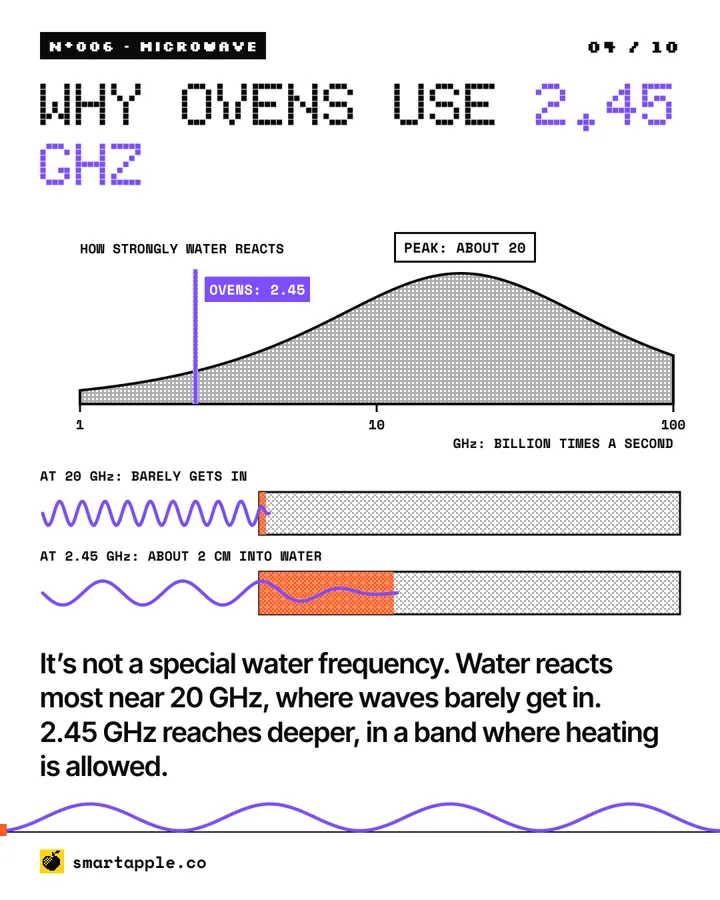
水にとって特別な周波数というわけではありません。水がもっとも強く反応するのは20 GHz付近ですが、その周波数の波はほとんど中に入りません。2.45 GHzはより深くまで届き、加熱への利用が認められている周波数帯にあります。
波が届く深さ
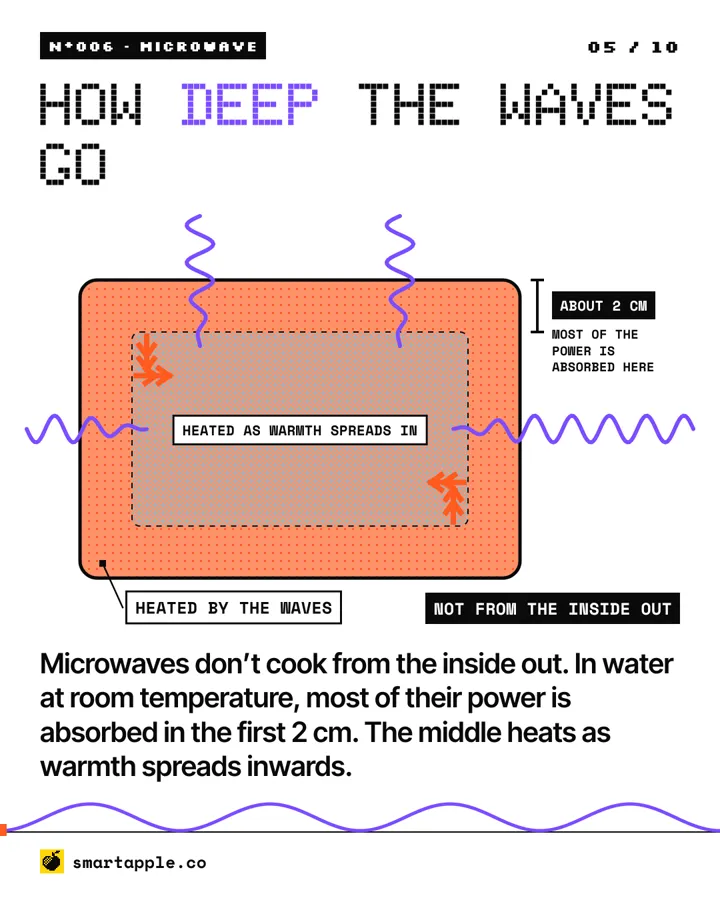
マイクロ波は、食べ物を内側から加熱するわけではありません。室温の水では、マイクロ波のエネルギーの大部分が表面から2 cmまでで吸収されます。中心部は、熱が内側へ伝わることで温まります。
食べ物に冷たい部分が残る理由
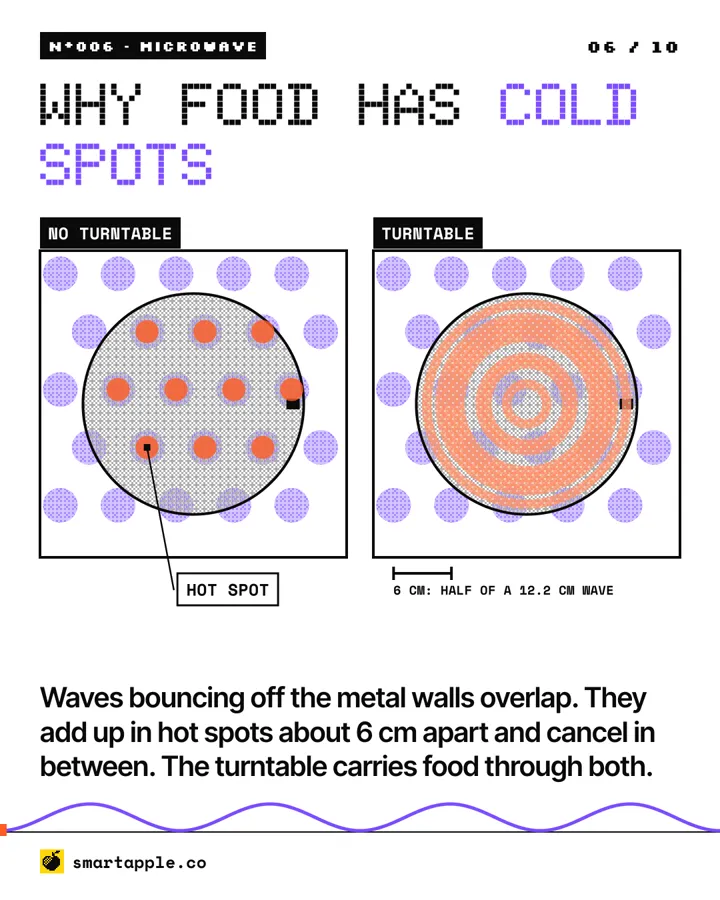
金属の壁ではね返った波が重なり合います。波は約6 cmおきに強め合って熱い場所をつくり、その間では打ち消し合います。ターンテーブルが、食べ物にその両方を通らせます。
凍った食べ物に加熱ムラが出る理由
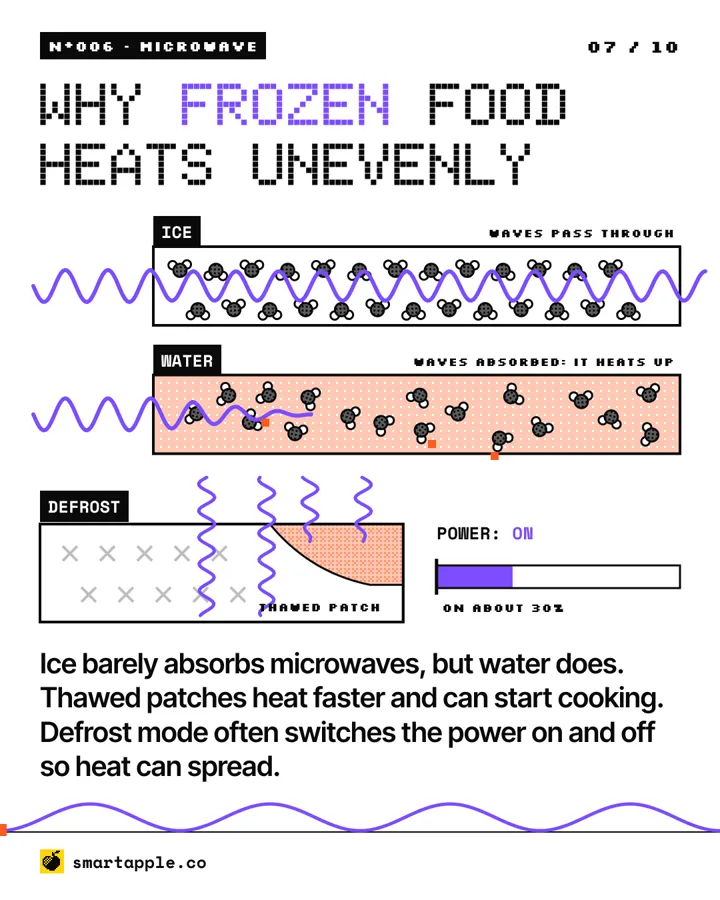
氷はマイクロ波をほとんど吸収しませんが、水は吸収します。解けた部分は速く温まり、火が通り始めることもあります。解凍モードでは、熱が広がるように、出力をオンとオフに切り替えることがよくあります。
一部の金属で火花が出る理由
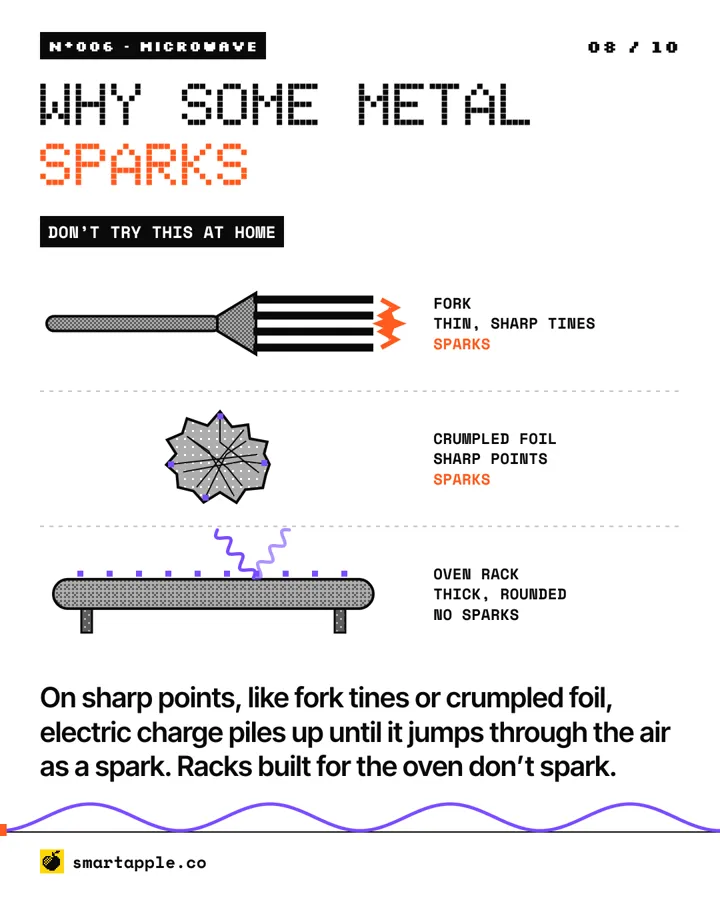
フォークの先やくしゃくしゃにしたアルミホイルのように、とがった部分には電荷がたまり、やがて火花となって空気中を飛びます。その電子レンジ専用につくられたラックでは、火花は出ません。
波が庫内にとどまる理由
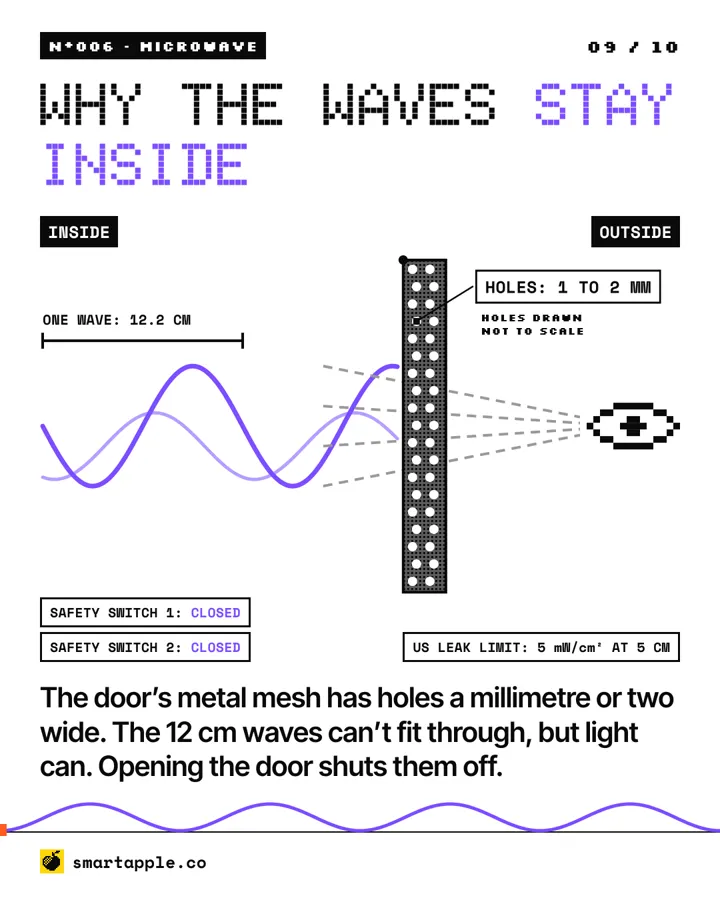
扉の金属メッシュには、幅1~2 mmほどの穴があいています。波長12 cmの波はそこを通り抜けられませんが、光は通れます。扉を開けると、波は止まります。
こういう仕組みです。
登場する電子レンジは一般的なデザインです。スポンサーはついていません。加熱の途中でかき混ぜ、加熱後は少し置いて、金属についてはお使いの電子レンジの取扱説明書に従ってください。
登場する機器は一般的なイラストであり、実在の製品ではありません。スポンサーはついていません。
Smart Appleは独立して運営されており、Apple Inc.とも、ストーリーに製品が登場するいかなる企業とも提携関係にありません。
AIツールの力を借りて制作し、一次資料と照らし合わせて確認しています。動画にはコンテンツ認証情報(Content Credentials、C2PA)が付いています。
出典
スライド 1 / 10
- Ovens run at 2.45 GHz (2,450 MHz); the waves bounce off the metal walls; the food absorbs thembritannica.com
- Ovens run at 2.45 GHz (2,450 MHz); the waves bounce off the metal walls; the food absorbs themfda.gov
- Ovens run at 2.45 GHz (2,450 MHz); the waves bounce off the metal walls; the food absorbs themitu.int
スライド 2 / 10
- A magnetron makes the waves: high voltage drives electrons from the centre outwards, a magnet swirls them past resonant cavities, an antenna and a metal channel (waveguide) carry the waves to the cavityhyperphysics.gsu.edu
- A magnetron makes the waves: high voltage drives electrons from the centre outwards, a magnet swirls them past resonant cavities, an antenna and a metal channel (waveguide) carry the waves to the cavitybritannica.com
- A magnetron makes the waves: high voltage drives electrons from the centre outwards, a magnet swirls them past resonant cavities, an antenna and a metal channel (waveguide) carry the waves to the cavityrpaulsingh.com
- Home ovens put out about 700 to 1,250 W (rated cooking power)consumerreports.org
スライド 3 / 10
- Water molecules are polar; the oscillating field twists them and they lag behind; their collisions turn this into heat; fats, sugars and dissolved salts absorb toowater.lsbu.ac.uk
- Water molecules are polar; the oscillating field twists them and they lag behind; their collisions turn this into heat; fats, sugars and dissolved salts absorb toowtamu.edu
- Water molecules are polar; the oscillating field twists them and they lag behind; their collisions turn this into heat; fats, sugars and dissolved salts absorb toobritannica.com
- Water molecules are polar; the oscillating field twists them and they lag behind; their collisions turn this into heat; fats, sugars and dissolved salts absorb toocfs.gov.hk
- The animation shows 4 field cycles in 6.4 s against 2.45 billion a second: slowed down billions of timesCalculation from the cited figures
スライド 4 / 10
- Not a special water frequency: water's dielectric loss peaks near 20 GHz (a broad relaxation), where waves are absorbed in the first layer; 2.45 GHz sits in the 2,400 to 2,500 MHz ISM bandarxiv.org
- Not a special water frequency: water's dielectric loss peaks near 20 GHz (a broad relaxation), where waves are absorbed in the first layer; 2.45 GHz sits in the 2,400 to 2,500 MHz ISM bandwater.lsbu.ac.uk
- Not a special water frequency: water's dielectric loss peaks near 20 GHz (a broad relaxation), where waves are absorbed in the first layer; 2.45 GHz sits in the 2,400 to 2,500 MHz ISM banditu.int
- Not a special water frequency: water's dielectric loss peaks near 20 GHz (a broad relaxation), where waves are absorbed in the first layer; 2.45 GHz sits in the 2,400 to 2,500 MHz ISM bandecfr.gov
スライド 5 / 10
- Not from the inside out: outer layers are heated by the microwaves, the inside mainly by conductionfda.gov
スライド 6 / 10
- Reflected waves form hot spots about half a wavelength (about 6 cm) apart; the wavelength is about 12.2 cm; the turntable moves food through them; cold spots remain, so stir and let food standphysics.umd.edu
- Reflected waves form hot spots about half a wavelength (about 6 cm) apart; the wavelength is about 12.2 cm; the turntable moves food through them; cold spots remain, so stir and let food standitu.int
- Reflected waves form hot spots about half a wavelength (about 6 cm) apart; the wavelength is about 12.2 cm; the turntable moves food through them; cold spots remain, so stir and let food standconsumerreports.org
- Reflected waves form hot spots about half a wavelength (about 6 cm) apart; the wavelength is about 12.2 cm; the turntable moves food through them; cold spots remain, so stir and let food standgovinfo.gov
スライド 7 / 10
- Ice is almost transparent to microwaves; thawed parts heat faster ("runaway heating") and can start cooking; defrost settings often cycle full power on and off (about 30%) so heat can spreadwater.lsbu.ac.uk
- Ice is almost transparent to microwaves; thawed parts heat faster ("runaway heating") and can start cooking; defrost settings often cycle full power on and off (about 30%) so heat can spreadintechopen.com
- Ice is almost transparent to microwaves; thawed parts heat faster ("runaway heating") and can start cooking; defrost settings often cycle full power on and off (about 30%) so heat can spreadpatents.google.com
- Ice is almost transparent to microwaves; thawed parts heat faster ("runaway heating") and can start cooking; defrost settings often cycle full power on and off (about 30%) so heat can spreadpatents.google.com
- Ice is almost transparent to microwaves; thawed parts heat faster ("runaway heating") and can start cooking; defrost settings often cycle full power on and off (about 30%) so heat can spreadfood.unl.edu
スライド 8 / 10
- On thin, sharp metal (fork tines, crumpled foil) charge piles up and the air breaks down into a spark; thick, blunt racks built for the oven reflect the waves safelyscienceupdate.com
- On thin, sharp metal (fork tines, crumpled foil) charge piles up and the air breaks down into a spark; thick, blunt racks built for the oven reflect the waves safelylivescience.com
スライド 9 / 10
- The door mesh has holes of about 1 mm (some screens use about 1.6 mm); the waves are about 120 times bigger, light passes; ovens must have two interlocks that stop the waves when the door openshyperphysics.gsu.edu
- The door mesh has holes of about 1 mm (some screens use about 1.6 mm); the waves are about 120 times bigger, light passes; ovens must have two interlocks that stop the waves when the door openspatents.google.com
- The door mesh has holes of about 1 mm (some screens use about 1.6 mm); the waves are about 120 times bigger, light passes; ovens must have two interlocks that stop the waves when the door opensvan.physics.illinois.edu
- The door mesh has holes of about 1 mm (some screens use about 1.6 mm); the waves are about 120 times bigger, light passes; ovens must have two interlocks that stop the waves when the door opensecfr.gov
- US leakage limit: 5 mW/cm² at 5 cm over the oven's lifetime (1 mW/cm² before sale)ecfr.gov
- US leakage limit: 5 mW/cm² at 5 cm over the oven's lifetime (1 mW/cm² before sale)fda.gov
- In water at room temperature, most of the power is absorbed in the first 2 cm (penetration depth about 1.4 cm with Chaplin's values, about 1.7 to 1.9 cm with current loss data; either way more than half is absorbed by 2 cm)water.lsbu.ac.uk
- In water at room temperature, most of the power is absorbed in the first 2 cm (penetration depth about 1.4 cm with Chaplin's values, about 1.7 to 1.9 cm with current loss data; either way more than half is absorbed by 2 cm)chimia.ch
- In water at room temperature, most of the power is absorbed in the first 2 cm (penetration depth about 1.4 cm with Chaplin's values, about 1.7 to 1.9 cm with current loss data; either way more than half is absorbed by 2 cm)hyperphysics.gsu.edu