
Cómo un microondas calienta la comida
Sin llama. Sin resistencia caliente. Entonces, ¿cómo calienta tu comida un microondas?
Un tubo llamado magnetrón llena la caja metálica de ondas cuyo tirón oscila de un lado a otro 2450 millones de veces por segundo. Las moléculas de agua de la comida giran a su ritmo y convierten ese movimiento en calor, la mayor parte en los primeros 2 cm. El centro se calienta a medida que el calor se propaga hacia el interior, por eso importa revolver la comida y dejarla reposar.
Cómo un microondas calienta la comida
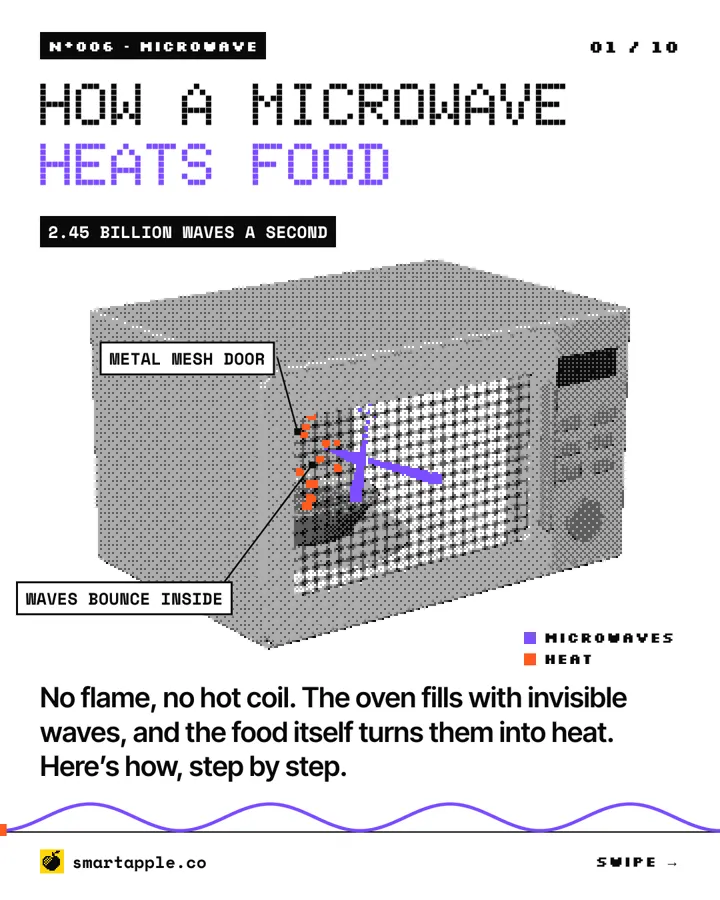
Sin llama ni resistencia caliente. El horno se llena de ondas invisibles, y es la propia comida la que las convierte en calor. Te explicamos cómo, paso a paso.
Qué produce las microondas
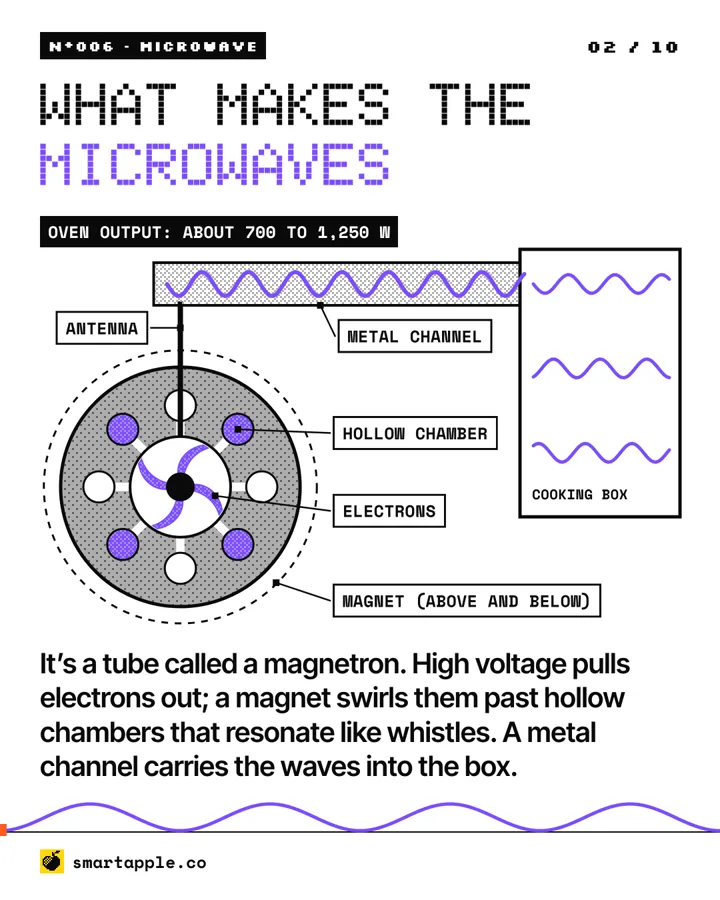
Es un tubo llamado magnetrón. Un alto voltaje arranca electrones; un imán los hace girar frente a unas cámaras huecas que resuenan como silbatos. Un conducto metálico lleva las ondas hasta la caja.
Cómo el agua convierte las ondas en calor
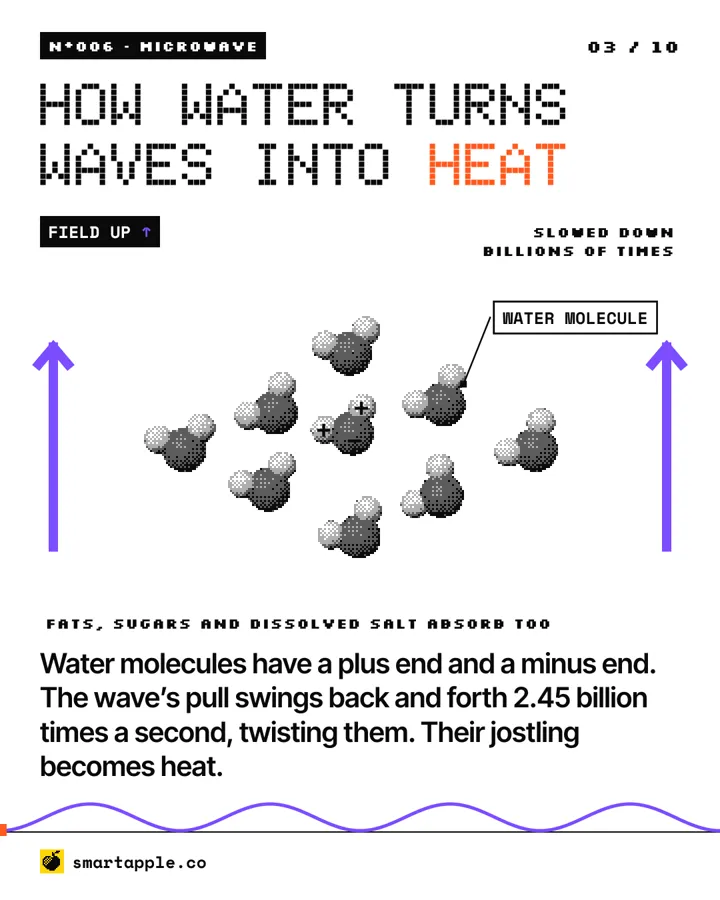
Las moléculas de agua tienen un extremo positivo y otro negativo. El tirón de la onda oscila de un lado a otro 2450 millones de veces por segundo y las hace girar. Sus empujones se convierten en calor.
Por qué los microondas usan 2,45 GHz
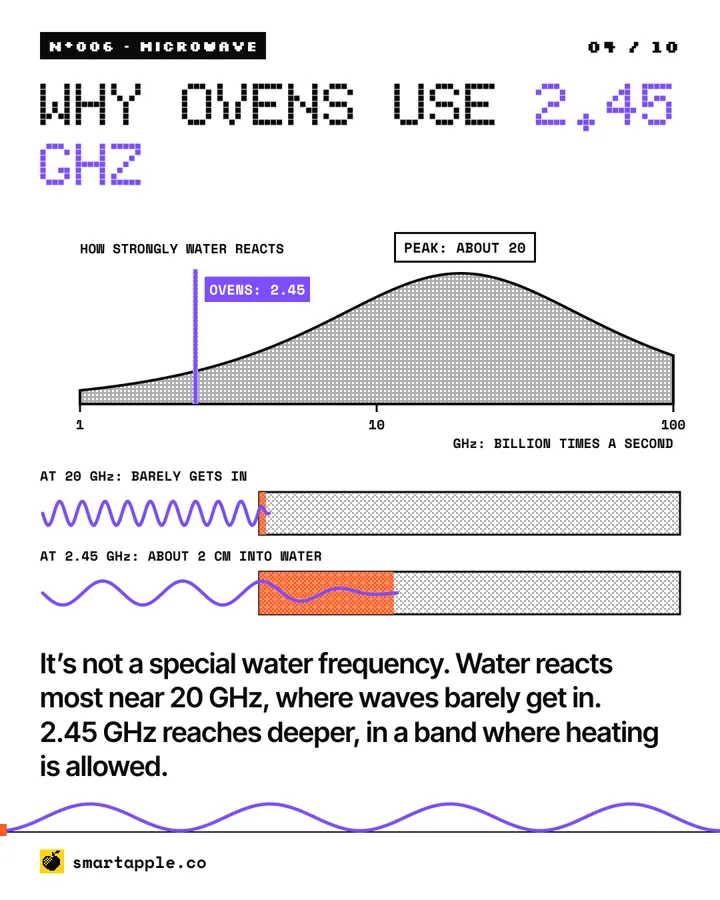
No es una frecuencia especial del agua. El agua reacciona al máximo cerca de 20 GHz, donde las ondas apenas entran. La frecuencia de 2,45 GHz llega más hondo, en una banda en la que se permite calentar.
Cuánto penetran las ondas
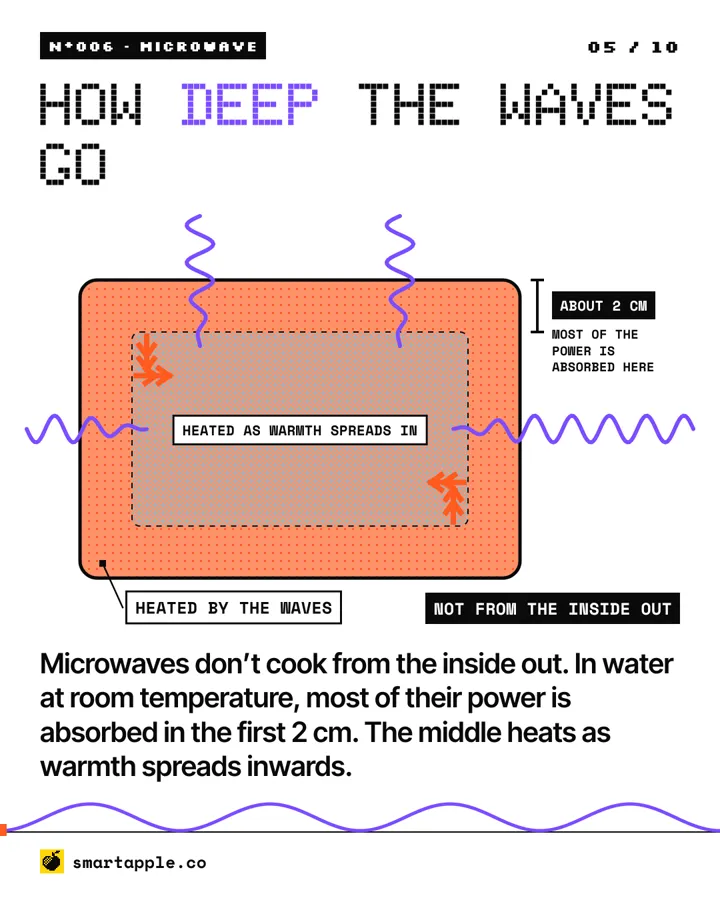
Las microondas no cocinan del interior al exterior. En agua a temperatura ambiente, la mayor parte de su potencia se absorbe en los primeros 2 cm. El centro se calienta a medida que el calor se propaga hacia el interior.
Por qué la comida tiene zonas frías
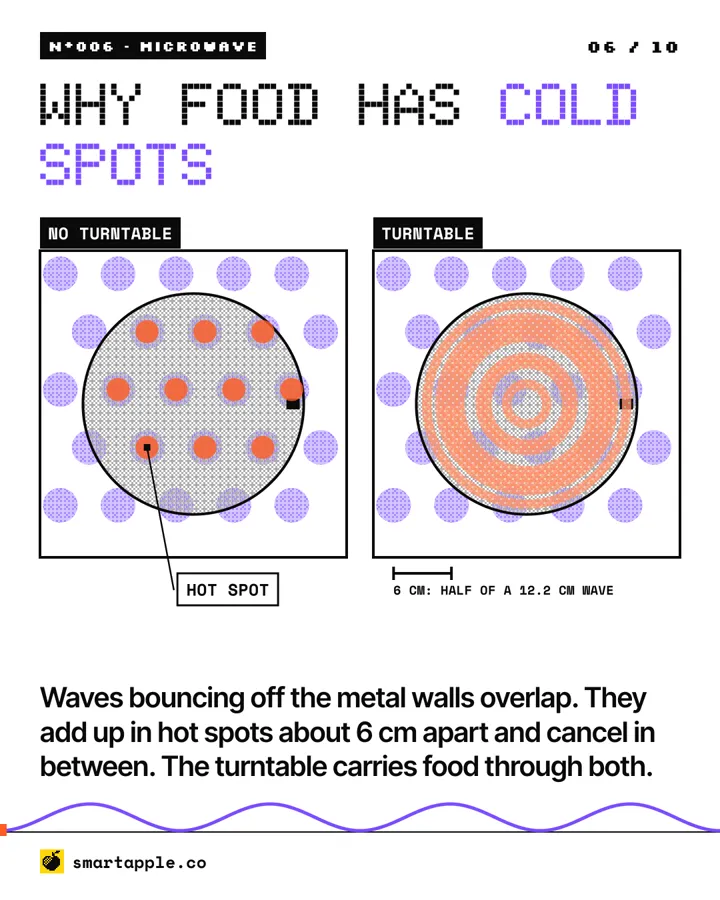
Las ondas que rebotan en las paredes de metal se superponen. Se suman en zonas calientes, separadas unos 6 cm, y se anulan en las zonas intermedias. El plato giratorio pasa la comida por ambas.
Por qué lo congelado no se calienta por igual
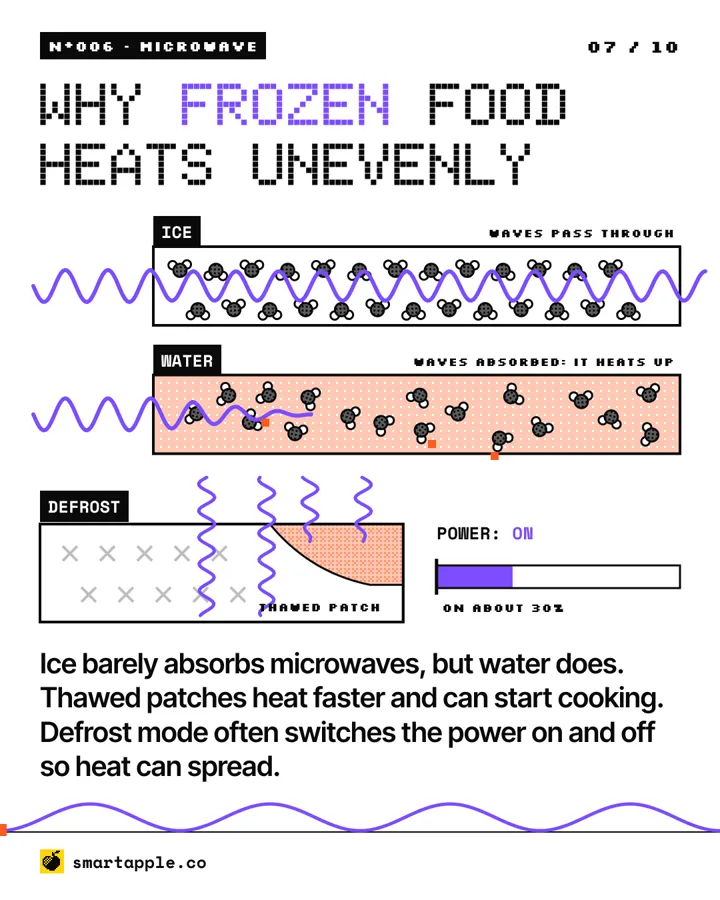
El hielo apenas absorbe las microondas, pero el agua sí. Las zonas descongeladas se calientan más rápido y pueden empezar a cocinarse. A menudo, el modo de descongelación enciende y apaga la potencia para que el calor se reparta.
Por qué algunos metales hacen chispas
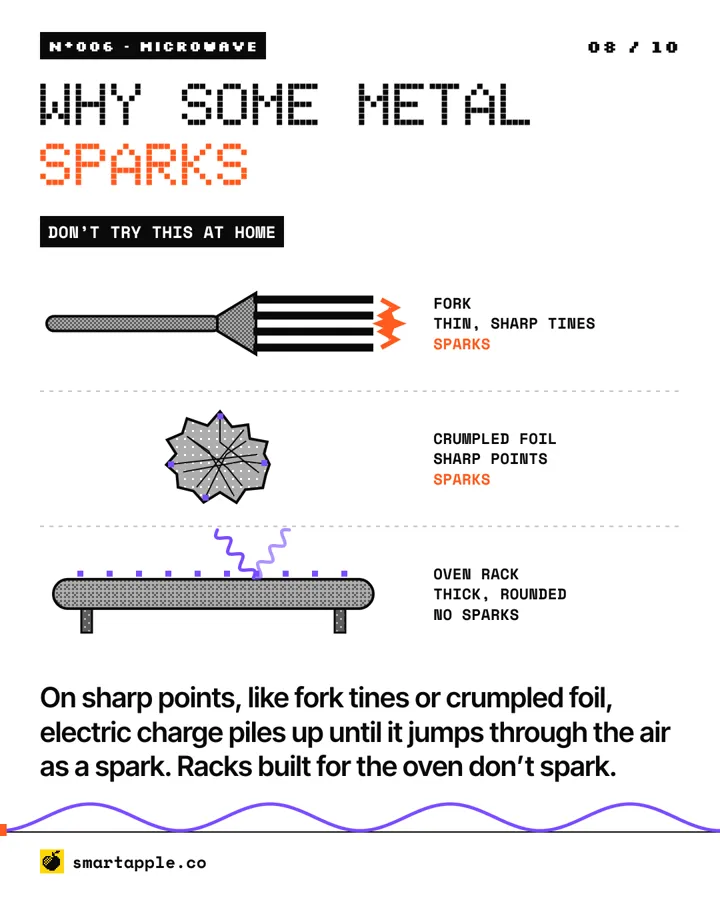
En las puntas afiladas, como los dientes de un tenedor o el papel de aluminio arrugado, la carga eléctrica se acumula hasta que salta por el aire en forma de chispa. Las rejillas hechas para el microondas no hacen chispas.
Por qué las ondas no salen
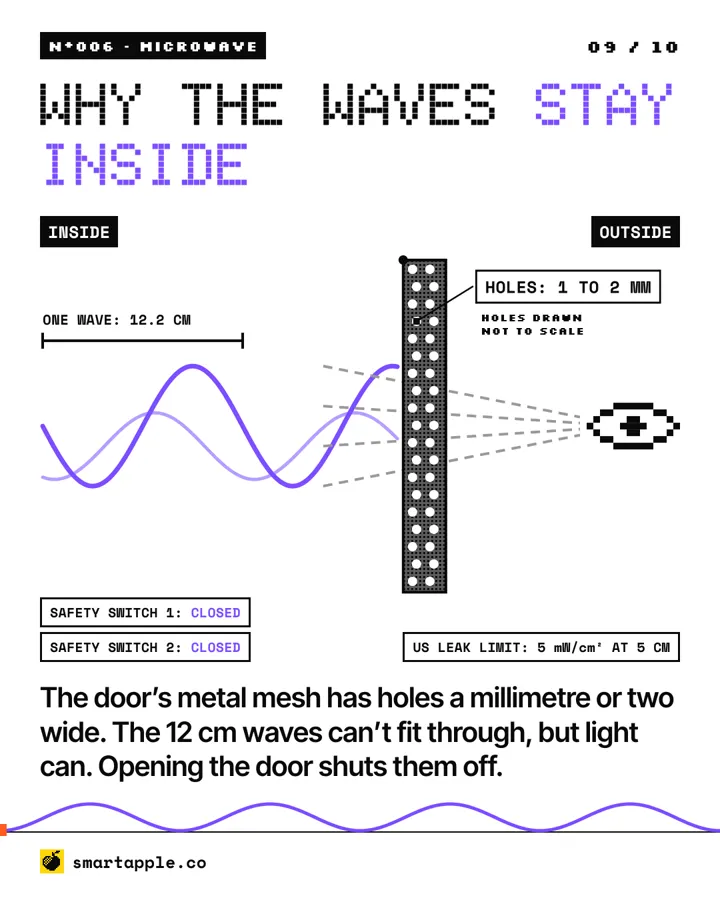
La malla metálica de la puerta tiene agujeros de uno o dos milímetros de ancho. Las ondas de 12 cm no caben por ellos, pero la luz sí. Al abrir la puerta, se cortan.
Así es como funciona.
El microondas que se muestra es un diseño genérico. Sin patrocinio. Revuelve a mitad de cocción, deja reposar la comida y sigue el manual de tu microondas sobre el metal.
Los dispositivos que se muestran son ilustraciones genéricas, no productos reales. Sin patrocinio.
Smart Apple es independiente y no tiene vínculos con Apple Inc. ni con ninguna empresa cuyos productos aparezcan en nuestras historias.
Hecho con ayuda de herramientas de IA y contrastado con fuentes primarias. Los videos llevan credenciales de contenido (Content Credentials, C2PA).
Fuentes
Diapositiva 1 de 10
- Ovens run at 2.45 GHz (2,450 MHz); the waves bounce off the metal walls; the food absorbs thembritannica.com
- Ovens run at 2.45 GHz (2,450 MHz); the waves bounce off the metal walls; the food absorbs themfda.gov
- Ovens run at 2.45 GHz (2,450 MHz); the waves bounce off the metal walls; the food absorbs themitu.int
Diapositiva 2 de 10
- A magnetron makes the waves: high voltage drives electrons from the centre outwards, a magnet swirls them past resonant cavities, an antenna and a metal channel (waveguide) carry the waves to the cavityhyperphysics.gsu.edu
- A magnetron makes the waves: high voltage drives electrons from the centre outwards, a magnet swirls them past resonant cavities, an antenna and a metal channel (waveguide) carry the waves to the cavitybritannica.com
- A magnetron makes the waves: high voltage drives electrons from the centre outwards, a magnet swirls them past resonant cavities, an antenna and a metal channel (waveguide) carry the waves to the cavityrpaulsingh.com
- Home ovens put out about 700 to 1,250 W (rated cooking power)consumerreports.org
Diapositiva 3 de 10
- Water molecules are polar; the oscillating field twists them and they lag behind; their collisions turn this into heat; fats, sugars and dissolved salts absorb toowater.lsbu.ac.uk
- Water molecules are polar; the oscillating field twists them and they lag behind; their collisions turn this into heat; fats, sugars and dissolved salts absorb toowtamu.edu
- Water molecules are polar; the oscillating field twists them and they lag behind; their collisions turn this into heat; fats, sugars and dissolved salts absorb toobritannica.com
- Water molecules are polar; the oscillating field twists them and they lag behind; their collisions turn this into heat; fats, sugars and dissolved salts absorb toocfs.gov.hk
- The animation shows 4 field cycles in 6.4 s against 2.45 billion a second: slowed down billions of timesCalculation from the cited figures
Diapositiva 4 de 10
- Not a special water frequency: water's dielectric loss peaks near 20 GHz (a broad relaxation), where waves are absorbed in the first layer; 2.45 GHz sits in the 2,400 to 2,500 MHz ISM bandarxiv.org
- Not a special water frequency: water's dielectric loss peaks near 20 GHz (a broad relaxation), where waves are absorbed in the first layer; 2.45 GHz sits in the 2,400 to 2,500 MHz ISM bandwater.lsbu.ac.uk
- Not a special water frequency: water's dielectric loss peaks near 20 GHz (a broad relaxation), where waves are absorbed in the first layer; 2.45 GHz sits in the 2,400 to 2,500 MHz ISM banditu.int
- Not a special water frequency: water's dielectric loss peaks near 20 GHz (a broad relaxation), where waves are absorbed in the first layer; 2.45 GHz sits in the 2,400 to 2,500 MHz ISM bandecfr.gov
Diapositiva 5 de 10
- Not from the inside out: outer layers are heated by the microwaves, the inside mainly by conductionfda.gov
Diapositiva 6 de 10
- Reflected waves form hot spots about half a wavelength (about 6 cm) apart; the wavelength is about 12.2 cm; the turntable moves food through them; cold spots remain, so stir and let food standphysics.umd.edu
- Reflected waves form hot spots about half a wavelength (about 6 cm) apart; the wavelength is about 12.2 cm; the turntable moves food through them; cold spots remain, so stir and let food standitu.int
- Reflected waves form hot spots about half a wavelength (about 6 cm) apart; the wavelength is about 12.2 cm; the turntable moves food through them; cold spots remain, so stir and let food standconsumerreports.org
- Reflected waves form hot spots about half a wavelength (about 6 cm) apart; the wavelength is about 12.2 cm; the turntable moves food through them; cold spots remain, so stir and let food standgovinfo.gov
Diapositiva 7 de 10
- Ice is almost transparent to microwaves; thawed parts heat faster ("runaway heating") and can start cooking; defrost settings often cycle full power on and off (about 30%) so heat can spreadwater.lsbu.ac.uk
- Ice is almost transparent to microwaves; thawed parts heat faster ("runaway heating") and can start cooking; defrost settings often cycle full power on and off (about 30%) so heat can spreadintechopen.com
- Ice is almost transparent to microwaves; thawed parts heat faster ("runaway heating") and can start cooking; defrost settings often cycle full power on and off (about 30%) so heat can spreadpatents.google.com
- Ice is almost transparent to microwaves; thawed parts heat faster ("runaway heating") and can start cooking; defrost settings often cycle full power on and off (about 30%) so heat can spreadpatents.google.com
- Ice is almost transparent to microwaves; thawed parts heat faster ("runaway heating") and can start cooking; defrost settings often cycle full power on and off (about 30%) so heat can spreadfood.unl.edu
Diapositiva 8 de 10
- On thin, sharp metal (fork tines, crumpled foil) charge piles up and the air breaks down into a spark; thick, blunt racks built for the oven reflect the waves safelyscienceupdate.com
- On thin, sharp metal (fork tines, crumpled foil) charge piles up and the air breaks down into a spark; thick, blunt racks built for the oven reflect the waves safelylivescience.com
Diapositiva 9 de 10
- The door mesh has holes of about 1 mm (some screens use about 1.6 mm); the waves are about 120 times bigger, light passes; ovens must have two interlocks that stop the waves when the door openshyperphysics.gsu.edu
- The door mesh has holes of about 1 mm (some screens use about 1.6 mm); the waves are about 120 times bigger, light passes; ovens must have two interlocks that stop the waves when the door openspatents.google.com
- The door mesh has holes of about 1 mm (some screens use about 1.6 mm); the waves are about 120 times bigger, light passes; ovens must have two interlocks that stop the waves when the door opensvan.physics.illinois.edu
- The door mesh has holes of about 1 mm (some screens use about 1.6 mm); the waves are about 120 times bigger, light passes; ovens must have two interlocks that stop the waves when the door opensecfr.gov
- US leakage limit: 5 mW/cm² at 5 cm over the oven's lifetime (1 mW/cm² before sale)ecfr.gov
- US leakage limit: 5 mW/cm² at 5 cm over the oven's lifetime (1 mW/cm² before sale)fda.gov
- In water at room temperature, most of the power is absorbed in the first 2 cm (penetration depth about 1.4 cm with Chaplin's values, about 1.7 to 1.9 cm with current loss data; either way more than half is absorbed by 2 cm)water.lsbu.ac.uk
- In water at room temperature, most of the power is absorbed in the first 2 cm (penetration depth about 1.4 cm with Chaplin's values, about 1.7 to 1.9 cm with current loss data; either way more than half is absorbed by 2 cm)chimia.ch
- In water at room temperature, most of the power is absorbed in the first 2 cm (penetration depth about 1.4 cm with Chaplin's values, about 1.7 to 1.9 cm with current loss data; either way more than half is absorbed by 2 cm)hyperphysics.gsu.edu