
Como o micro-ondas aquece a comida
Sem chama. Sem resistência quente. Então como o micro-ondas esquenta a sua comida?
Um tubo chamado magnetron enche a caixa de metal com ondas cuja força oscila para lá e para cá 2,45 bilhões de vezes por segundo. As moléculas de água da comida giram junto e transformam esse movimento em calor, a maior parte nos primeiros 2 cm. O centro esquenta à medida que o calor se espalha para dentro, por isso mexer e deixar a comida descansar faz diferença.
Como o micro-ondas aquece a comida
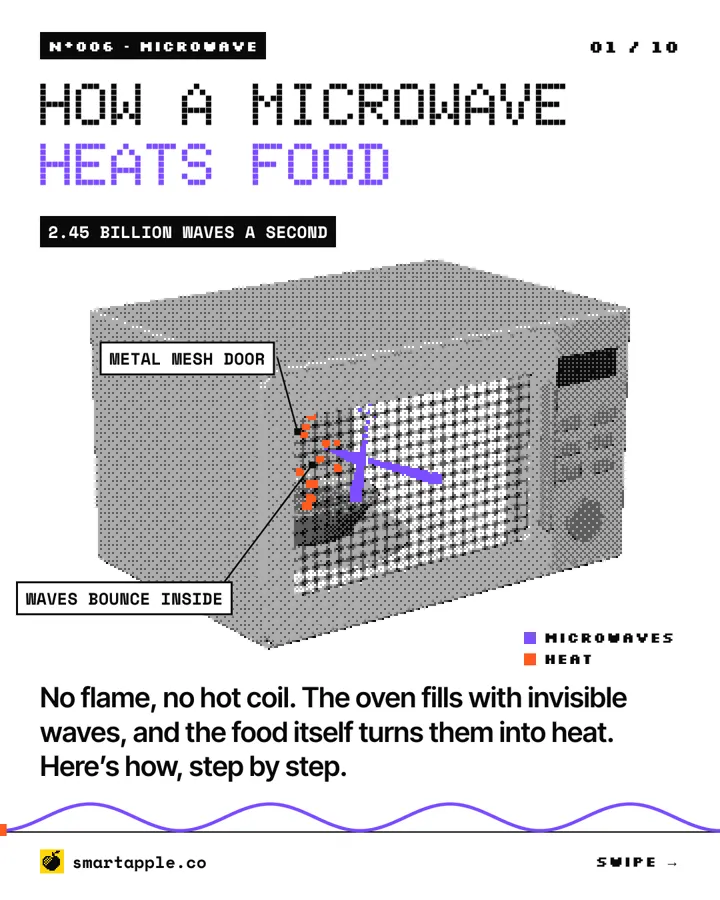
Sem chama, sem resistência quente. O forno se enche de ondas invisíveis, e a própria comida as transforma em calor. Veja como, passo a passo.
O que produz as micro-ondas
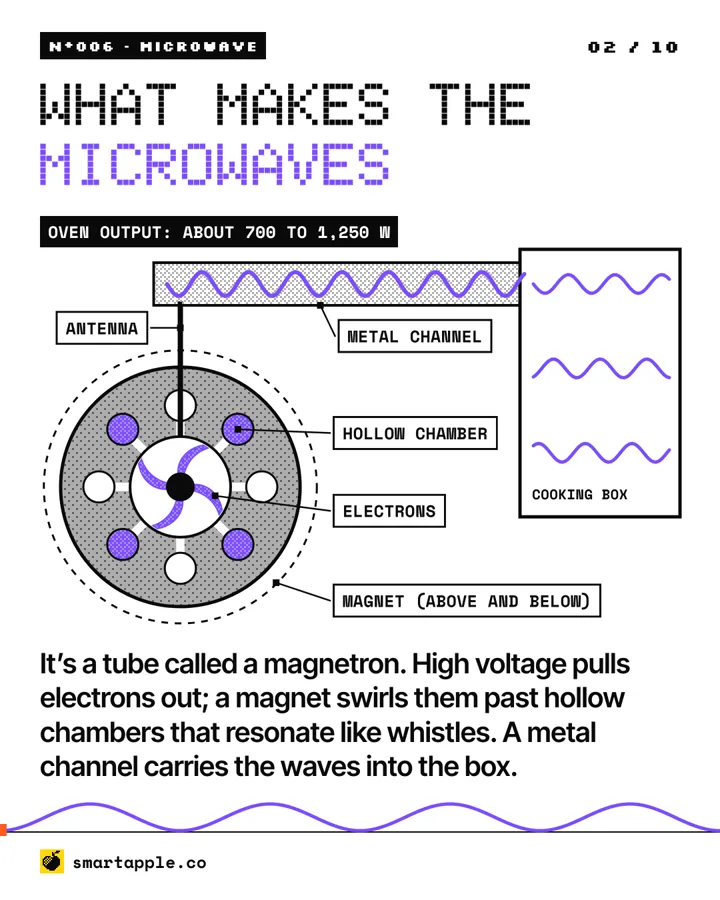
É um tubo chamado magnetron. A alta tensão arranca elétrons; um ímã os faz girar rente a câmaras ocas que ressoam como apitos. Um canal de metal leva as ondas até a caixa.
Como a água transforma ondas em calor
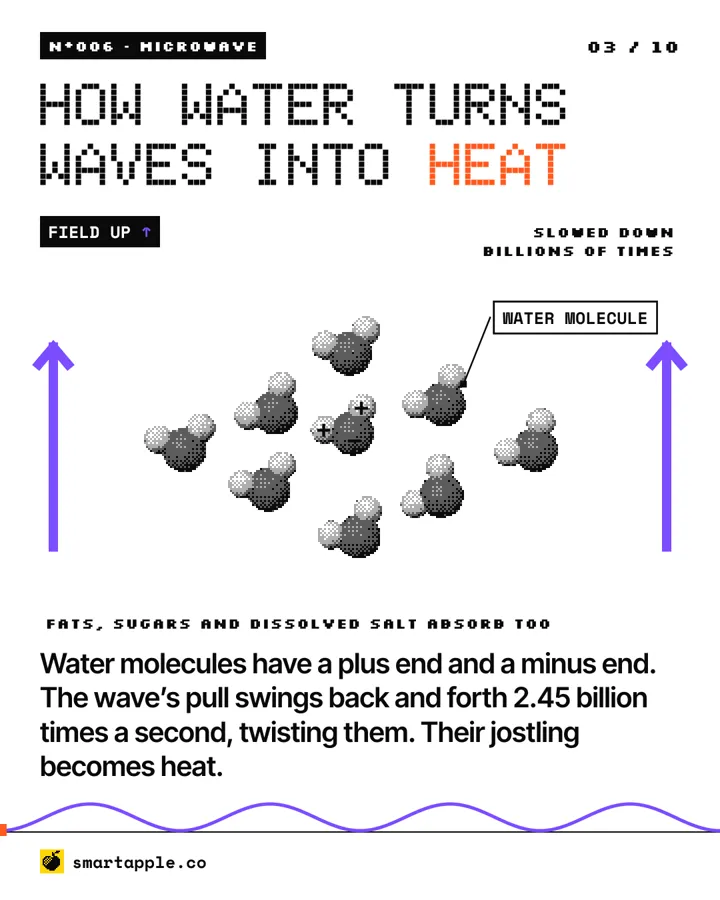
As moléculas de água têm uma ponta positiva e uma ponta negativa. A força da onda oscila para lá e para cá 2,45 bilhões de vezes por segundo e as faz girar. A agitação delas vira calor.
Por que os fornos usam 2,45 GHz
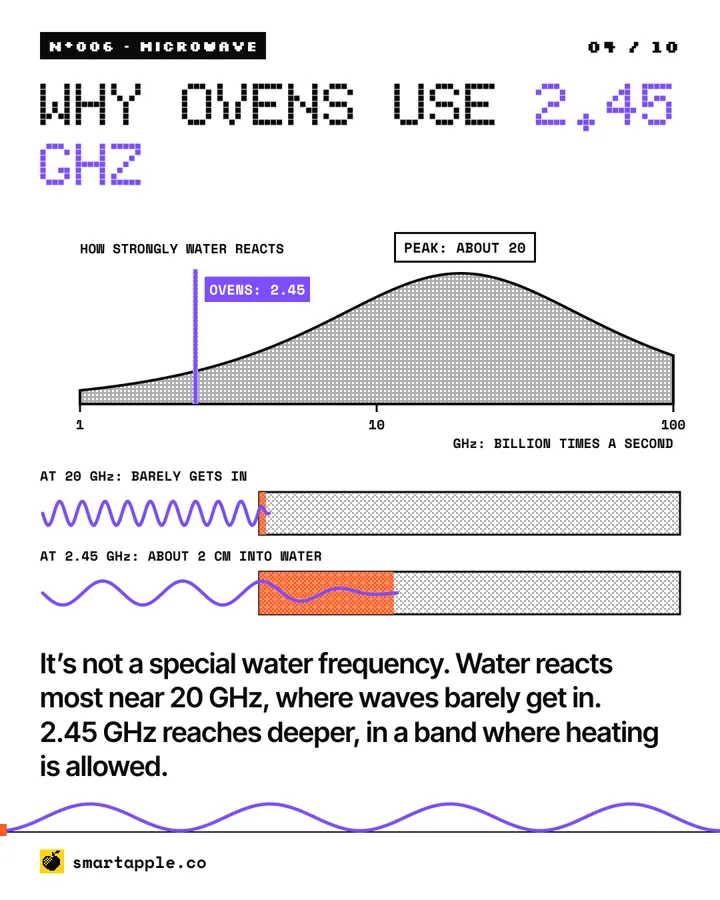
Não é uma frequência especial da água. A água reage mais perto de 20 GHz, onde as ondas mal conseguem entrar. Já a frequência de 2,45 GHz vai mais fundo, numa faixa em que o aquecimento é permitido.
Até que profundidade as ondas chegam
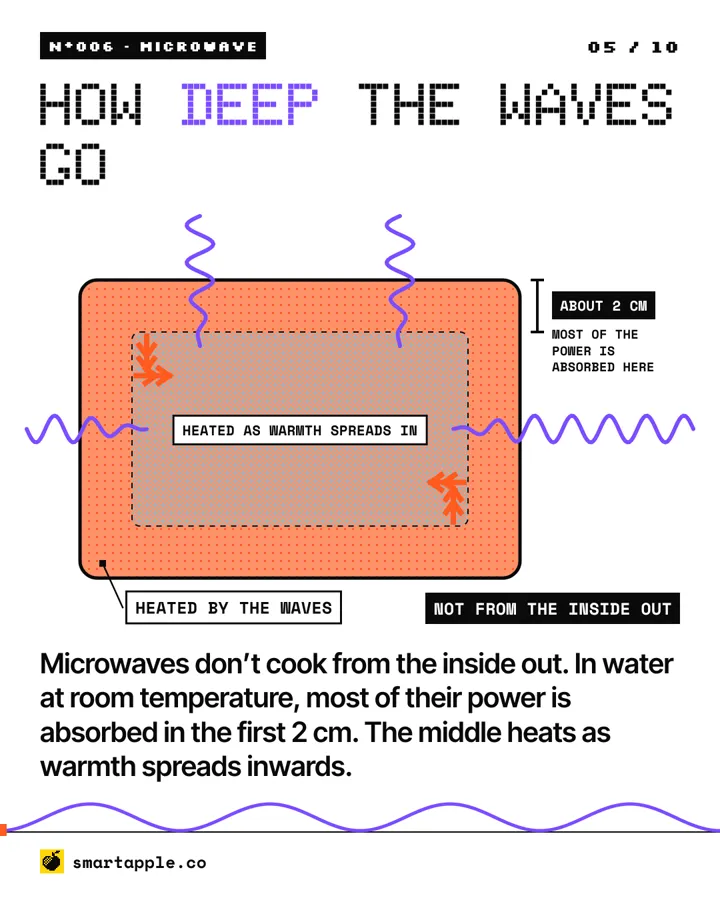
As micro-ondas não cozinham de dentro para fora. Na água à temperatura ambiente, a maior parte da potência delas é absorvida nos primeiros 2 cm. O centro esquenta à medida que o calor se espalha para dentro.
Por que a comida tem pontos frios
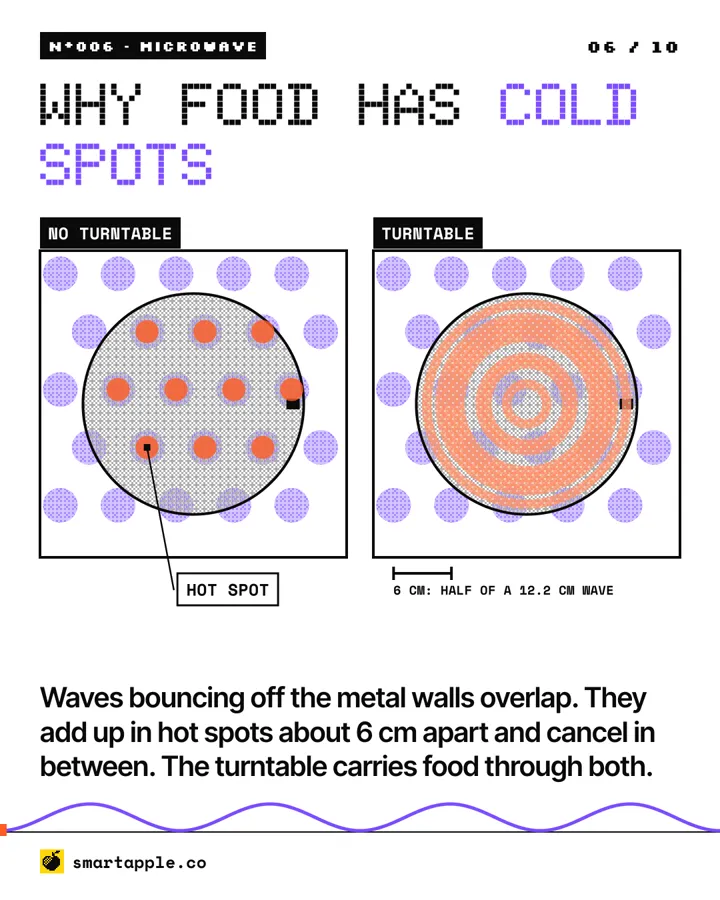
As ondas refletidas pelas paredes de metal se sobrepõem. Elas se somam em pontos quentes a cerca de 6 cm uns dos outros e se anulam entre eles. O prato giratório leva a comida pelos dois.
Por que comida congelada não esquenta por igual
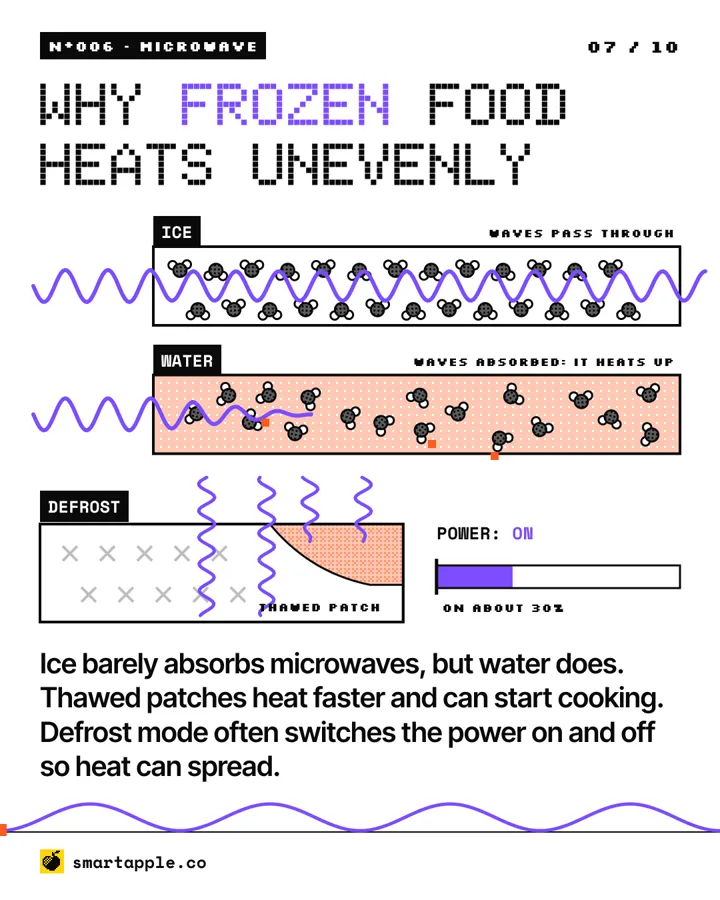
O gelo quase não absorve micro-ondas, mas a água absorve. Partes já descongeladas esquentam mais rápido e podem começar a cozinhar. O modo descongelar muitas vezes liga e desliga a potência para o calor se espalhar.
Por que alguns metais faíscam
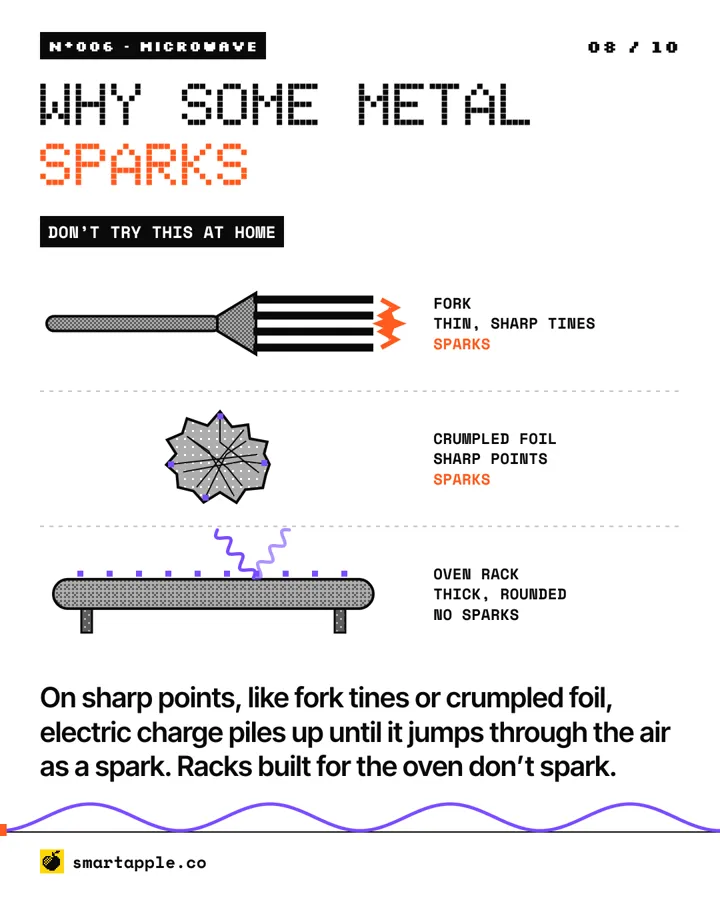
Em pontas finas, como os dentes de um garfo ou papel-alumínio amassado, a carga elétrica se acumula até saltar pelo ar como uma faísca. Grelhas feitas para o forno não faíscam.
Por que as ondas ficam lá dentro
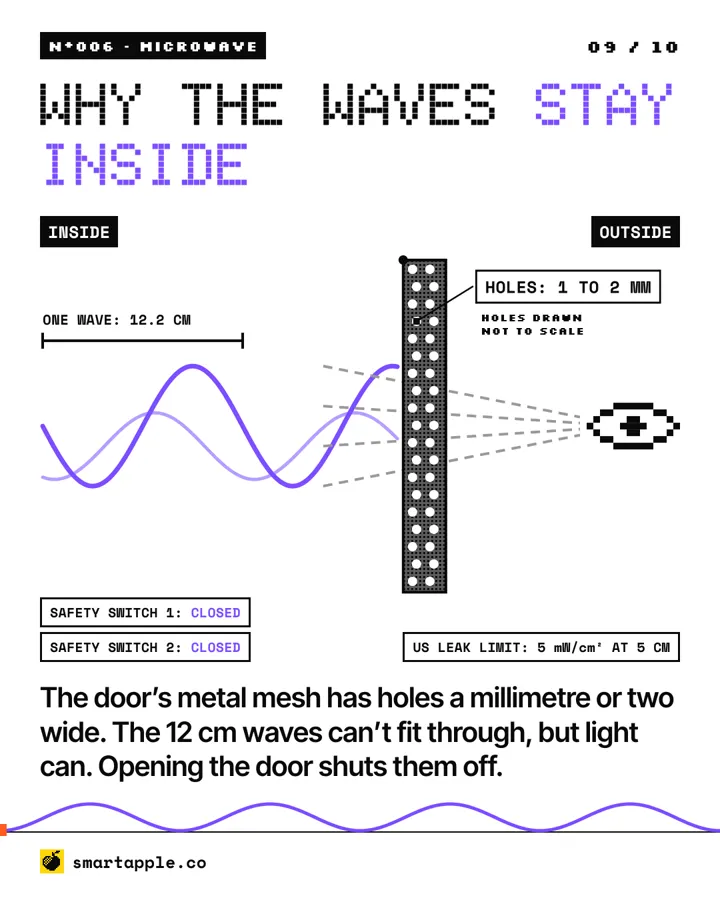
A tela de metal da porta tem furos de um ou dois milímetros de largura. As ondas de 12 cm não passam, mas a luz passa. Abrir a porta desliga as ondas.
É assim que funciona.
O forno mostrado tem design genérico. Sem patrocínio. Mexa na metade do tempo, deixe a comida descansar e siga o manual do seu forno sobre metais.
Os aparelhos mostrados são ilustrações genéricas, não produtos reais. Sem patrocínio.
O Smart Apple é independente e não tem vínculo com a Apple Inc. nem com nenhuma empresa cujos produtos aparecem nas nossas histórias.
Feito com a ajuda de ferramentas de IA e conferido com fontes primárias. Os vídeos trazem Content Credentials (C2PA).
Fontes
Slide 1 de 10
- Ovens run at 2.45 GHz (2,450 MHz); the waves bounce off the metal walls; the food absorbs thembritannica.com
- Ovens run at 2.45 GHz (2,450 MHz); the waves bounce off the metal walls; the food absorbs themfda.gov
- Ovens run at 2.45 GHz (2,450 MHz); the waves bounce off the metal walls; the food absorbs themitu.int
Slide 2 de 10
- A magnetron makes the waves: high voltage drives electrons from the centre outwards, a magnet swirls them past resonant cavities, an antenna and a metal channel (waveguide) carry the waves to the cavityhyperphysics.gsu.edu
- A magnetron makes the waves: high voltage drives electrons from the centre outwards, a magnet swirls them past resonant cavities, an antenna and a metal channel (waveguide) carry the waves to the cavitybritannica.com
- A magnetron makes the waves: high voltage drives electrons from the centre outwards, a magnet swirls them past resonant cavities, an antenna and a metal channel (waveguide) carry the waves to the cavityrpaulsingh.com
- Home ovens put out about 700 to 1,250 W (rated cooking power)consumerreports.org
Slide 3 de 10
- Water molecules are polar; the oscillating field twists them and they lag behind; their collisions turn this into heat; fats, sugars and dissolved salts absorb toowater.lsbu.ac.uk
- Water molecules are polar; the oscillating field twists them and they lag behind; their collisions turn this into heat; fats, sugars and dissolved salts absorb toowtamu.edu
- Water molecules are polar; the oscillating field twists them and they lag behind; their collisions turn this into heat; fats, sugars and dissolved salts absorb toobritannica.com
- Water molecules are polar; the oscillating field twists them and they lag behind; their collisions turn this into heat; fats, sugars and dissolved salts absorb toocfs.gov.hk
- The animation shows 4 field cycles in 6.4 s against 2.45 billion a second: slowed down billions of timesCalculation from the cited figures
Slide 4 de 10
- Not a special water frequency: water's dielectric loss peaks near 20 GHz (a broad relaxation), where waves are absorbed in the first layer; 2.45 GHz sits in the 2,400 to 2,500 MHz ISM bandarxiv.org
- Not a special water frequency: water's dielectric loss peaks near 20 GHz (a broad relaxation), where waves are absorbed in the first layer; 2.45 GHz sits in the 2,400 to 2,500 MHz ISM bandwater.lsbu.ac.uk
- Not a special water frequency: water's dielectric loss peaks near 20 GHz (a broad relaxation), where waves are absorbed in the first layer; 2.45 GHz sits in the 2,400 to 2,500 MHz ISM banditu.int
- Not a special water frequency: water's dielectric loss peaks near 20 GHz (a broad relaxation), where waves are absorbed in the first layer; 2.45 GHz sits in the 2,400 to 2,500 MHz ISM bandecfr.gov
Slide 5 de 10
- Not from the inside out: outer layers are heated by the microwaves, the inside mainly by conductionfda.gov
Slide 6 de 10
- Reflected waves form hot spots about half a wavelength (about 6 cm) apart; the wavelength is about 12.2 cm; the turntable moves food through them; cold spots remain, so stir and let food standphysics.umd.edu
- Reflected waves form hot spots about half a wavelength (about 6 cm) apart; the wavelength is about 12.2 cm; the turntable moves food through them; cold spots remain, so stir and let food standitu.int
- Reflected waves form hot spots about half a wavelength (about 6 cm) apart; the wavelength is about 12.2 cm; the turntable moves food through them; cold spots remain, so stir and let food standconsumerreports.org
- Reflected waves form hot spots about half a wavelength (about 6 cm) apart; the wavelength is about 12.2 cm; the turntable moves food through them; cold spots remain, so stir and let food standgovinfo.gov
Slide 7 de 10
- Ice is almost transparent to microwaves; thawed parts heat faster ("runaway heating") and can start cooking; defrost settings often cycle full power on and off (about 30%) so heat can spreadwater.lsbu.ac.uk
- Ice is almost transparent to microwaves; thawed parts heat faster ("runaway heating") and can start cooking; defrost settings often cycle full power on and off (about 30%) so heat can spreadintechopen.com
- Ice is almost transparent to microwaves; thawed parts heat faster ("runaway heating") and can start cooking; defrost settings often cycle full power on and off (about 30%) so heat can spreadpatents.google.com
- Ice is almost transparent to microwaves; thawed parts heat faster ("runaway heating") and can start cooking; defrost settings often cycle full power on and off (about 30%) so heat can spreadpatents.google.com
- Ice is almost transparent to microwaves; thawed parts heat faster ("runaway heating") and can start cooking; defrost settings often cycle full power on and off (about 30%) so heat can spreadfood.unl.edu
Slide 8 de 10
- On thin, sharp metal (fork tines, crumpled foil) charge piles up and the air breaks down into a spark; thick, blunt racks built for the oven reflect the waves safelyscienceupdate.com
- On thin, sharp metal (fork tines, crumpled foil) charge piles up and the air breaks down into a spark; thick, blunt racks built for the oven reflect the waves safelylivescience.com
Slide 9 de 10
- The door mesh has holes of about 1 mm (some screens use about 1.6 mm); the waves are about 120 times bigger, light passes; ovens must have two interlocks that stop the waves when the door openshyperphysics.gsu.edu
- The door mesh has holes of about 1 mm (some screens use about 1.6 mm); the waves are about 120 times bigger, light passes; ovens must have two interlocks that stop the waves when the door openspatents.google.com
- The door mesh has holes of about 1 mm (some screens use about 1.6 mm); the waves are about 120 times bigger, light passes; ovens must have two interlocks that stop the waves when the door opensvan.physics.illinois.edu
- The door mesh has holes of about 1 mm (some screens use about 1.6 mm); the waves are about 120 times bigger, light passes; ovens must have two interlocks that stop the waves when the door opensecfr.gov
- US leakage limit: 5 mW/cm² at 5 cm over the oven's lifetime (1 mW/cm² before sale)ecfr.gov
- US leakage limit: 5 mW/cm² at 5 cm over the oven's lifetime (1 mW/cm² before sale)fda.gov
- In water at room temperature, most of the power is absorbed in the first 2 cm (penetration depth about 1.4 cm with Chaplin's values, about 1.7 to 1.9 cm with current loss data; either way more than half is absorbed by 2 cm)water.lsbu.ac.uk
- In water at room temperature, most of the power is absorbed in the first 2 cm (penetration depth about 1.4 cm with Chaplin's values, about 1.7 to 1.9 cm with current loss data; either way more than half is absorbed by 2 cm)chimia.ch
- In water at room temperature, most of the power is absorbed in the first 2 cm (penetration depth about 1.4 cm with Chaplin's values, about 1.7 to 1.9 cm with current loss data; either way more than half is absorbed by 2 cm)hyperphysics.gsu.edu