
How your watch measures your heart rate
Your watch flashes green light into your skin hundreds of times a second. Here’s why.
·
On the back of a smartwatch, green LEDs flash into your skin and light sensors measure how much comes back. Blood absorbs green light, so each heartbeat dims the returning light by about 1%, and the time between those dips gives your heart rate.
How your watch measures your heart rate
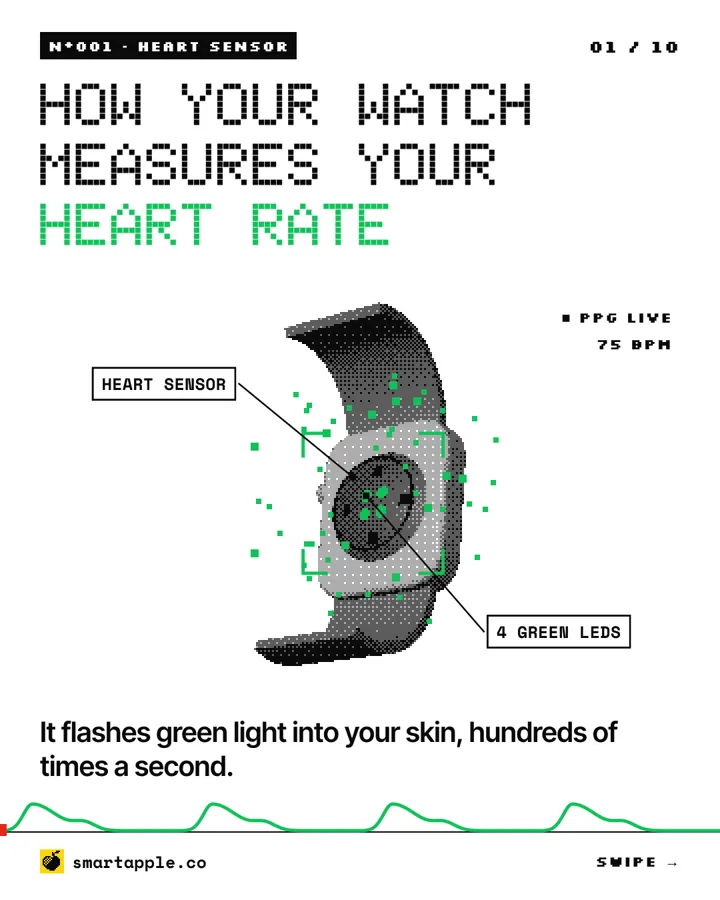
It flashes green light into your skin, hundreds of times a second.
It shines green light into your skin
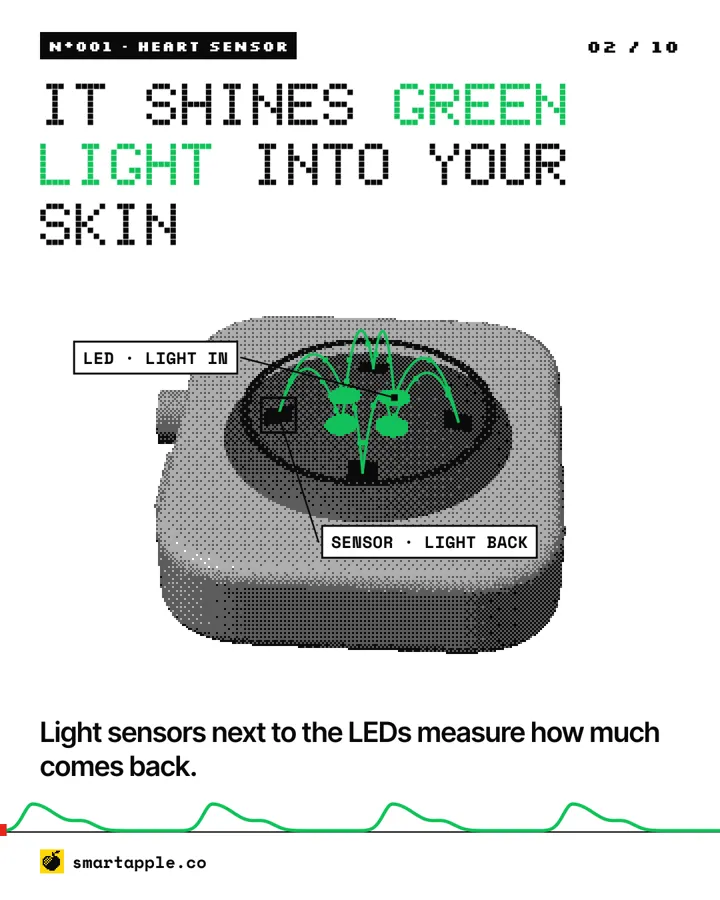
Light sensors next to the LEDs measure how much comes back.
Why the light is green
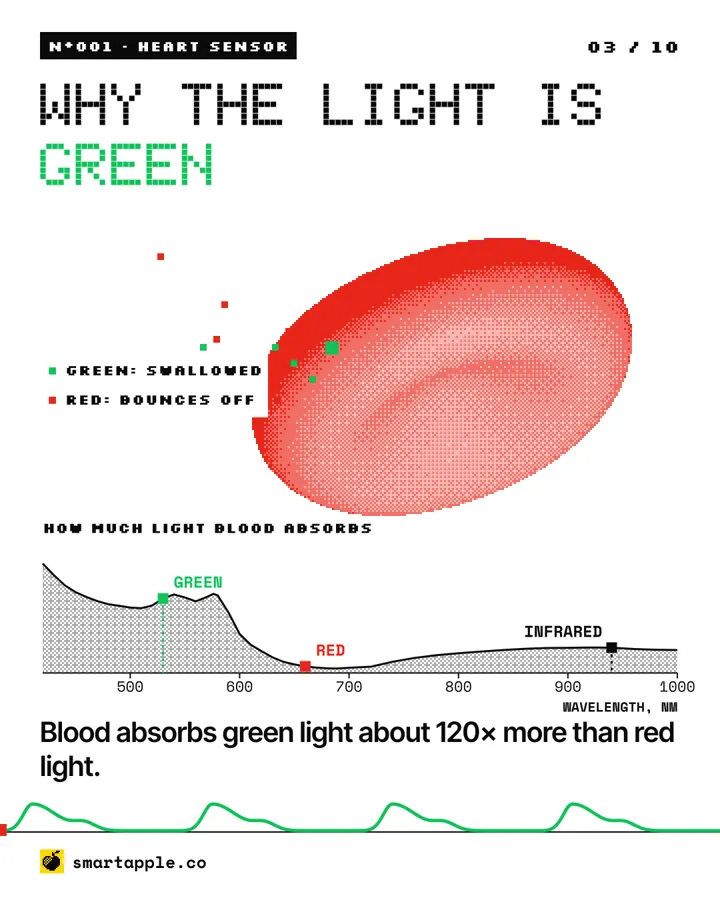
Blood absorbs green light about 120× more than red light.
The light goes less than 1 mm deep
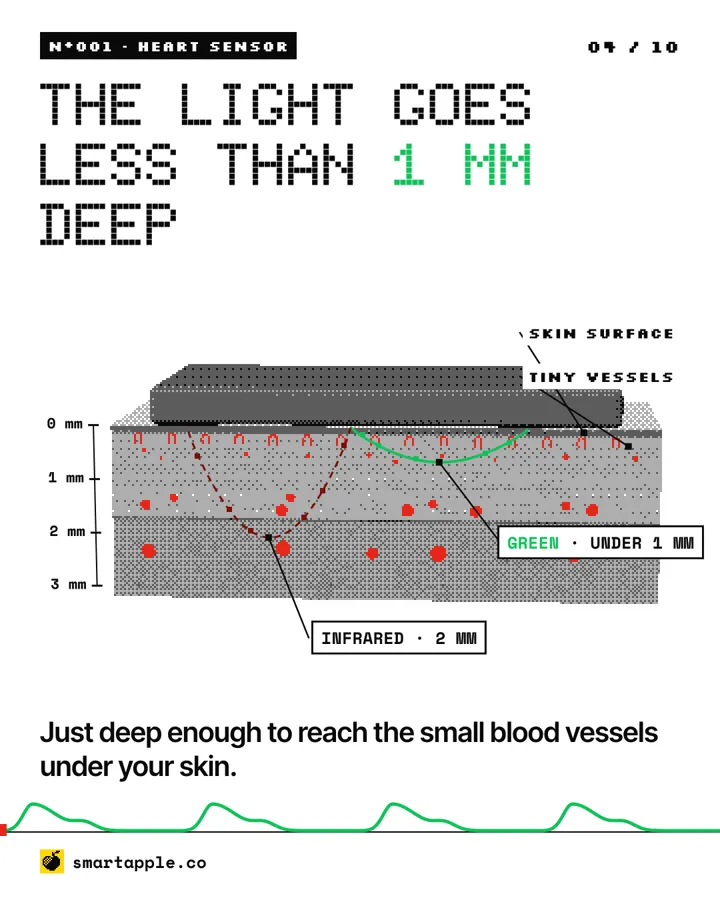
Just deep enough to reach the small blood vessels under your skin.
Each heartbeat absorbs more light
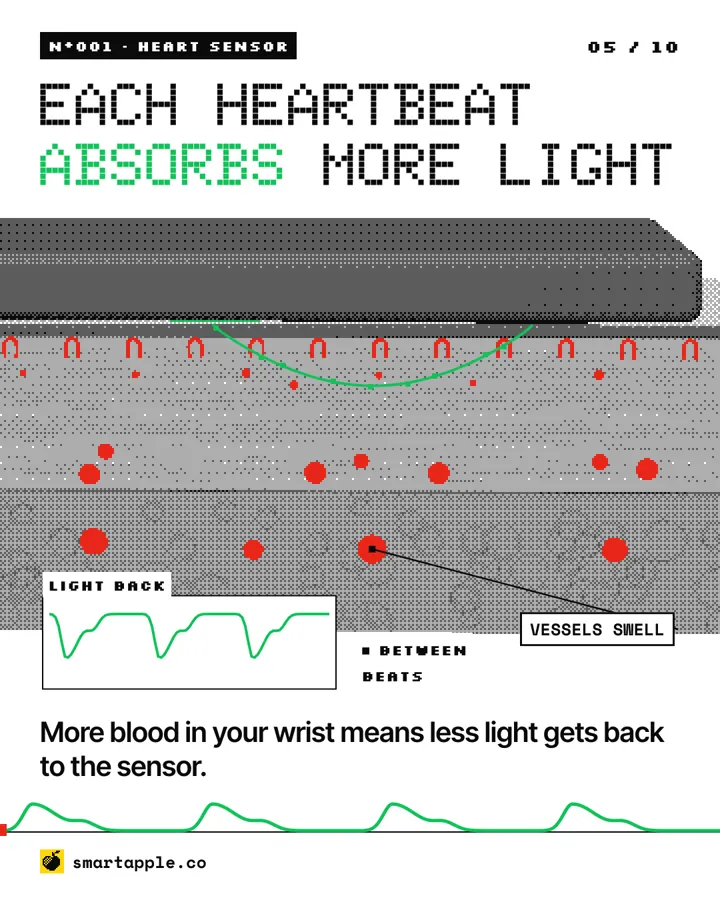
More blood in your wrist means less light gets back to the sensor.
The light changes by only 1%
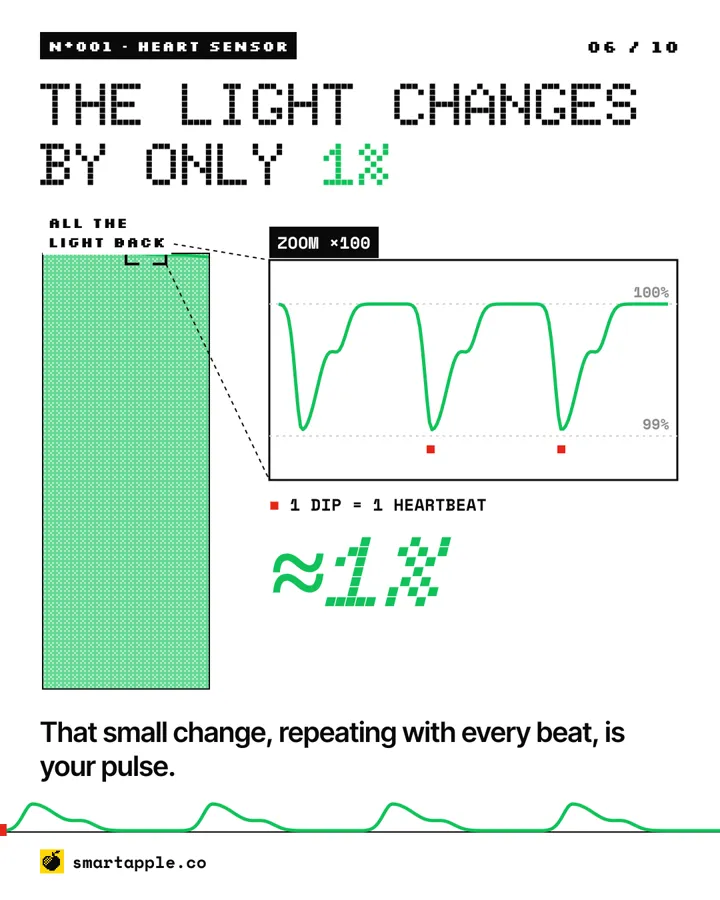
That small change, repeating with every beat, is your pulse.
Time between dips = heart rate
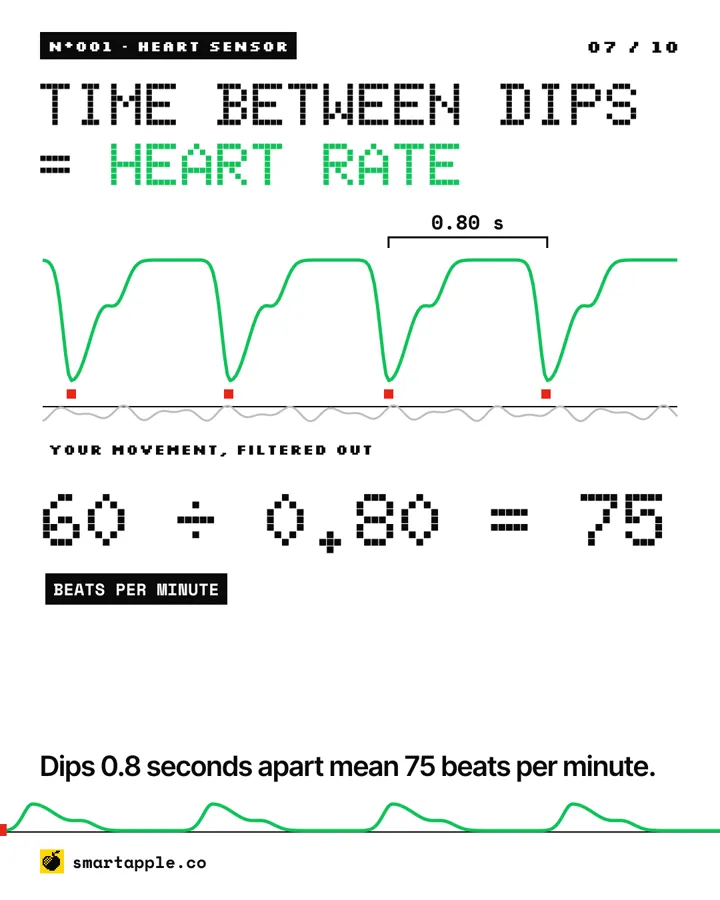
Dips 0.8 seconds apart mean 75 beats per minute.
What makes it less accurate
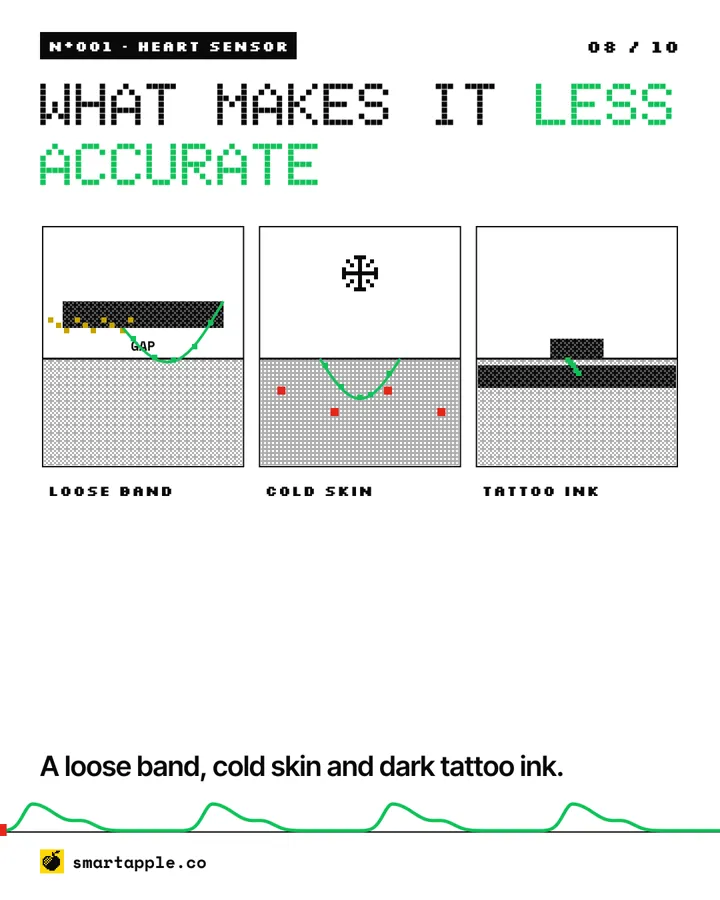
A loose band, cold skin and dark tattoo ink.
It also does ECG and temperature
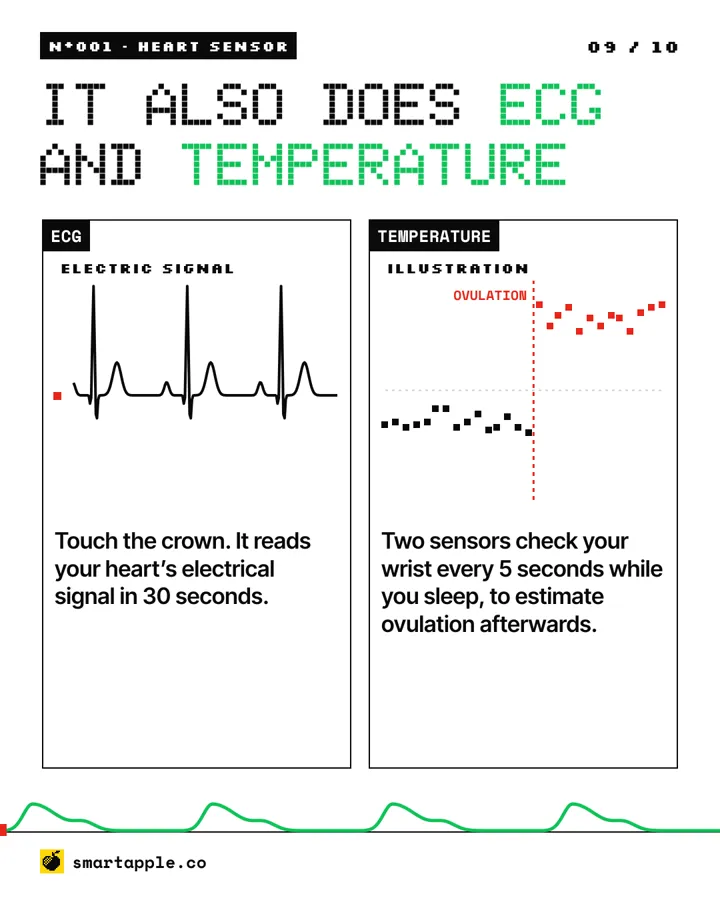
ECG: Touch the crown. It reads your heart’s electrical signal in 30 seconds. Temperature: Two sensors check your wrist every 5 seconds while you sleep, to estimate ovulation afterwards.
So that’s how.
The watch shown is a generic design. Not sponsored. Not affiliated with Apple.
Devices shown are generic illustrations, not real products. Not sponsored.
Smart Apple is independent and not affiliated with Apple Inc. or with any company whose products appear in our stories.
Made with the help of AI tools and checked against primary sources. The videos carry Content Credentials (C2PA).
Sources
Slide 1 of 10
- LEDs flash "hundreds of times per second"support.apple.com
- 4 green LEDs at 525 nm (Series 6 to 9, Ultra, Ultra 2)developer.apple.com
Slide 2 of 10
- LEDs + photodiodes measure light returned (photoplethysmography)support.apple.com
Slide 3 of 10
- "Blood is red because it reflects red light and absorbs green light"support.apple.com
- HbO2 absorption: 39,957 at 530 nm vs 320 at 660 nm (about 120x)omlc.org
Slide 4 of 10
- Green reaches about 0.3 to 0.8 mm, near infrared 1.5 to 2.5 mmjournals.plos.org
- Epidermis about 0.1 mm, dermis about 1.6 mm (forearm, as wrist proxy)qims.amegroups.org
Slide 5 of 10
- "When the heart beats, the volume of blood in the wrist increases, leading to increased light absorption"apple.com
Slide 6 of 10
- Pulse changes reflected green light by about 0.6 to 2%journals.plos.org
Slide 7 of 10
- ML models fuse PPG and accelerometer data; motion is filteredapple.com
- 0.8 s between beats = 75 bpm (illustration)Calculation from the cited figures
Slide 8 of 10
- Tattoo ink can block light; fit and cold skin reduce accuracysupport.apple.com
Slide 9 of 10
- ECG: finger on the Digital Crown, 30 s, single-leadsupport.apple.com
- Temperature: two sensors, every 5 s overnight, 0.1 °C changes, retrospective ovulation estimatessupport.apple.com
- Temperature: two sensors, every 5 s overnight, 0.1 °C changes, retrospective ovulation estimatessupport.apple.com